From meat to veggies: Genetic markers tell us European diets shifted 8,000 years ago

neander

The genes of Europeans reflect the dietary shifts that occurred with the rise of farming, report researchers.

Before the Neolithic revolution, European populations were hunter-gatherers who ate animal-based diets and some seafood. But after the advent of farming in southern Europe around 8,000 years ago, which spread northward thereafter, European farmers switched to primarily plant-heavy diets.

The study finds that adaptations occurred in an important genomic region that includes three fatty acid desaturase (FADS) genes. Different versions of the same FADS1 gene, called alleles, corresponded to the types of diets that were adopted.

Based on one’s ancestry, clinicians may one day tailor each person’s diet to her or his genome to improve health and prevent disease….
EuropeanDiets x
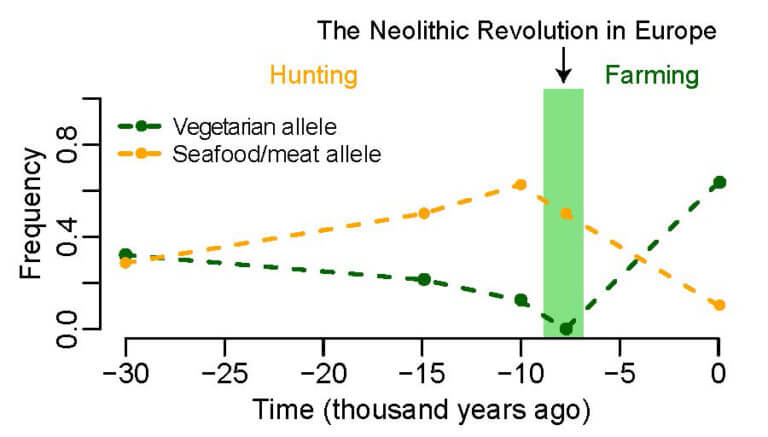
This graphic shows the frequency of a vegetarian allele and a seafood/meat allele, two versions of the same gene, over the past 30,000 years in European populations. The trends were opposite for the two alleles and both took a turn after the Neolithic revolution. Credit: Kaixiong Ye/Cornell.

The study shows that plant-heavy diets of European farmers led to an increased frequency of an allele that encodes cells to produce enzymes that helped farmers metabolize plants. Frequency increased as a result of natural selection, where veggie-eating farmers with this allele had health advantages that allowed them to have more children, passing down this genetic variant to their offspring.

[Read the full study here (behind paywall)]

The GLP aggregated and excerpted this blog/article to reflect the diversity of news, opinion, and analysis. Read full, original post: Switch from meat to veg marks Europeans’ genes

{{ reviewsTotal }}{{ options.labels.singularReviewCountLabel }}
{{ reviewsTotal }}{{ options.labels.pluralReviewCountLabel }}
{{ options.labels.newReviewButton }}
{{ userData.canReview.message }}

Related Articles

Infographic: Global regulatory and health research agencies on whether glyphosate causes cancer

Infographic: Global regulatory and health research agencies on whether glyphosate causes cancer

Does glyphosate—the world's most heavily-used herbicide—pose serious harm to humans? Is it carcinogenic? Those issues are of both legal and ...

Most Popular

d-b
Blocked arteries, kidney stones, nausea, constipation, fatigue: Long list of health problems caused by too much vitamin D 
Screenshot-PM-24
Viewpoint: The herbicide glyphosate isn’t perfect. Banning it would be far worse.
79d03212-2508-45d0-b427-8e9743ff6432
Viewpoint: The Casey Means hustle—Wellness woo opportunism dressed up as medical wisdom
ChatGPT-Image-Mar-27-2026-11_27_05-AM
The myths of “process”: What science says about the “dangers’ of synthetic products and ultra-processed foods
ChatGPT-Image-Apr-30-2026-12_21_05-PM-2
The tech billionaires behind the immortality movement
ChatGPT-Image-Apr-30-2026-05_00_48-PM
Wellness grifter physician turned wellness influencer out as surgeon general nominee

Sorry. No data so far.

glp menu logo outlined

Get news on human & agricultural genetics and biotechnology delivered to your inbox.