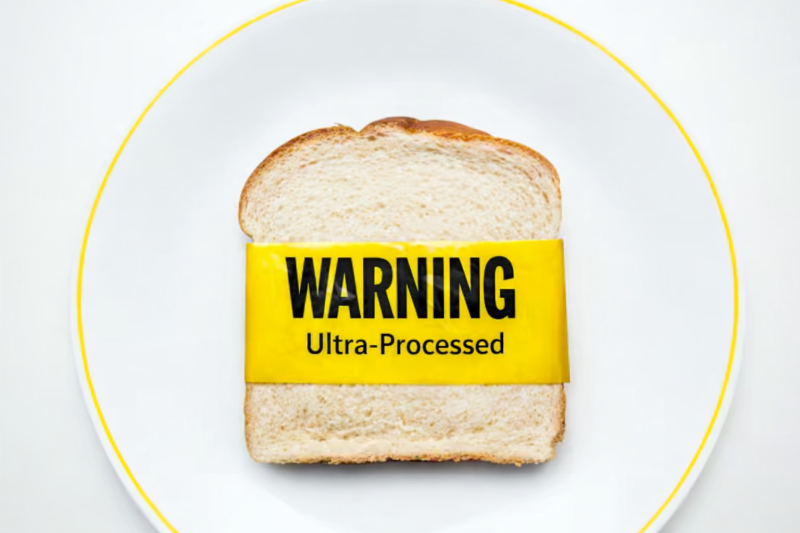
Two words used to scare people are impossible to avoid: synthetic and its younger cousin, ultra-processed. They’re everywhere—on supermarket shelves, on television, and baked into the psyche of nervous consumers who no longer know what to believe. And that’s entirely intentional. And it works very well.
The terms come from different debates. Synthetic belongs to the world of chemical scares. Ultra-processed comes from modern nutrition arguments about industrial food.
But the reasoning behind both is essentially the same—and equally flawed. Both confuse how something is made with what it actually does when ingested.
The body responds to what it’s given—molecules or nutrients—not to how they were made. Processing steps don’t determine biological effects; ingredients do.
Your body does not respond to a molecule’s origin story, something I’ve written about before. It responds to its chemical structure. And when it comes to food, it responds to what ingredients are present, not to how many machines were involved in producing it or whether it came from an Amish farm or a Walmart factory.
The “Synthetic” Scare
The equivalence of synthetic and natural versions of the same chemical has been beaten to death by science writers, including me.
I’m not going to revisit this non-debate. Suffice it to say that “natural” and “synthetic” describe how a molecule was made—and nothing more.
But good luck convincing people of that. It undermines the entire marketing campaign of the enormous organic food industry, something that much of the American public has bought into with admirable gullibility.
Enter “Ultra-Processed”
Now we’re seeing a conceptually identical argument in nutrition. It’s just as flawed, which is not surprising, since it partly overlaps with the often-insane MAHA movement.
“Ultra-processed food,” the bad guy du jour, is usually defined using the NOVA classification system. Foods are grouped according to how industrially processed they are.
Note the parallel to the synthetic scare. The focus is on how food is produced, not what it contains.
What determines the health effects of food are things like:
- calories
- sugar
- fat
- fiber
- portion size
- the absence or presence of jelly donuts
Processing itself is not a nutrient. A food does not become unhealthy simply because it passes through industrial machinery. In fact, the label often tells us very little about nutritional quality.
Which leads to a simple point:




The fact that something is ultra-processed doesn’t make it healthier or unhealthier. It does neither. It just tells you how the food was made.
The Parallel Is Obvious
The argument against synthetic chemicals goes like this:
It was made in a lab; it must be risky.
The argument against ultra-processed foods goes like this:
It was made in a factory; it must be unhealthy.
Different subject, same logic. Both assume that the origin determines the biological effect.
But biology doesn’t care about origin stories. A molecule made in a lab behaves no differently from the same molecule produced in nature, and food processed in a factory does not acquire metabolic properties that the same nutrients would lack if prepared in a kitchen.
Part of the appeal of these arguments is the comforting belief that natural things are inherently better.
They aren’t.
In case you don’t already know…some of the most dangerous substances known—botulinum toxin, aflatoxin, and many plant poisons—are perfectly natural. And, life-saving drugs, like insulin and many antibiotics, are produced synthetically or industrially.
“Natural” and “synthetic” describe origin, not risk. The same is true for “processed” and “unprocessed.” What really matters is far simpler: what molecules and nutrients are present, and in what amounts.
“Synthetic” and “ultra-processed” are rhetorically powerful labels that exploit Americans’ naivete. And it works like a charm.
Josh Bloom is ACSH’s Director of Chemical and Pharmaceutical Science. Josh earned his Ph.D. in organic chemistry at the University of Virginia, followed by postdoctoral training at the University of Pennsylvania. Find Josh on X @JoshBloomACSH
A version of this article was originally posted at American Council on Science and Health and has been reposted here with permission. Any reposting should credit the original author and provide links to both the GLP and the original article. Find American Council on Science and Health on X @ACSHorg