Bear love affair: Grizzly and polar–Interbreeding neighboring species played key role in evolution

PolarBearHybridStroke LR e
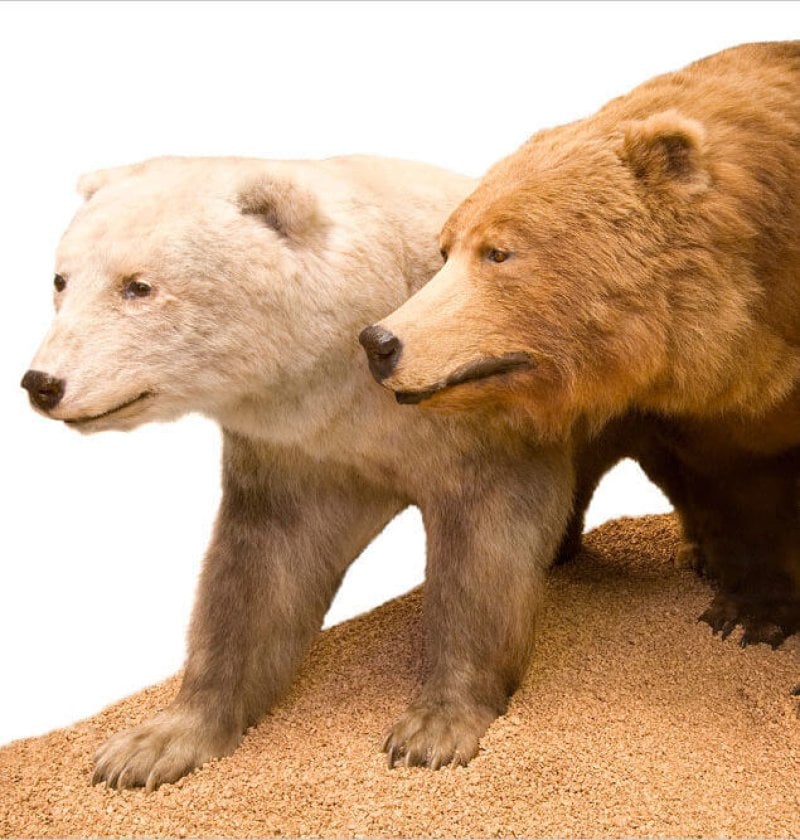
Grizzly-polar bear hybrid specimen. This rare hybrid occurs when grizzly bears (Ursus arctos horribilis) mate with polar bears (Ursus maritimus). This display is part of the collections at the Natural History Museum at Tring, Hertfordshire, UK.

In 2006, a hunter shot what he thought was a polar bear in the Northwest Territories of Canada. Closer examination, however, revealed brown patches on its white fur, uncharacteristically long claws and a slightly hunched back. The creature was in fact a hybrid, its mother a polar bear, its father a grizzly.

But grizzlies and polar bears, as it turns out, have been mating since the species diverged hundreds of thousands of years ago. Polar bear genomes have retained mitochondrial DNA from ancient grizzly bears, and grizzlies have inherited genes from hybridizing with polar bears.

Hybrids have generally been disqualified from protection by conservationists: Hybrids are thought to degrade the gene pools of their parent generations and pose a threat to biodiversity. […] But preventing hybridization altogether can also have negative repercussions.

[W]hen interbreeding between geographically neighboring species happens naturally, it can help species adapt to new threats. “When [hybridization is] a creative evolutionary force, conservation policies that retain that process are important and should come to the forefront,” [Bradley Shaffer, an evolutionary biologist] said.

The GLP aggregated and excerpted this blog/article to reflect the diversity of news, opinion, and analysis. Read full, original post: Hybrids Play a Vital Role in Evolution

{{ reviewsTotal }}{{ options.labels.singularReviewCountLabel }}
{{ reviewsTotal }}{{ options.labels.pluralReviewCountLabel }}
{{ options.labels.newReviewButton }}
{{ userData.canReview.message }}

Related Articles

Infographic: Global regulatory and health research agencies on whether glyphosate causes cancer

Infographic: Global regulatory and health research agencies on whether glyphosate causes cancer

Does glyphosate—the world's most heavily-used herbicide—pose serious harm to humans? Is it carcinogenic? Those issues are of both legal and ...

Most Popular

Screenshot-PM-24
Viewpoint: The herbicide glyphosate isn’t perfect. Banning it would be far worse.
d-b
Blocked arteries, kidney stones, nausea, constipation, fatigue: Long list of health problems caused by too much vitamin D 
79d03212-2508-45d0-b427-8e9743ff6432
Viewpoint: The Casey Means hustle—Wellness woo opportunism dressed up as medical wisdom
ChatGPT-Image-Mar-10-2026-01_39_01-PM
Viewpoint—“Miracle molecule” debunked: Why acemannan supplements don’t work
ChatGPT-Image-Apr-30-2026-12_21_05-PM-2
The tech billionaires behind the immortality movement
ChatGPT-Image-Mar-27-2026-11_27_05-AM
The myths of “process”: What science says about the “dangers’ of synthetic products and ultra-processed foods
ChatGPT-Image-Apr-30-2026-05_00_48-PM
Wellness grifter physician turned wellness influencer out as surgeon general nominee

Sorry. No data so far.

glp menu logo outlined

Get news on human & agricultural genetics and biotechnology delivered to your inbox.