Decoded fall armyworm genome could aid fight against destructive corn pest

C F E D F C F A E CD AE w r s
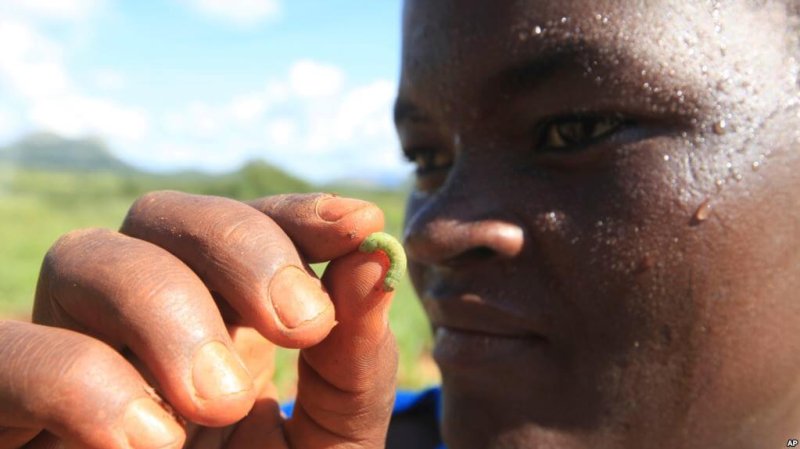
A farmer in Zimbabwe holds an army worm she found feeding on her corn crop.

Until now limited to America and the Caribbean, Spodoptera frugiperda [also known as the Fall Armyworm] is estimated to cause 600 million dollars in damage in Brazil every year…. Since January 2016, it has become invasive in Africa, where it destroys maize crops in 21 countries in the south and west parts of the continent. It is currently a threat to the European continent.

In the framework of an international public consortium called Fall Armyworm…researchers…sequenced the genome of Spodoptera frugiperda.

For the purpose of the study, two genomes of S. frugiperda were analysed…based on the insect’s host plant – the maize variant and rice variant, which are found throughout their range of distribution in America.  The researchers found differences between the variants in terms of the number and sequence of genes necessary to detoxify the toxins emitted by the plants and in the genes necessary for digestion.

This data was made available to the international scientific community to allow specialists to identify which variant of the moth is invading Africa. Moreover, this work will also make it possible to envision new biological control methods. It will also improve understanding of the mechanisms by which pesticide resistance appears.

The GLP aggregated and excerpted this article to reflect the diversity of news, opinion and analysis. Read full, original post: Scientists decode the genome of Fall Armyworm: a moth pest that is invading Africa


{{ reviewsTotal }}{{ options.labels.singularReviewCountLabel }}
{{ reviewsTotal }}{{ options.labels.pluralReviewCountLabel }}
{{ options.labels.newReviewButton }}
{{ userData.canReview.message }}

Related Articles

Infographic: Global regulatory and health research agencies on whether glyphosate causes cancer

Infographic: Global regulatory and health research agencies on whether glyphosate causes cancer

Does glyphosate—the world's most heavily-used herbicide—pose serious harm to humans? Is it carcinogenic? Those issues are of both legal and ...

Most Popular

ChatGPT-Image-Jun-19-2026-04_11_20-PM
Daubert for Dummies—Scientific Reliability in U.S. Courts: Daubert, Rule 702, and Made-for-Litigation Evidence
ChatGPT-Image-Jun-25-2026-12_23_17-PM
No, Bill Gates did not secretly engineer ticks to promote veganism
ChatGPT-Image-Jun-25-2026-01_14_50-PM
Viewpoint: Disinformation grift: The wellness industry is a lucrative and mostly worthless marketplace of ‘balms, brews, and baloney’
ChatGPT-Image-Mar-10-2026-01_39_01-PM
Viewpoint—“Miracle molecule” debunked: Why acemannan supplements don’t work
ChatGPT-Image-Jun-30-2026-01_09_47-PM
Viewpoint: As MAHA blows up over Supreme Court ruling limiting glyphosate litigation, Trump offers toothless plan to reduce pesticides in food
ChatGPT-Image-Jun-23-2026-12_19_35-PM
Ideological red flag: Led by anti-vax doctor, Tennessee is now the U.S. epicenter selling potent ivermectin shown worthless to prevent or treat Covid
Screenshot-2026-06-05-at-2.12.30-PM
Some plants can poison you. So how did humans figure out what is safe to eat?
ChatGPT-Image-May-18-2026-12_06_18-PM-2
Defying death: The immortality movement goes mainstream

Sorry. No data so far.

glp menu logo outlined

Get news on human & agricultural genetics and biotechnology delivered to your inbox.