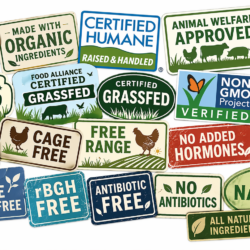
Many consumers mistakenly believe organic and non-GMO labels are interchangeable

organic is non gmo and more
The California Certified Organic Organic Farmers released this label in 2015 in an effort to clear up the confusion.

[Editor’s Note: Jayson Lusk is a food and agricultural economist and head of the Agricultural Economics Department at Purdue University.]

An organic seal on a product should already convey to consumers that the ingredients came from a process that excluded GMOs. However, the very presence of [a new] label suggests many consumers may not be aware of this fact.  

I have a paper with Brandon McFadden forthcoming in [the] journal Applied Economic Perspectives and Policy…. In the paper, we delve into this issue and others. Here’s part of the motivation.  

It appears that organic organizations are concerned that consumers perceive non-GM and organic labels to be substitutes. Although many organic food companies supported the general idea of mandatory labeling, now that the policy has passed, organic producers have expressed concern that non-GM verification may be perceived as a substitute for the more expensive and encompassing organic certification…. Despite these concerns, little is known about the extent to which the two most common non-GM labels, USDA Organic and Non-GMO Project, are demand substitutes or complements.

…

Because it is more costly to be organic than non-GMO (since the latter is a subset of the former), it is easy to see why many food companies would want to add the additional label that “Organic is non-GMO and more”.

The GLP aggregated and excerpted this article to reflect the diversity of news, opinion and analysis. Read full, original post: Are organic and non-GMO labels substitutes or complements?


Related Articles

Infographic: Global regulatory and health research agencies on whether glyphosate causes cancer

Infographic: Global regulatory and health research agencies on whether glyphosate causes cancer

Does glyphosate—the world's most heavily-used herbicide—pose serious harm to humans? Is it carcinogenic? Those issues are of both legal and ...

Most Popular

ChatGPT-Image-Mar-10-2026-01_39_01-PM
Viewpoint—“Miracle molecule” debunked: Why acemannan supplements don’t work
Weed Killer, Gavel, and Cash on Wood Table
Who were the biggest winners in Bayer’s $7.25 billion glyphosate settlement? The tort lawyers, natch
Screenshot-2026-11-24-at-11.07.44-AM
Here's a sure way to increase testosterone levels and jack up your sex drive
PFAS Molecules and Hazard Icons
Viewpoint: $$$ Billions of reasons why environmental activists are trying to slap a ‘killer PFAS’ label on many safe and essential ‘forever chemicals’
Glassy Molecules Above Floral Pads
Viewpoint: ‘Forever' PFAS chemicals in panty liners? The only ‘forever’ truth is endless lawsuits that do not protect women’s health 
Pastel Breakfast Pedestals with Yogurt Bowl
RFK Jr. is about to issue an edict defining ultra-processed foods. What could go wrong?
Screenshot-2026-11-16-at-2.37.32-PM
30 years of GMO farming: Is the boom in glyphosate and glufosinate use harming the environment? Data show they’re the most sustainable choice
Neon-AI-Globe-Network
Viewpoint: The three biggest threats posed by AI hyper-intelligence
Screenshot 2026-11-23 at 11.51
Calley Means’ demonization of glyphosate is ‘just craziness’. Farmers are responding with science.
glp menu logo outlined

Get news on human & agricultural genetics and biotechnology delivered to your inbox.