Here I am at Costco, getting far too many things for my family of four. As I try to navigate my unwieldy cart, I see a new product – avocado oil spray. Apparently, it has a higher smoke point for cooking AND healthy fats!
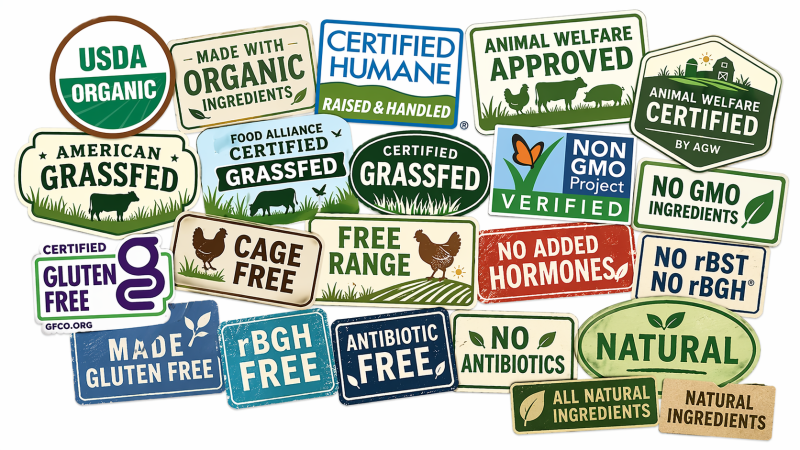
But, wait…look at all these labels: organic, non-GMO, all natural, glyphosate residue-free, gluten free…what? Avocados have gluten!?

Food companies are in a constant battle to prove superiority of their products, even at the expense of the truth. But how are we to know if a label is informative or just a marketing ploy?
Below, we’ve compiled summaries on each popular food label so you can decide which is most meaningful to you…and which ones are gimmicks.

ORGANIC
What it means:
- USDA organic products have strict production and labeling requirements.
- These requirements demand that approved food items are produced using no genetic engineering or ionizing radiation and with natural pesticides and fertilizers. Organic products are overseen by authorized personnel of the USDA National Organic Program.
Don’t be fooled:
- Several USDA-certified organic labels exist, so just because you see “organic” in the label, don’t assume the entire product is organic
- “100% Organic” indicates it’s a fully organic product
- The “Organic” label indicates at least 95% if the product is organic
- “Made with Organic Ingredients” indicates at least 70% of the product is organic
- Organic foods have pesticides. Many consumers falsely assume organic means zero pesticides. However, organic foods can be treated with pesticides from the USDA’s approved list.
- Also, the USDA reports that pesticide residues are found on both organic and conventional crops alike, but all crops are held to regulations governing safe consumption levels

CERTIFIED HUMANE
What it means:
- The USDA requires meat, dairy and egg producers to submit applications and receive permission before using terms like “humanely raised” on packages
- Third-party non-profit organizations strive to improve the lives of farm animals in food production. The Humane Farm Animal Care‘s “Certified Humane” label is the most common logo seen on packages. Other organizations, like Animal Welfare Certified and Animal Welfare Approved, have their own labels.
Don’t be fooled:
- Producers don’t need to do anything after receiving USDA permission, so if this is really important to you, stick with a third-party humane verifier.

GRASS-FED
What it means:
- “Grass-fed” is a term used for cow, sheep and goat products to indicate the animals’ diet is primarily comprised of pasture grass, hay, and forage.
- To claim “grass-fed”, the USDA’s Food Safety & Inspection Service requires documentation stating that animals have access to a pasture during most of its life. Feedlots are allowed during weaning and in the months before harvesting.
- However, products with the American Grassfed label indicate that the ruminating animals had continuous access to pasture and a diet of 100% forage. Cage confinement, hormones and all antibiotics are expressly prohibited by the organization.
Don’t be fooled:
- Cows, goats and sheep spend at least two-thirds of their lives in a pasture setting, so all these animals are considered “grass-fed” by default
- Pigs, chicken and turkey cannot subsist on grass, so be aware of any pork or poultry products with this label

NON-GMO
There are only 11 GMO crops currently approved for consumption in the U.S.: alfalfa, Arctic apples, canola, corn, cotton, papaya, Pinkglow pineapples, potatoes (select varieties), soybeans, squash (select varieties), and sugar beets
That’s it. No GMO wheat, strawberries, tomatoes, rice, chickens, etc.
GMO crops are proven completely safe for consumption and have the same nutritional profile as their non-GMO counterparts.
What it means:
- When you see food products with a “non-GMO” label at the grocery store, it either means:
- The food product is made from a crop with a GMO counterpart and the producer chose to use the non-GMO version. For instance, tortilla corn chips made from non-GMO corn.
- You’re paying extra for a label on a product with no GMO alternative: think avocados, strawberry jam, and hummus
Don’t be fooled:
- A “non-GMO” label on foods with no GMO counterpart creates unnecessary fear among consumers
The Non-GMO Project approves companies to use their “non-GMO verified” logo, even on non-GMO alternative products.




With no FDA or USDA regulation for the term, “non-GMO”, organizations like this can take advantage of consumers who don’t know which crops have GMO counterparts. Think avocado oil, or even products with no genes in the first place, like salt and bottled water.
- If avoiding GMOs is important to you, look for the logo on products with a GMO counterpart (see above list)
- Organic products will always be non-GMO products; however, non-GMO products are not necessarily organic

CAGE FREE & FREE RANGE
What it means:
- With “cage free” and “free range” labels, cages are prohibited. With the exception of “free range“, hens can still be raised in an enclosed space
Don’t be fooled:
- The amount of outdoor space is not regulated, so there’s no way of knowing if the hens have a sizable outdoor enclosure
- Also, “cage free” only applies to egg-laying hens; if you see this term on poultry meat, it’s solely for marketing purposes

NO ADDED HORMONES
What it means:
- Beef and sheep producers sometimes administer hormones to help their livestock enter the meat market more quickly. And the same goes for dairy cow producers, though fewer farms practice this now.
- Labels showing “no hormones added” or “no hormones administered” are allowed if these producers can prove that no hormones were used during the animal’s life.
Don’t be fooled:
- Despite what labels state, hormones are prohibited for use on chickens, turkeys and pigs in the U.S., so don’t assume one brand of chicken is superior to another because of the label – no brands use them!
- Be wary of any labels stating “hormone-free”; this claim is not approved by USDA since all animals naturally produce hormones.

NO ANTIBIOTICS ADDED
What it means:
- The USDA approves the labels, “No antibiotics administered,” “no antibiotics added” and “raised without antibiotics”, if producers can prove that antibiotics were not administered at any point.
Don’t be fooled:
- The “antibiotic free” label is not permitted by the USDA, as no antibiotic residue is detected before the animal is harvested or a cow is milked. The FDA has strict withdrawal guidelines that require all livestock to be clear of any antibiotic residue before it is harvested.

GLUTEN FREE
What it means:
- Gluten is a general name for the proteins found in cereal grains, like wheat, barley and rye and informs those with a gluten allergy or celiac disease that the product is safe for their consumption.
Don’t be fooled:
- This label is being used on products that don’t normally include cereal grains (think sugar, rice and corn products), thus becoming another marketing gimmick.
- Also, know that gluten-free products are not healthier, as gluten-free substitutes may contain other additives. In fact, many gluten-free products are higher in saturated fat and sugar.

NATURAL
What it means:
- The terms, “100% Natural”, “Made with natural ingredients”, and “All natural”, are not closely monitored by any government agency. Because of this, food companies apply these claims and fancy logos to make us believe their product is superior.
Don’t be fooled:
- The labels don’t really mean anything at all. These products can still contain hormones, antibiotics, pesticides…really anything
- And there’s not much relief in sight: since 2016, the FDA has been discussing how to regulate this term, but with no standard set
So eat your veggies and fruits with abandon!
No matter the labels or lack thereof, fresh produce will only promote a healthier you.
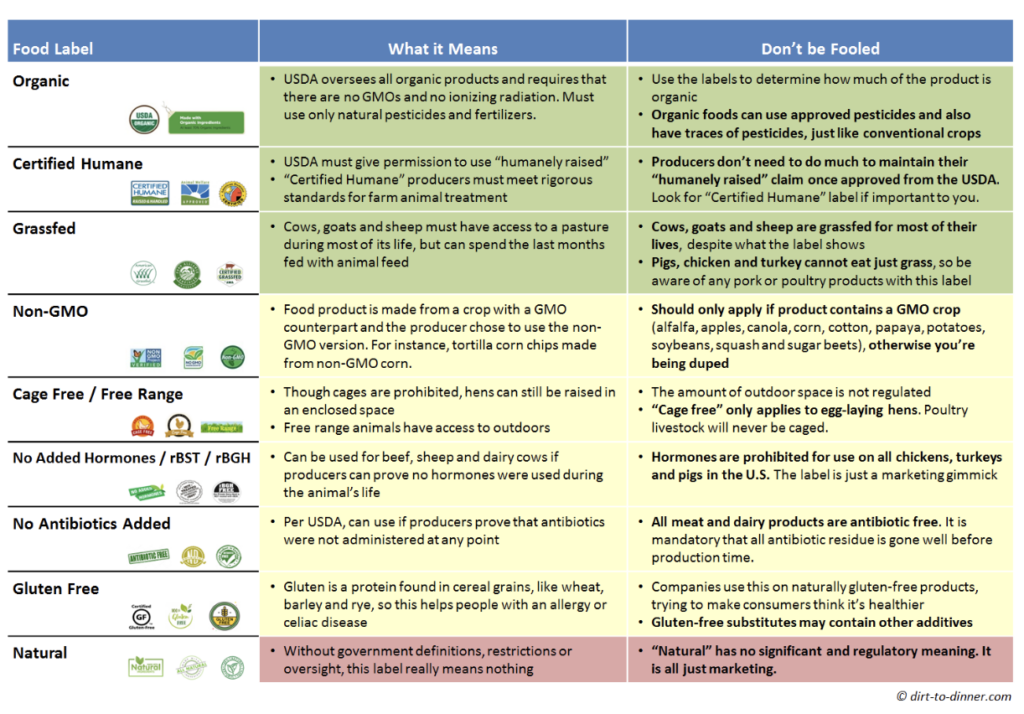
And here’s a quick reference chart for your next grocery run:
The Bottom Line:
Take a moment to examine your food when in the grocery store. See if all those labels make sense…or if you’re falling prey to marketing gimmicks and misinformation. By becoming a more knowledgeable consumer, you’re one step closer to better understanding our food system.
Hillary E. Kaufman studied at Northeastern University and manages the Dirt To Dinner website. Find Hillary on Linkedin
A version of this article was originally posted at Dirt to Dinner and is reposted here with permission. Any reposting should credit both the GLP and original article. Find Dirt to Dinner on X @Dirt_To_Dinner