Passage of Ugandan biotech law opens access to vitamin-fortified, disease-resistant crops

bananas bring hope
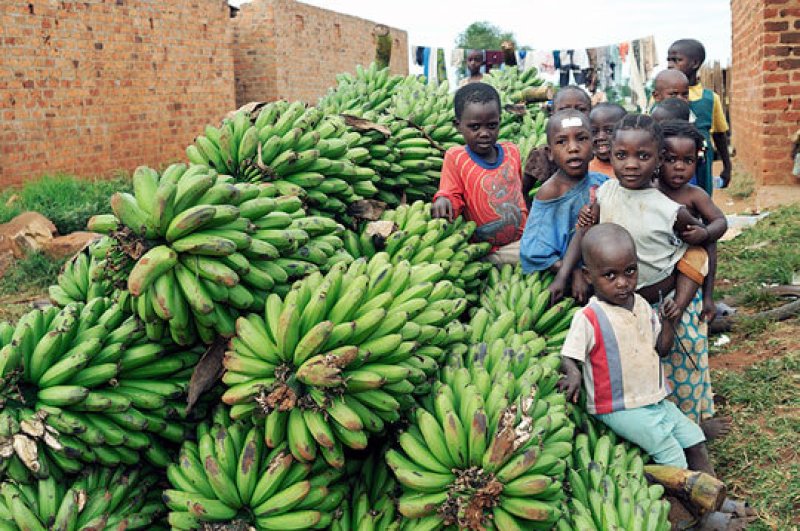
Bananas are sold at a market in Uganda

Genetically engineered crops that promise to benefit both farmers and consumers are poised to enter Uganda’s marketplace now that its Parliament has adopted a law to regulate agricultural biotechnology.

In Uganda, [Dr. Priver Namanya, head of the banana biofortification project at National Agricultural Research Laboratories (NARL) in Kawanda, said] vitamin A-biofortified bananas have already proven successful in confined field trials, and the passage of the Biosafety Act will now allow her team to move on to multi-locational field trials in different areas of the country in partnership with local farmers.

People like the deep orange color of the fortified banana, she said, and the vitamin A also makes it softer, which adds to consumer appeal. Feeding and nutrition studies still must be conducted, but Namanya is optimistic that the fortified banana she has been working on for the past 13 years will finally be released to farmers by 2021…

Meanwhile, research is also well advanced in Uganda on matoke resistant to banana bacterial wilt (BBW), the top banana-killer disease in the Great Lakes region. NARO scientists have used genetic engineering to extract resistance genes from green pepper and introduce them into the popular M-9 hybrid variety.

The GLP aggregated and excerpted this article to reflect the diversity of news, opinion and analysis. Read full, original post: Uganda biotech law opens door to disease-resistant GMO crops


{{ reviewsTotal }}{{ options.labels.singularReviewCountLabel }}
{{ reviewsTotal }}{{ options.labels.pluralReviewCountLabel }}
{{ options.labels.newReviewButton }}
{{ userData.canReview.message }}

Related Articles

Infographic: Global regulatory and health research agencies on whether glyphosate causes cancer

Infographic: Global regulatory and health research agencies on whether glyphosate causes cancer

Does glyphosate—the world's most heavily-used herbicide—pose serious harm to humans? Is it carcinogenic? Those issues are of both legal and ...

Most Popular

ChatGPT-Image-Apr-20-2026-11_17_18-AM-2
10,000 scientists gone: Trump’s cuts create an unprecedented brain drain
ChatGPT-Image-Apr-22-2026-04_31_20-PM
‘Irresponsible decision’? On mandatory military flu shots, Hegseth chooses ‘freedom’ over health
Screenshot-2026-04-22-at-4.10.32-PM
Viewpoint — ‘Completely unethical’: RFK, Jr.’s medical ignorance deprives melanoma cancer-sufferers of a life-saving therapy
ChatGPT-Image-Apr-20-2026-12_28_36-PM
Vaccine skepticism is a growing global problem
ChatGPT-Image-Apr-17-2026-03_30_52-PM
Food labels, decoded: What they really mean
images
The never-ending GMO debate: Pros and cons
Screenshot-2026-04-15-at-1.22.58-PM
Anti-biotechnology activists smear hybrid wheat breakthrough that could surge yields in poorer countries
ChatGPT-Image-Mar-11-2026-11_58_46-AM
The Trump administration has run out more than 4,000 National Institutes of Health employees. Here are the consequences
ChatGPT-Image-Mar-2-2026-03_22_54-PM
Why ‘support supplements’ for GLP-1 users are mostly a waste of money
Screenshot-2026-04-22-at-1.14.34-PM
Latest fevered, right-wing conspiracy: Fox, New York Post, and kooky GOP legislators push ‘Dead Scientists’ scare
Screenshot-2026-04-12-135256
Bixonimania: The fake disease scam that AI swallowed whole
glp menu logo outlined

Get news on human & agricultural genetics and biotechnology delivered to your inbox.