[A team of five researchers from the National Cancer Centre Singapore (NCCS) ] used state-of-the-art sequencing platforms to map the genome of the Musang King or Mao Shan Wang durian. According to the team, they received funding of S$500,000 from a group of anonymous durian lovers.
The team’s analysis, published in the journal Nature Genetics, revealed that the durian genome comprises about 46,000 genes, almost double that of humans who have 23,000 genes.
…
Comparing gene activity patterns from different parts of the durian plant led to the identification of a class of genes called MLGs (methionine gamma lyases), which regulate the production of odor compounds called volatile sulphur compounds (VSC), the press release stated.




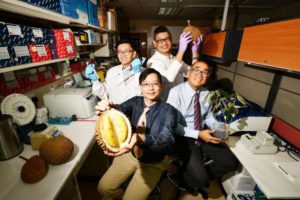 “Our analysis revealed that VSC production is turbocharged in durian fruits, which fits with many people’s opinions that durian smell has a ‘sulphury’ aspect,” said Duke-NUS’s Prof Patrick Tan, who is also co-lead author.
The durian genome sequence will be a useful resource for durian agronomy research – for example in identifying, and possibly modifying genes involved in disease resistance, drought tolerance and flavor profiles.
“We can look at the genes (responsible for) the high sugar level in the durian. Theoretically, it’s possible to create a diabetic-friendly durian,” said [professorTeh Bin Tean, the deputy director of the National Cancer Center]
The GLP aggregated and excerpted this article to reflect the diversity of news, opinion and analysis. Read full, original post: Singapore scientists crack the durian genome