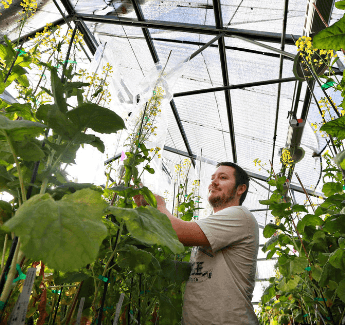
Majority of farmers say GMOs allow them to minimize pesticides and conserve water, survey finds

bm chemicalsplants feat free

Editor’s Note: This article discusses a recent survey by the US Farmers & Ranchers Alliance and National Corn Growers Association.

According to a recent survey of farmers by US Farmers & Ranchers Alliance and National Corn Growers Association, farmers believe people find pesticides (96%) and water usage (95%) to be consumers’ top concerns. Farmers reported that they grow genetically engineered crops as a way of addressing these concerns.

The majority of farmers said genetically engineered crops allow them to minimize pesticide and herbicide use, and over three-quarters chose genetically engineered crops in conjunction with practices such as conservation tillage, which promotes better water quality and soil health.

In no till planting, the soil is left virtually undisturbed. Since the genetically engineered crops have weed- and pest-resistant traits, they do not need as much tillage to control the weeds and less pesticide is applied. Also, farmers are able to pinpoint their fertilizer application, knifing it into the soil to reduce runoff.


The GLP aggregated and excerpted this blog/article to reflect the diversity of news, opinion, and analysis. Read full, original post: Emily Buck: Genetic engineering improves crops, helps the environment
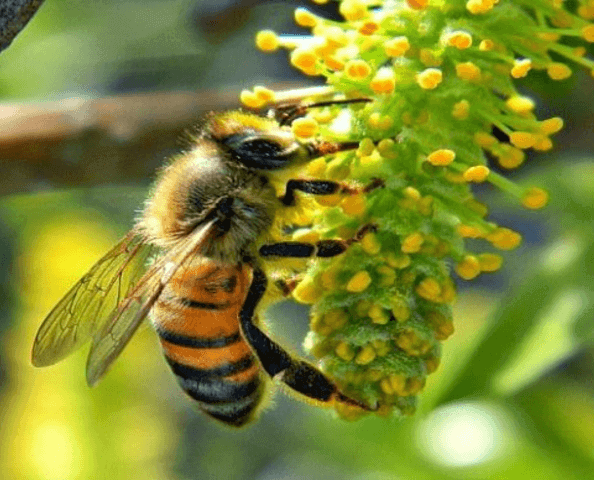
Economists, in ‘predatory’ journal, challenge Syngenta study finding neonics pose ‘low risk’ to bees

Screen Shot at AM

Editor’s Note: This article discusses the attack on a Syngenta study by economists published in the Environmental Sciences Europe titled “An experiment on the impact of an neonicotinoid pesticide on honeybees: the value of a formal analysis of the data.” Environmental Sciences Europe is known as a predatory “play for play” journal, meaning it often publishes articles by activist scientists who could not get their work accepted by more mainstream academic journals. The GLP profiled ESE after it republished the discredited GMO rat tumor study by Gilles-Éric Séralini, without peer review, after it had been retracted from a more mainstream publication. It also published a letter from activist scientists and anti-GMO campaigners, including Vandana Shiva, Consumer Reports Michael Hansen and colleagues of Séralini,, claiming there is “no scientific consensus” in support of GMO safety, despite the fact that more than 275 independent science oversight agencies have concluded otherwise.

A study by a global agrochemical company that concluded there was only a low risk to honey bees from a widely used agricultural pesticide has been described as “misleading” in new research published by statisticians at the University of St Andrews.

A major study conducted by Swiss agrochemical company Syngenta on the effects of the neonic thiamethoxam on honey bees in the field concluded that there was only a low risk to honey bees.

New research conducted at the Centre for Research into Ecological and Environmental Modelling (CREEM) by Dr Robert Schick, Professor Jeremy Greenwood and Professor Steve Buckland shows even large and important effects could have been missed because the Syngenta study was statistically too small.

The Syngenta study involved two experiments: an experiment conducted at two locations and a maize experiment at three locations. At each location the experiments used pairs of fields – in one field the crop was treated with thiamethoxam at levels normally used by farmers, in the other field the crop was untreated.

The Syngenta study concluded that because the experiments involved so little replication …  a formal analysis of the data “would lack the power to detect anything other than very large treatment effects … Therefore a formal statistical analysis was not conducted because this would be potentially misleading”.

The St Andrews team believe this is fundamentally wrong because formal statistical analysis is only potentially misleading if the wrong method is used and because the mere inspection of the results is always potentially misleading because it is an entirely subjective procedure.

The GLP aggregated and excerpted this blog/article to reflect the diversity of news, opinion, and analysis. Read full, original post: New research debunk honey bee pesticide study

Our Facebook, social media use is influenced by genetics

Teens and the social media

Scientists found our DNA influences how long we spend on Facebook, chat rooms and online gaming.

A study reveals up to 39 percent of the difference between the highest and lowest users is down to the influence of their genes.

Kings College London experts said the findings reveal people are not “helplessly” consuming media.

Instead, they tailor their use based on a number of factors, including availability and their own unique genetic needs.

Lead researcher Ziada Ayorech, from the Institute of Psychiatry, Psychology & Neuroscience at King’s College London, said: “Finding that DNA differences substantially influence how individuals interact with the media puts the consumer in the driver’s seat, selecting and modifying their media exposure according to their needs.

“Our findings contradict popular media effects theories, which typically view the media as an external entity that has some effect – either good or bad – on ‘helpless’ consumers.”

[The study can be found here.]

The GLP aggregated and excerpted this blog/article to reflect the diversity of news, opinion, and analysis. Read full, original post: The Social Networking Gene

Brains of people with autism share distinct genetic ‘signature’

strand of dna under a magnifying glass

The brains of people with autism show a distinct molecular signature, according to the largest-yet postmortem study of people with the condition. The signature reflects alterations in how genes are pieced together and expressed.

“We can be now fairly certain that this pattern really means something,” says lead researcher Daniel Geschwind, distinguished professor of neurology, psychiatry and human genetics at the University of California, Los Angeles.

The study…suggests that the diverse molecular underpinnings of autism converge on a key set of biological pathways.

“Even with very different genetic and presumably also environmental risk factors that place these people with an autism diagnosis, they all seem to share certain features of their gene expression,” says Evan Macosko, assistant professor of psychiatry at Harvard University…The findings “could give us some deep insight not only potentially into the cause of autism, but also how we might be able to [treat] it.”

The splicing seen in the brains of people with autism is known to occur in response to increased neuronal activity…The findings help to firmly establish altered splicing patterns as an important component of autism….

[The study can be found here.]

The GLP aggregated and excerpted this blog/article to reflect the diversity of news, opinion, and analysis. Read full, original post: Diverse causes of autism converge on common gene signature

Cancer scientists fail to replicate key study results – for good reasons

la oe firestein science replication failure

The general principle [of replicating studies] is that if the results repeat, then the original results were correct and reliable. If they don’t, then the first study must be flawed, or its findings false.

As researchers reproduce more experiments, they’re learning that they can’t always get clear answers about the reliability of the original results.

Take the latest findings from the large-scale Reproducibility Project: Cancer Biology. Here, researchers focused on reproducing experiments from the highest-impact papers about cancer biology published from 2010 to 2012…[N]ot one of their replications definitively confirmed the original results.

Replicating a study…[is] like trying to play a complicated board game without all the instructions or even all the parts.

Sometimes, things as small as the temperature of the lab could cause a cell biology experiment to flop, said [Tim Errington, who led the cancer reproducibility project].

“[Replication projects are] shining a light on the way we conduct research,” Errington said…But, he added, “If we make ourselves more open and transparent from the beginning, before our work is even published in a paper, that’ll probably help a lot.”

[The replication studies can be found here.]

The GLP aggregated and excerpted this blog/article to reflect the diversity of news, opinion, and analysis. Read full, original post: Cancer scientists are having trouble replicating groundbreaking research

Artificial intelligence, more data hold keys to curing cancer

DNA x

Although there are various treatments available that are improving all the time, there is still no cure for cancer. Research in developing effective cancer treatments has been going on for decades, and now researchers are turning to the help of AI in hopes of finding a cure for the disease.

But one thing that is needed for searching for a cure for cancer, even when using AI, is data. The problem with this is that a lot of data including mammograms, genetic tests, and medical records are still under lock and key and not available to those who can make use of it.

To make data more available for cancer research purposes, three things need to happen. These are: there should be no barriers to patients wanting to contribute their data (including genetic testing, medical records, and radiology images), further funding is required for using AI in the search to find a cure for cancer, and new data sets need to be generated with a focus on all ethnicities.

The GLP aggregated and excerpted this blog/article to reflect the diversity of news, opinion, and analysis. Read full, original post: Is Artificial Intelligence the Answer to Finding a Cure for Cancer?

Step toward synthetic life: Genetic code expanded from four to six letters

Screen Shot at AM
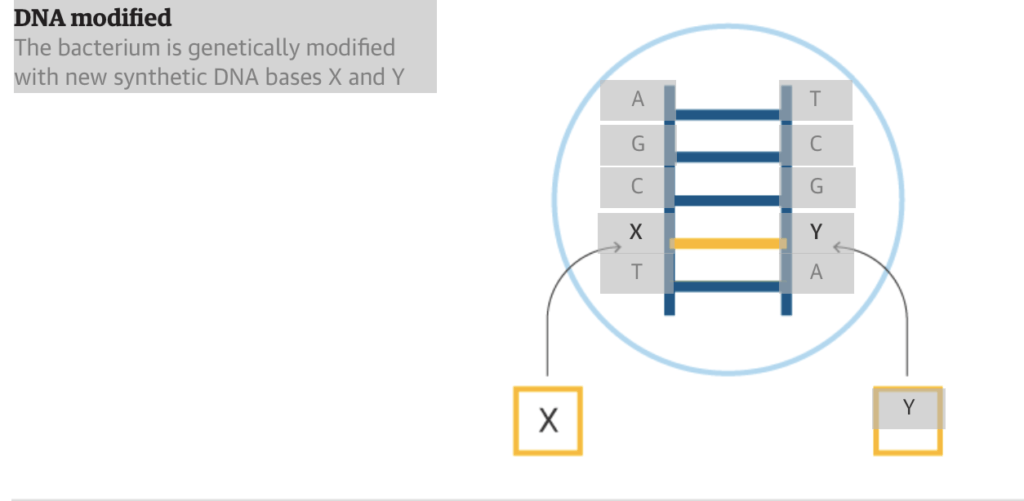
[T]he first living organisms to thrive with an expanded genetic code have been made by researchers in work that paves the way for the creation and exploitation of entirely new life forms.

Scientists in the US modified common E coli microbes to carry a beefed-up payload of genetic material which, they say, will ultimately allow them to program how the organisms operate and behave.

The work is aimed at making bugs that churn out new kinds of proteins which can be harvested and turned into drugs to treat a range of diseases.

Floyd Romesberg and his team at the Scripps Research Institute in California expanded the genetic code from four letters to six by adding two new molecules they call X and Y and adding them to the bugs’ genetic makeupScreen Shot at AM

“This is a major step forward in showing that a living cell such as a simple bacterium can be engineered to sustain a synthetic base pair not found in nature,” said Paul Freemont, who specialises in synthetic biology at Imperial College in London.

[The study can be found here.]

The GLP aggregated and excerpted this blog/article to reflect the diversity of news, opinion, and analysis. Read full, original post: Organisms created with synthetic DNA pave way for entirely new life forms

Non-browning Arctic Apple hit shelves February 1: Will they change consumers’ opinions about GMOs?

imrs

The fruit, sold sliced and marketed under the brand Arctic Apple, could hit a cluster of Midwestern grocery stores as early as Feb. 1.

Critics and advocates of genetic engineering say that the apple could be a turning point in the nation’s highly polarizing debate over genetically modified organisms (GMOs). While genetic modifications have in the past been mainly defended as a way to protect crops, the Arctic Apple would be one of the first GMOs marketed directly to consumers as more convenient.

Industry executives predict the apple could open a whole new trade in genetically engineered produce, potentially opening the market to pink pineapples, antioxidant-enriched tomatoes, and other food currently in development.

GMO critics say they are hopeful, however, that consumers will continue to show skepticism about the produce. Despite a growing consensus in scientific circles that GMOs pose little risk, environmental and consumer groups have successfuly mounted campaigns against GMOs over the past 30 years, successfully limiting the practice to commodity crops like soybeans and corn.

“This apple is understudied, unlabeled, and unnecessary,” said Dana Perls, the senior food and technology campaigner with environmental nonprofit Friends of the Earth.

For the Arctic Apple, however, the greatest test is yet to come: whether the convenience of a non-browning apple is enough to convince consumers to look past GMO’s negative reputation.

The GLP aggregated and excerpted this blog/article to reflect the diversity of news, opinion, and analysis. Read full, original post: The apple that never browns wants to change your mind about genetically modified foods

GMO mustard approval in India stalled by lawsuit alleging scientists deceived public on crop’s benefits

mustard e

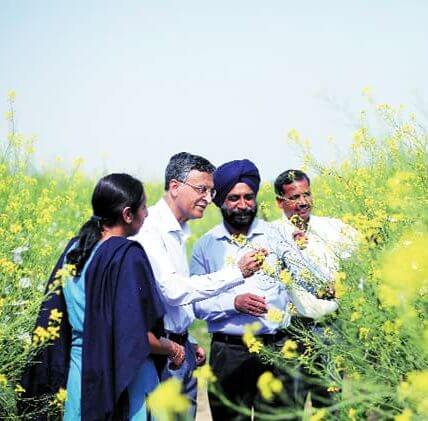
India’s long-standing push to approve genetically modified (GM) food crops has been controversially delayed, after an environmental campaigner launched a lawsuit that accuses scientists of deceiving the public about the benefits of transgenic mustard.

[O]n 7 October, India’s Supreme Court agreed to hear a case brought by Aruna Rodrigues, an anti-GM campaigner who wants a moratorium on the crop’s approval until it undergoes an independent evaluation … Rodrigues says that both Pental and India’s regulatory authorities have exaggerated the benefits of transgenic mustard, and that non-GM mustard could be just as high-yielding. Tests overseen by the environment ministry’s Genetic Engineering Appraisal Committee (GEAC) didn’t pit the new crop against its best possible competitors, she says. She accuses Pental and the authorities of deliberate deception.

Deepak Pental, a plant geneticist at the University of Delhi who has led research into the crop, dismisses these criticisms. The trials were designed to test health and safety, he says, not to stringently compare yields against all competitors. It’s possible, he says, that non-GM varieties might produce higher yields than his first GM generation—but this hasn’t been tested.

No one knows when the Supreme Court will decide on Rodrigues’s complaints, says Kabir Dixit, a lawyer in Delhi—but India’s government has already agreed that it needs the court’s permission before it can approve the mustard’s commercial release.

The GLP aggregated and excerpted this blog/article to reflect the diversity of news, opinion, and analysis. Read full, original post: India’s First GM Food Crop Held Up by Lawsuit

Will release of GMO American chestnut trees have ‘unforeseen’ consequences for environment?

chestnut

The [American chestnut tree]…fell victim to a [Cryphonectria parasitica fungus] disease introduced by a foreign chestnut species in the early 20th century….

“The specific gene that’s being inserted into [the] chestnut comes out of wheat, so every single person on earth that poured a bowl of cold cereal this morning ate that same gene,” says [Brian McCarthy, a forest ecologist at Ohio University].

The release of genetically modified trees into the forest could have some unforeseen long-term impacts, says Chad Oliver, an environmentalist at Yale University….For American chestnut, however, the risk is very small, he says…

“Trees have a very good habit of [co-existing] — some in shades, and some in sunlight,” says Oliver. “The [American chestnut] is not going to become a super tree that kills everything else out.”

Research geneticist Dana Nelson of the USDA Forest Service also objects to the genetic approach — but on an evolutionary basis…. “[T]hat population you produce doesn’t have the genetic diversity to adapt to the variable environment and climate,” [Nelson says.] [William Powell, an biotechnologist at the State University of New York College of Environmental Science & Forestry] acknowledges this drawback. To solve the problem, he plans to cross his GMO trees with surviving American chestnut trees.

The GLP aggregated and excerpted this blog/article to reflect the diversity of news, opinion, and analysis. Read full, original post: The American chestnut tree has a good shot at making a comeback

Agricultural Research Service rescinds order barring its scientists from contact with public

ars

U.S. Department of Agriculture officials have rescinded an order that barred its researchers from releasing “public-facing documents,” ranging from news releases and photos to social media posts.

Reports about the order, which first arose on BuzzFeed News, sparked widespread complaints on [January 24] about a Trump administration crackdown – particularly in light of similar limits that were placed on communications from the Environmental Protection Agency.

Late [January 24], the USDA issued a statement saying that the original email from Agriculture Research Service (ARS) chief of staff Sharon Drumm “was released without Departmental direction, and prior to Departmental guidance being issued.”

[On January 25], BuzzFeed reported that ARS Administrator Chavonda Jacobs-Young sent an email to employees referencing the earlier ban. “This internal email was released prior to receiving official Departmental guidance and is hereby rescinded,” she wrote.

GeekWire confirmed that the earlier order was rescinded, and that new guidance has been sent out. The new guidance tells researchers to get approval from above before addressing questions related to policy, legislation, budgets or regulations.

The GLP aggregated and excerpted this blog/article to reflect the diversity of news, opinion, and analysis. Read full, original post: After huge outcry, USDA scales back its limits on scientists’ contacts with public

Viruses ‘talk’ with each other to plan attacks on cells

thinkstockphotos x
[Israeli scientists have accidentally] discovered for the first time an instance of viruses leaving messages for other viruses.

Viruses attack bacteria in two ways. Most of the time they enter the bacterial cell and take over its machinery to multiply until the cell explodes and dies. Sometimes, however, they simply inject their genome into the bacteria, waiting for an environmental cue to reawaken and multiply later.

[Rotem Sorek of Weizmann Institute of Science] has found the protein that viruses used to communicate. His team has called the protein arbitrium, which is Latin for “decision.”

Sorek believes that when the levels of arbitrium build up, viruses switch their strategy from killing their host cells to injecting their genome.

What’s more intriguing, however, is that Sorek found signs of many more types of arbitrium-like proteins…The possibility of tapping into viral communication has many scientists excited, because it offers new ways to build drugs that could defeat viruses.

[The study can be found here.]

The GLP aggregated and excerpted this blog/article to reflect the diversity of news, opinion, and analysis. Read full, original post: Scientists have caught viruses talking to each other—and that could be the key to a new age of anti-viral drugs

US adults wary of gene editing: What does that mean for medicine?

Screen Shot at AM

The Pew survey revealed that 50 percent of U.S. adults said they would not want genetic editing and 68 percent were worried about it, even if it gave their future child a much reduced disease risk. Furthermore, 66 percent of U.S. adults said that they would not want anything implanted in their brain to improve their cognitive abilities and 69 percent were worried about it.

Interestingly enough, 81 percent of U.S. adults do believe that artificially made organs will be available for routine transplant…and 54 percent believe that computer chips will be routinely embedded in our bodies. So why the apparent discord between the beliefs that we are marching toward progress, yet the reluctance to make those changes that will allow us to do so?

So taken altogether, what do the attitudes of American people mean for biotechnology researchers and the clinicians of the not-so-distant future? [I]t is abundantly clear that any technology that has the potential to “alter” who we are in the fundamental sense and results in a permanent change to the individual…will have to be outcomes-researched into oblivion.

And most important, there will have to be a cultural shift in the mindset of the public…to administer therapies that might push the boundaries of the unknown.

[Study can be read here.]

The GLP aggregated and excerpted this blog/article to reflect the diversity of news, opinion, and analysis. Read full, original post: Why are Americans wary of advances in biotechnology?

Agriculture Department: No gag order on its scientists

Screen Shot at AM

Employees of the scientific research arm at the Agriculture Department were ordered Monday to cease publication of “outward facing” documents and news releases, raising concerns that the Trump administration was seeking to influence distribution of their findings.

Department officials scrambled to clarify the memo Tuesday afternoon, after intense public scrutiny and media requests, stating that the Agricultural Research Service (ARS) had not “blacked out public information” and adding that scientific articles published through professional peer-reviewed journals have not been banned.

The USDA-wide memo, issued by the department’s acting deputy administrator, Michael Young, was intended to offer guidance on “interim procedures” until a new secretary takes over USDA.

Young stressed during a phone call with reporters Tuesday evening that his guidance does not place a gag order on publication to scientific journals, does not place a blanket freeze on press releases, or prohibit food safety announcements.

Young stressed that he is a “career official,” not a partisan appointee, and said that the memo he issued closely mirrored one sent at the beginning of the Obama administration. He also said he shared the memo with Trump transition official Sam Clovis before issuing it.

The GLP aggregated and excerpted this blog/article to reflect the diversity of news, opinion, and analysis. Read full, original post: USDA scrambles to ease concerns after researchers were ordered to stop publishing news releases

How GMO crops can help feed world’s growing population in time of climate change

climatechange

Editor’s Note: This article was written by Stuart Thompson, a senior lecturer in Plant Biochemistry at the University of Westminster.

The United Nations forecasts global population to rise to more than 9 billion people by 2050. Climate change may mean that the crops we depend on now may no longer be suited to the areas where they are currently cultivated and may increasingly be threatened by droughts, floods and the spread of plant diseases due to altered weather patterns. So feeding everyone in the coming decades will be a challenge – can genetically modified crops help us achieve this?

Two groups of genetically modified crops are widely grown. The first are altered so that they are not affected by the herbicide glyphosate, which means that farmers can eliminate weeds without harming their crop …. The second type produce a natural insecticide inside the parts of the plant that pests eat.

Genetic modification can certainly be used in the fight to make crops more disease resistant…It is also becoming possible to rewrite the genes for these gatekeeper proteins so that they work for different diseases. A powerful and rapid method for editing genes called CRISPR-Cas9 has recently been developed and it is already being harnessed to produce genetically modified crops.

Fundamentally, agriculture uses photosynthesis to convert light energy, water and carbon dioxide into food – so improving this process would increase how much food we produce. An obvious target is the step that captures carbon dioxide as it sometimes mistakes oxygen for carbon dioxide in a wasteful set of reactions called photorespiration.

The GLP aggregated and excerpted this blog/article to reflect the diversity of news, opinion, and analysis. Read full, original post: How GM crops can help us feed a fast-growing world

Will the next FDA commissioner speed up drug approvals?

American Flag Prescription Pills Drugs Doctor
[I]t’s gratifying that all of the people whose names have been floated for FDA Commissioner…[understands] that there is fundamental tradeoff – longer and larger clinical trials mean that the drugs that are approved are safer but at the price of increased drug lag and drug loss. Unsafe drugs create concrete deaths…but drug lag and drug loss fill invisible graveyards. We need an FDA commissioner who sees the invisible graveyard.

Each of the leading candidates also understands that we are entering a new world of personalized medicine that will require changes in how the FDA approves medical devices and drugs.

The world of personalized medicine also impacts how new drugs and devices should be evaluated. The more we look at people and diseases the more we learn that both are radically heterogeneous.

If we stick to standard methods that means even larger and more expensive clinical trials and more drug lag and drug delay. Instead, personalized medicine suggests that we allow for more liberal approval decisions and improve our techniques for monitoring individual patients so that physicians can adjust prescribing in response to the body’s reaction.

[In] an effort to be scientific, the FDA has sometimes fallen victim to the fatal conceit. In particular, the ultimate goal of medical knowledge is increased life expectancy (and reducing morbidity) but that doesn’t mean that every drug should be evaluated on this basis.

The GLP aggregated and excerpted this blog/article to reflect the diversity of news, opinion, and analysis. Read full, original post: Will Trump Appoint a Great FDA Commissioner?

US withdrawal from Trans Pacific Partnership worries nation’s cattle producers

Screen Shot at AM

On [January 23], he signs [a Presidential memorandum that withdraws] the U.S. from the Trans-Pacific Partnership. What’s more, he has the North American Free Trade Agreement (NAFTA) lined up in his crosshairs. The honeymoon with many in agriculture was over before it ever really began, it appears. And many in ag don’t like it.

One of them is Tracy Brunner, president of the National Cattlemen’s Beef Association (NCBA):

Fact is American cattle producers are already losing out on $400,000 in sales every day because we don’t have TPP, and since NAFTA was implemented, exports of American-produced beef to Mexico have grown by more than 750%. We’re especially concerned that the Administration is taking these actions without any meaningful alternatives in place that would compensate for the tremendous loss that cattle producers will face without TPP or NAFTA.

Likewise, Phil Seng, CEO of the U.S. Meat Export Federation, says that “USMEF remains fully committed to our valued trading partners in the Trans-Pacific Partnership (TPP) and the North American Free Trade Agreement (NAFTA). These countries account for more than 60% of U.S. red meat exports.”

Seng says in some of these key markets, the U.S. red meat industry will remain at a serious competitive disadvantage unless meaningful market access gains are realized.

The GLP aggregated and excerpted this blog/article to reflect the diversity of news, opinion, and analysis. Read full, original post: Trump’s honeymoon already over for ag, it appears

CRISPR, EXZACT technologies boost gene-editing efficiency in plants from 1% to 90%

Screen Shot at PM

The perfect seed doesn’t exist—but can it? Breeders have tried without success for decades to perfectly combine yield, disease tolerance and weather hardiness to hit the Holy Grail. Now scientists say gene editing could be the key to success.

“This new technology allows us to discover, develop, deploy and commercialize traits with more precision and predictability,” says Steve Webb, Dow AgroSciences external technology and intellectual property portfolio development leader. “We see gene editing as rounding out the toolbox.”

Dow’s new gene-editing tool called EXZACT, co-developed by Sangimo Technologies, uses protein-based gene recognition. It promises faster, more accurate gene changes with less “collateral damage” than found in traditional breeding. Monsanto recently entered an agreement with Dow for access to the technology. “EXZACT is specific and recognizes larger gene sequences,” Webb adds.

Another tool, CRISPR-Cas9, uses nucleotide technology to provide highly specific gene alterations.

“CRISPR-Cas9 uses guide RNA to go inside cells and target a specific area in the genome,” says Paul Dabrowski, Synthego CEO. Synthego provides various gene-editing solutions, with CRISPR-Cas9 among the most popular. CRISPR-Cas9 allows breeders to change the genome down to a single gene they can delete, move, alter or replace.

“Before CRISPR, you might expect 1% to 5% of cells you’re modifying to be done correctly,” Dabrowski says. “With CRISPR and our products, we’ve brought it up to 80% to 90%.”

The GLP aggregated and excerpted this blog/article to reflect the diversity of news, opinion, and analysis. Read full, original post: Ctrl, Alt, Delete to Better Yields

USDA’s GAIN report: China to grow its own GE crops by 2020

Screen Shot at PM

Editor’s Note: The following is an excerpt from the US Department of Agriculture’s Global Agricultural Information Network (GAIN) annual report on agricultural biotechnology in China. The report, which can be read in full here, was released on December 16, 2016.

Biotechnology is designated as a strategic emerging industry in China, and the government invests heavily in biotechnology research.

The 13th Five-Year Plan for National Science and Technology Innovation (13th FYP) issued by the State Council in August 2016 revealed that China will push forward the commercialization of key products, including the new generation Bt cotton, Bt corn, and herbicide-tolerant soybeans.

The government of China is in the process of revising laws and regulations governing biotechnology. In July 2016, the Ministry of Agriculture (MOA) released the “Revised Administrative Measures for Safety Assessment of Agricultural Genetically Modified Organisms”… The regulations defined in MOA Decree [2016] No.7 revises…the previous regulations governing biotechnology. The amendments remove timelines for approvals, extend the National Biosafety Committee’s term from three years to five years, and emphasize that entities engaging in GMO research and experiments are accountable for safety management.

China has not approved any GE food or feed crops developed by foreign biotechnology firms for domestic commercial production. When foreign companies have asked to submit an application for domestic cultivation, MOA informed them that China’s foreign direct investment restrictions prohibit them from doing so.

MOA approved three events for import in February 2016 …These were the first new approvals since December 2014. Trade in corn and distiller’s dried grains with solubles (DDGS) remain weak. Trade in other products, such as alfalfa, suffers from biotechnology related trade disruptions. Despite these challenges, China is expected to remain a significant importer of GE products, notably soybeans.

The GLP aggregated and excerpted this blog/article to reflect the diversity of news, opinion, and analysis. Read full, original post: China: Agricultural Biotechnology Annual