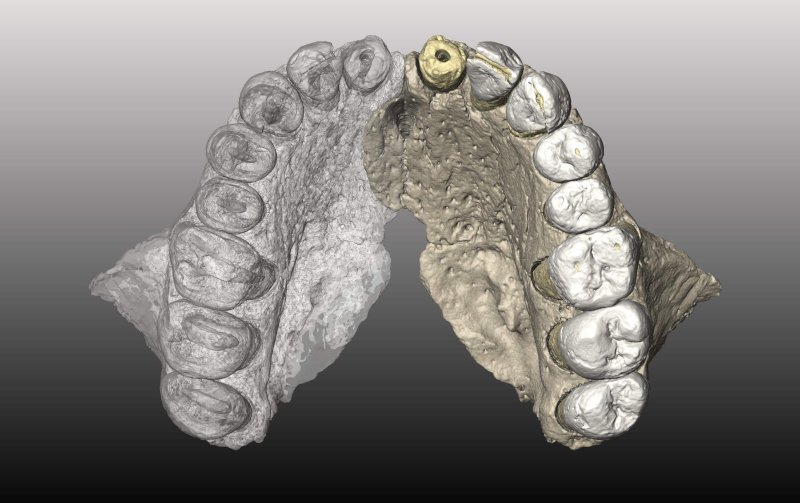
Rewriting human history: Fossils discovered in Israel suggest earlier departure from Africa

fossil

A small bit of human jawbone found in Israel has been dated to between 177,000 and 194,000 years ago. Before this discovery, most evidence suggested Homo sapiens hadn’t left the African continent until 122,000 years ago.

It’s a big deal. The research was published [January 25] in Science, and if it holds true, then humanity’s story just got a lot more complex. (Our species is believed to have arisen around 315,000 years ago from some common ancestor with the Neanderthal in Africa.)

This skull fragment is older than any previously found outside of Africa, and that’s not all. It also has more modern features than those associated with East African sapiens fossils. This might place our species something closer to 500,000 years old.

As fossil evidence has accumulated, a new picture of human history has been painted: we shared the Earth with at least four different human relatives, including the Neanderthals, the Denisovans (an Asian relative of the Neanderthals), Homo erectus, and the diminutive and regionally isolated Homo floresiensis. DNA evidence shows interbreeding with the Neanderthals and the Denisovans, and the Denisovans likely mated with an ancient human ancestor—possibly Homo erectus, though its DNA has never been sequenced.

But “anatomically modern” people may have been a result of interbreeding with several human cousin species known to be living alongside modern humans.

Read full, original post: Major Human Evolution Discovery Suggests Homo Sapiens Left Africa Sooner Than We Thought


{{ reviewsTotal }}{{ options.labels.singularReviewCountLabel }}
{{ reviewsTotal }}{{ options.labels.pluralReviewCountLabel }}
{{ options.labels.newReviewButton }}
{{ userData.canReview.message }}

Related Articles

Infographic: Global regulatory and health research agencies on whether glyphosate causes cancer

Infographic: Global regulatory and health research agencies on whether glyphosate causes cancer

Does glyphosate—the world's most heavily-used herbicide—pose serious harm to humans? Is it carcinogenic? Those issues are of both legal and ...

Most Popular

Screenshot-2026-04-22-at-12.21.32-PM
Viewpoint: Why the retracted Monsanto glyphosate study doesn’t change the science—the world’s most popular herbicide is safe 
Picture1
The FDA couldn’t find a vaccine safety crisis, so it buried its own research
ChatGPT-Image-May-1-2026-11_42_59-AM-2
Viewpoint: NAD is the wellness grifters latest evidence-lite longevity fad. At least the mice are impressed.
ChatGPT-Image-Apr-16-2026-02_56_53-PM
Financial incentives, over diagnosis, and weak oversight: Autism claims are driving up Medicare costs
global warming
‘Implausible’: Top climate scientists reject worst-case scenario—soaring temperatures and fast-rising sea levels
ChatGPT-Image-May-12-2026-11_27_01-AM-2
AI likely to improve health care, research shows—but not for blacks and ethnic minorities
ChatGPT-Image-May-7-2026-01_23_27-PM-2
Viewpoint: Will AI democratize personalized cancer treatment or fuel medical misinformation?
vax-misinformation-main
Facts & Fallacies Podcast: Limit free speech to blunt social media misinfo?

Sorry. No data so far.

glp menu logo outlined

Get news on human & agricultural genetics and biotechnology delivered to your inbox.