2 brain tests could lead to better autism treatments

hqdefault
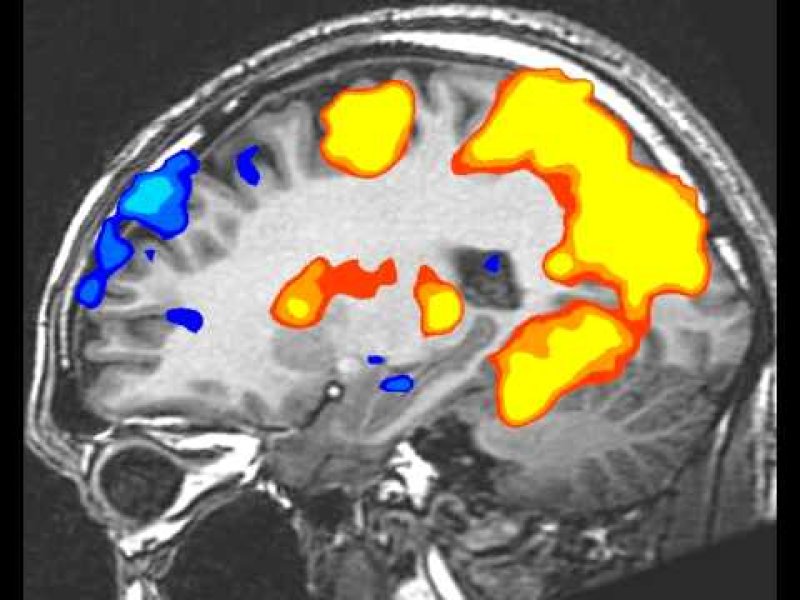
FMRI of a brain. Image credit: Hope Lab

For the first time, new research from the University of Missouri provides evidence that there may be a correlation between cerebro-cerebellar functional connectivity and the balance of excitation-to-inhibition neurotransmitters in the cerebellum of individuals with autism spectrum disorder (ASD). The MU researchers speculate that clinical implementation of two tests used for this study — resting state functional magnetic resonance imaging (fMRI) and proton magnetic resonance spectroscopy (1 H-MRS) — could eventually lead to more precise and individualized medical treatments for patients with ASD.

I spoke with David Beversdorf (link is external), who was the senior author of this paper and is a professor of psychological sciences [and] neurology.

[T]he primary regions of interest for the researchers were the right posterolateral cerebellar hemisphere (R Cereb Hemi) and the left dorsolateral prefrontal cortex (L DLPFC). The interplay between these contralateral brain regions is believed to play a central role in social communication and language processing. Notably, study participants with low functional connectivity between these brain regions also displayed a lower ability to infer meaning from verbal information.

[T]his research is significant because it is the first time neuroscientists have identified a possible link between cerebro-cerebellar functional connectivity, neurotransmitter imbalance in the cerebellum, and the potential use of fMRI and 1 H-MRS tests to identify specific biomarkers for ASD.

Read full, original post: Two Cerebellum-Related Tests Could Improve Autism Treatments

{{ reviewsTotal }}{{ options.labels.singularReviewCountLabel }}
{{ reviewsTotal }}{{ options.labels.pluralReviewCountLabel }}
{{ options.labels.newReviewButton }}
{{ userData.canReview.message }}

Related Articles

Infographic: Global regulatory and health research agencies on whether glyphosate causes cancer

Infographic: Global regulatory and health research agencies on whether glyphosate causes cancer

Does glyphosate—the world's most heavily-used herbicide—pose serious harm to humans? Is it carcinogenic? Those issues are of both legal and ...

Most Popular

Screenshot-PM-24
Viewpoint: The herbicide glyphosate isn’t perfect. Banning it would be far worse.
d-b
Blocked arteries, kidney stones, nausea, constipation, fatigue: Long list of health problems caused by too much vitamin D 
circular-bioeconomy-should-focus-on-sustainable-wellbeing
GLP podcast: What's wrong with 'doomsday' environmentalism? It's false.
Screenshot-2026-04-27-at-12.22.38-PM
Running ‘wild’: Last year, RFK, Jr. was given a green light to ‘reform’ chemical policies. Glyphosate illustrates how Trump now has him on a tight leash, and MAHA is furious
bayer-supremecourt-lt
EPA concludes glyphosate is not carcinogenic. Missouri courts say Monsanto failed to warn it might be. SCOTUS weighs in.
Screenshot 2026-02-25 at 11.20
Why the herbicide glyphosate is key to sustainable agriculture
ChatGPT-Image-Apr-22-2026-11_06_18-AM
Wellness influencer nonsense: No, nicotine does not boost cognition and productivity, but it can damage your health 
glp menu logo outlined

Get news on human & agricultural genetics and biotechnology delivered to your inbox.