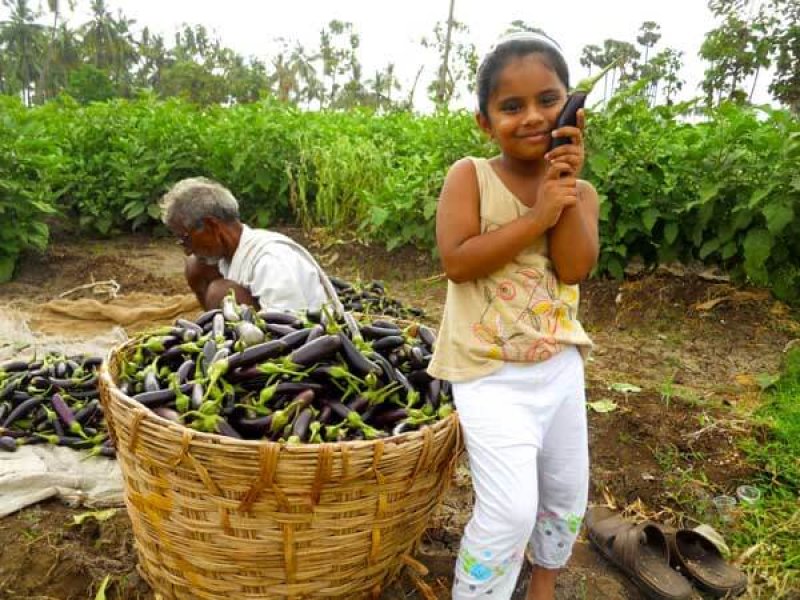
Eggplant is a staple in vegetarian diets throughout South Asia, and one of the cheapest vegetables to procure by resource-poor communities in Bangladesh, [but] a large percentage of the crop does not make it to the market because of [eggplant fruit and shoot borer, EFSB] infestation.
In little over four years’ time nearly a fifth of Bangladeshi [eggplant] farmers are now cultivating – Bt brinjal – a [pest-resistant] eggplant, making it one of the fastest adopted biotech crops ever.
In January 2014 Bangladesh was the first country in South Asia to introduce genetically modified (GM) [brinjal] in the region.
…
This year …. four Bt brinjal varieties reached 27,012 farmers across the country, which constitute roughly 18 percent of Bangladesh’s estimated 150,000 brinjal growers.
…
Net returns per hectare were $2,151 per hectare for Bt brinjal as compared to $357 per hectare for non-Bt brinjal, a six-fold difference …. farmers saved 61 percent of the pesticide cost compared to non-Bt brinjal farmers, experienced no losses due to EFSB

…
EFSB ravages brinjal fields and can cause loss of the crop by as much as 70 percent unless a heavy dose of pesticide is used.
…
[S]cientists …. engineered local varieties of brinjal …. by inserting a …. gene (Cry1Ac) taken from the soil bacterium Bacillus thuringiensis, known as Bt, back in 2005. Bt gene insertion in brinjal made it resistant to EFSB.Read full, original article: A fifth of brinjal farmers adopt Bangladesh’s first GM food crop