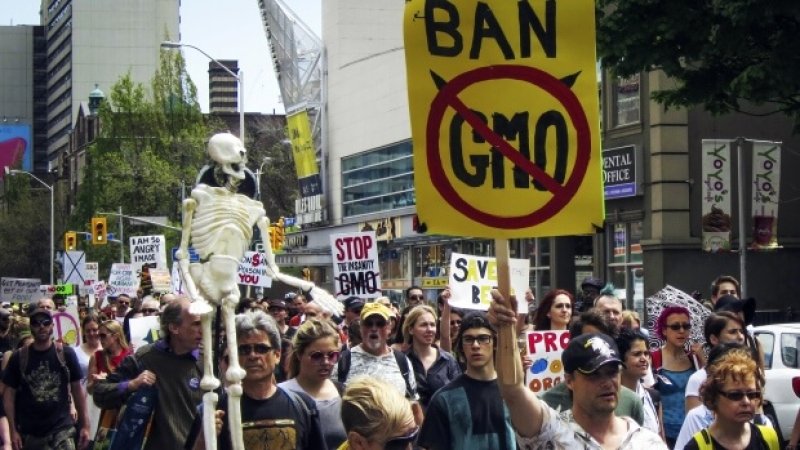
Silent majority? Most Americans may embrace biotech, but vocal anti-GMO minority dominates the conversation

gmo monsanto protest toronto
[Citrus greening disease] is threatening to topple the multibillion-dollar citrus industry in the U.S. by infecting millions of acres of orchards….

[S]cientists are exploring the possibility of breeding genetically modified trees that are resistant to the disease. But….scientists need to know whether….shoppers will buy and consume GM citrus fruit.

A recent study….provides some encouraging answers….About half of the 1,050 people who responded to the survey had positive attitudes toward GM science, the researchers found. Nearly 37 percent of the consumers surveyed felt neutral about GM science….

[P]eople surveyed who rejected GM science were more likely to express their opinion when they believed others held the opposite view. But people with positive feelings about GM technology were less likely to speak out when they believed others supported it too.

“The way others express their attitude has an indirect effect on what our attitude ends up being,” said University of Illinois agricultural communications professor Taylor K. Ruth. “….[I]f other people aren’t vocalizing their opinions, we don’t know that others out there are like-minded.

“Then we start to think ‘Well, maybe I should realign my attitude to what I’m seeing in the media.’ What we see in the media is just reflective of the most dominant voice in the conversation, not necessarily the majority opinion….”

Read full, original article: Future of US citrus may hinge on consumer acceptance of genetically modified food


{{ reviewsTotal }}{{ options.labels.singularReviewCountLabel }}
{{ reviewsTotal }}{{ options.labels.pluralReviewCountLabel }}
{{ options.labels.newReviewButton }}
{{ userData.canReview.message }}

Related Articles

Infographic: Global regulatory and health research agencies on whether glyphosate causes cancer

Infographic: Global regulatory and health research agencies on whether glyphosate causes cancer

Does glyphosate—the world's most heavily-used herbicide—pose serious harm to humans? Is it carcinogenic? Those issues are of both legal and ...

Most Popular

d-b
Blocked arteries, kidney stones, nausea, constipation, fatigue: Long list of health problems caused by too much vitamin D 
Screenshot-PM-24
Viewpoint: The herbicide glyphosate isn’t perfect. Banning it would be far worse.
circular-bioeconomy-should-focus-on-sustainable-wellbeing
GLP podcast: What's wrong with 'doomsday' environmentalism? It's false.
Screenshot 2026-02-25 at 11.20
Why the herbicide glyphosate is key to sustainable agriculture
screen shot at pm
Word games: How Moderna is selling its newest vaccine without using the “v” word
ChatGPT-Image-Feb-16-2026-01_04_32-PM
Raw milk myth wake-up call
ChatGPT-Image-Apr-28-2026-12_46_14-PM-2
Kennedy has quietly stopped touting problematic raw milk. Health concerns aren’t why
ChatGPT-Image-Feb-16-2026-01_57_31-PM
Viewpoint: ‘Science-as-Satan’ unites the MAHA—MAGA movements. Is a breakup in the works?
ChatGPT-Image-Apr-22-2026-11_06_18-AM
Wellness influencer nonsense: No, nicotine does not boost cognition and productivity, but it can damage your health 
bayer-supremecourt-lt
EPA concludes glyphosate is not carcinogenic. Missouri courts say Monsanto failed to warn it might be. SCOTUS weighs in.
glp menu logo outlined

Get news on human & agricultural genetics and biotechnology delivered to your inbox.