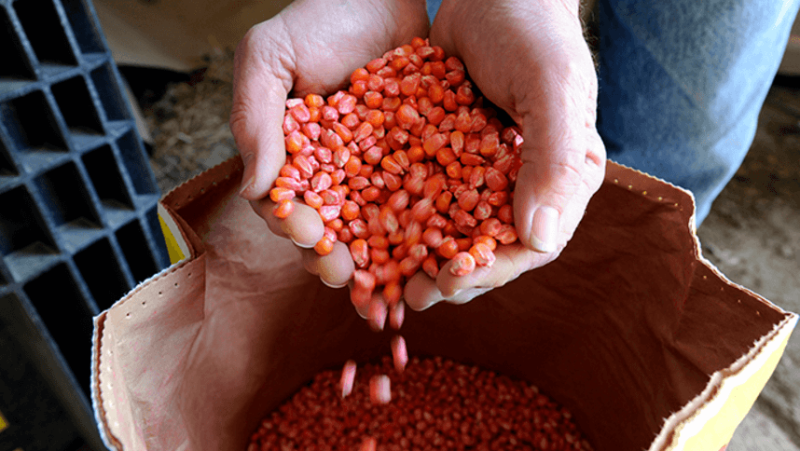

New research from Gian Carlo Moschini at the Center for Agricultural and Rural Development at Iowa State University and Ed Perry at Kansas State University shows that a neonicotinoid ban in the United States may not be a risk free solution to the problem of declining bee populations. In fact, they find that a total agricultural ban in US maize, similar to one introduced in the European Union in 2013, could have unintended consequences.
Neonicotinoids, which were first commercially introduced in the early-1990s and gained popularity as an insecticide throughout the 1990s and 2000s, are now the most popular insecticide in the world. Moschini and Perry found that from 1998 to 2014, adoption of neonicotinoids helped drive a significant reduction in traditional insecticide use. “We show that the major observed reduction in traditional insecticide use was driven in large part by the adoption of two new methods for insect control—genetically engineered (GE) insect-resistant traits and neonicotinoid seed treatments,” Moschini said. “What’s more, our results suggest that neonicotinoid seed treatments actually reduced insecticide use by more than GE traits. Specifically, we found that neonicotinoid seed treatments reduced the use of pyrethroids by 52% and organophosphates by 47%.”
Neonicotinoid use has not been without recent controversy, however, as some lab studies have linked neonicotinoids to the decline of bee populations. Similar studies were a driving factor behind the EU’s 2013 decision to ban neonicotinoids. However, that ban has been shown to have some unintended consequences, just as Moschini says could happen in the United States.
“The results of the ban are still playing out, but some recent research has found that, in response to the ban, EU farmers switched to using other types of insecticides such as pyrethroids. Pyrethroids are also highly toxic to bees,” Moschini said. “Whether the ban has been effective in addressing declining bee populations is also still being assessed—some have noted that bee health did not improve following the implementation of the 2013 restrictions.”
Moschini and Perry’s research shows that, were the United States to ban neonicotinoids, a two-step process is likely to play out. First, some farmers would substitute organophosphates and pyrethroids, as some EU farmers did, in place of neonicotinoids. Second, the switch to neonicotinoid alternatives could result in greater toxicity risk for other groups such as fish, mammals, and humans. Neonicotinoids are much less toxic to mammals and humans than organophosphates and have been classified as a reduced-risk alternative by the Environmental Protection Agency since 2001.




Instead of an outright ban that could lead to increased usage of other insecticides, Moschini said the United States should consider a more balanced approach. This approach would not only aim to address bee population declines, but also neonicotinoid insect resistance. “What would a balanced approach look like? One possibility would be to be to use something like refuges, as with GE insect resistant crops. Another possibility is to require farms to not use neonicotinoid seed treatments once every X years,” he said. “Regulators may also want to consider where bee issues are more problematic—thus, restrictions would be location specific.”
Moschini and Perry’s research is based on roughly 89,000 farm-level surveys on pesticide use for US maize farmers from 1998 to 2014—the same underlying pesticide use data the US Geological Survey uses in The Pesticide National Synthesis Project.
Moschini said one caveat for their work is that it only focuses on maize farmers. “While this is the crop with the most neonicotinoid use, there are other crops, such as soybeans, where neonics are frequently used as well. Our results may not apply to these crops, as their insect control options may differ in important ways from those in maize,” he said.
Original article: US may want to take “balanced approach” to neonicotinoids