
For the first-time we can take a molecular-level look at one of the world’s deadliest crop killers.
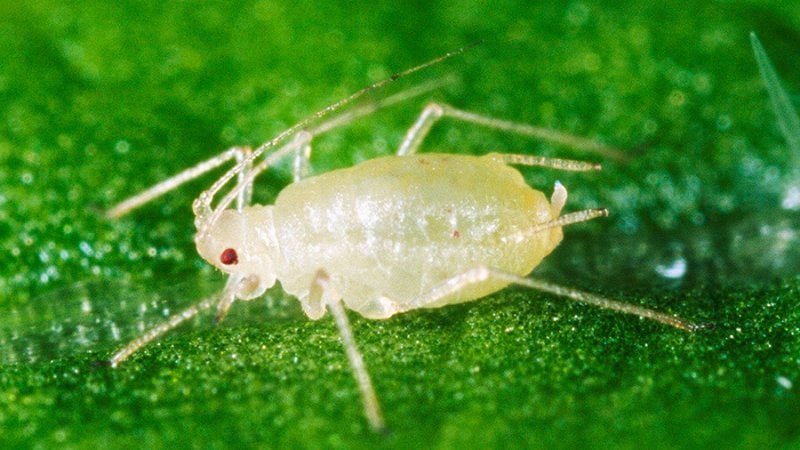
The Luteoviridae are pathogenic plant viruses responsible for major crop losses worldwide. Transmitted by aphids, the viruses infect a wide range of food crops including cereals, legumes, cucurbits, sugar beet, sugarcane and potato.
Until now researchers have been unable to generate the quantities of these viruses needed to study their structures in high resolution.
Now a team of researchers have used recent advances in plant expression technology to generate sufficient quantities of the pathogen to allow more detailed scrutiny with state of the art microscopy techniques.
The method involves infiltrating a type of tobacco plant with the genes necessary to create virus-like particles (VLPs). From the inserted genetic information, the VLPs self-assemble inside the plant host. This technique avoids the need to handle the infectious virus.
Using the VLPs extracted from the plants the team from the John Innes Centre and the Astbury Biostructure Laboratory at the University of Leeds could observe the viral structures to high resolution by cryo-electron microscopy.
This provided, for the first time, a molecular-level insight into how the luteovirid capsid forms and suggests how it is transmitted by aphids. The method may help unlock the secrets of other viruses, say the team involved in the study.



Professor George Lomonossoff of the John Innes Centre says. “This development provides a platform for the development of diagnostic tools for this important family of plant viruses that cause enormous loses worldwide.”
Professor Neil Ranson from the University of Leeds adds: “The combination of plant expression technology and structural biology is hugely exciting, and we can use it to understand the structures of many other types of virus.”
Plant virus infection is responsible for global economic losses estimated at $30billion.
The Luteoviridae attack the plant vasculature which causes severe stunting leading to crop loss. The family includes barley yellow dwarf virus and potato leafroll virus which cause crop losses to a value of £40-60m per year in the United Kingdom.
The full study ‘Combining Transient Expression and Cryo-EM to Obtain High-Resolution Structures of Luteovirid Particles‘ appears in the Cell Press journal Structure.
Original article: Family of crop viruses at the molecular level