51% of Americans say GMO-derived food is unhealthy, 59% know very little about it, Pew survey shows

Screen Shot at AM

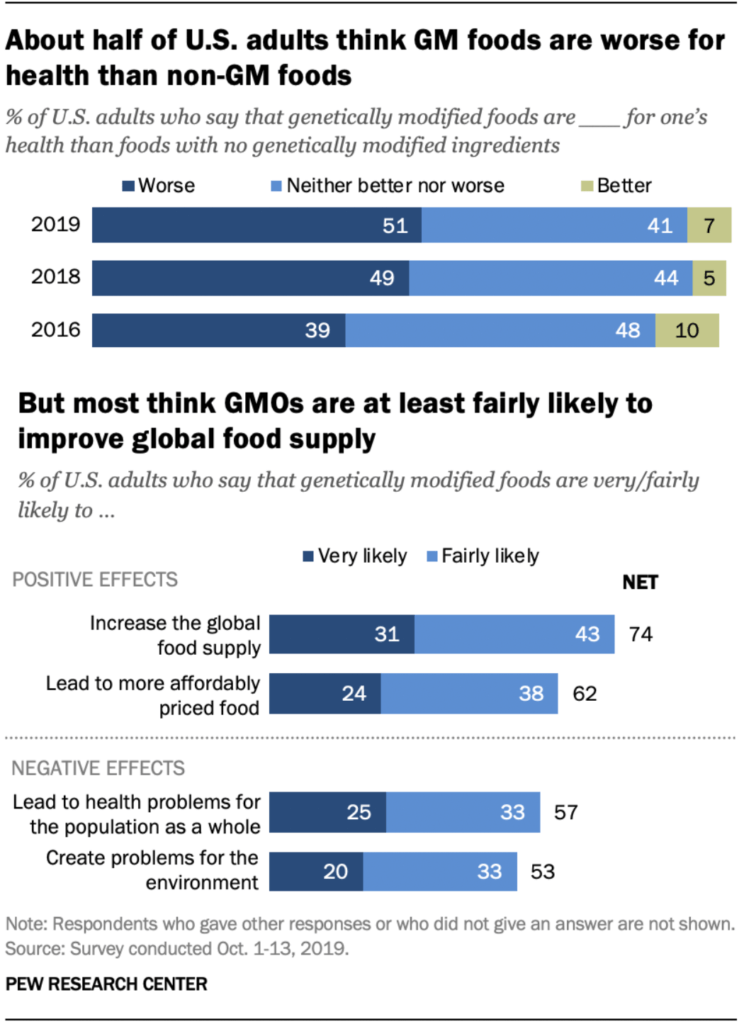
Americans have mixed views about genetically modified foods (GMOs) and their implications for society. About half of U.S. adults (51%) think GMOs are worse for people’s health than foods with no genetically modified ingredients, while 41% say GM foods have a neutral effect on health. Just 7% say they are better for health than other foods.

Views about the health effects of such foods grew more negative between 2016 and 2018 and have been steady since then, according to Pew Research Center surveys, the latest of which was conducted in October 2019.
screenshot about half of u s adults are wary of health effects of genetically modified foods but many also see
Credit: Pew Research

As Americans think about the effects of GMOs, about three-quarters (74%) say it is at least fairly likely that GM foods will increase the global food supply. And 62% say GM foods are very or fairly likely to lead to more affordably priced food.

Roughly three-in-ten U.S. adults (29%) report that they have heard a lot about foods with genetically modified ingredients, while 59% have heard a little and 12% say they have heard nothing at all about these foods …. 55% of those who know a lot and a similar share (51%) of those who know a little about GM foods believe such foods are worse for health, compared with 39% of those who say they know nothing about GM foods.


Read the original post

{{ reviewsTotal }}{{ options.labels.singularReviewCountLabel }}
{{ reviewsTotal }}{{ options.labels.pluralReviewCountLabel }}
{{ options.labels.newReviewButton }}
{{ userData.canReview.message }}

Related Articles

Infographic: Global regulatory and health research agencies on whether glyphosate causes cancer

Infographic: Global regulatory and health research agencies on whether glyphosate causes cancer

Does glyphosate—the world's most heavily-used herbicide—pose serious harm to humans? Is it carcinogenic? Those issues are of both legal and ...

Most Popular

ChatGPT-Image-May-7-2026-12_16_37-PM-2
Viewpoint: Are cancer rates ‘skyrocketing’ as RFK, Jr. and MAHA claims? The evidence says mostly the opposite
Screenshot-2026-04-22-at-10.46.29-AM
Viewpoint: How to counter science disinformation? Science journalist offers 12 practical tips
ChatGPT-Image-May-12-2026-08_39_41-PM
GLP podcast: Big Pharma, Big Ag, Big Food—health harming industries or life-saving innovators?
png-pill-omega-Supp-fish-oil
Millions take omega-3 fish oil for brain health. New research suggests it may do the opposite.
Screenshot-2026-02-20-at-10.48.04-AM
Deepfakes raise profound ethical questions in science
Screenshot-2026-04-23-at-11.00.36-AM
Regulators' dilemma: Thalidomide, Metformin, and the cost of getting drug approvals wrong
Picture1-1
Cooling the planet with balloons: Could a geoengineering gamble slow global warming?
Picture1-5
Science Disinformation Gap: The transatlantic battle over social media and censorship
Screenshot-2026-04-13-at-1.39.26-PM
Viewpoint: ‘Safer for children?’ Stonyfield yogurt under fire for deceptive organic marketing
Screenshot-2026-05-08-at-3.40.33-PM
Seeds of power: China turns to genetic engineering to become global superpower
ChatGPT-Image-May-13-2026-11_56_08-AM
After slashing global health aid by $19 Billion, Trump moves to tap $2.1 billion more—to cover shutdown costs
glp menu logo outlined

Get news on human & agricultural genetics and biotechnology delivered to your inbox.