Locust invasion has jeopardized the livelihoods of 20 million Africans—now a second wave is coming

locustskenya
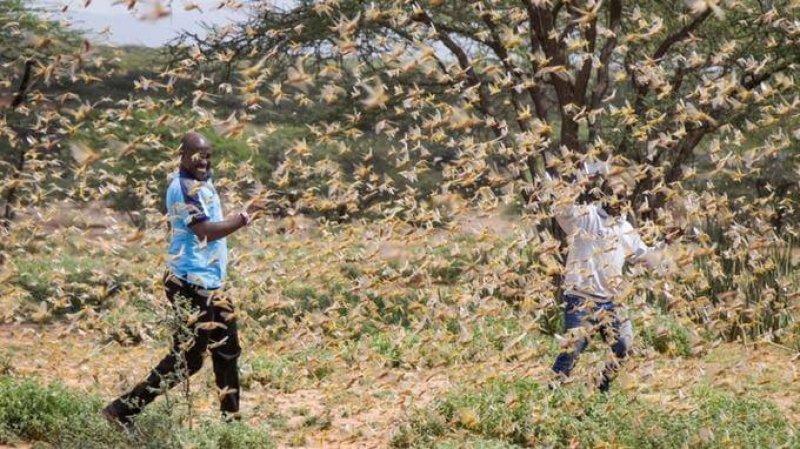
A locust swarm in Kenya. Credit: AP

Billions of desert locusts have swept across east Africa, threatening the livelihoods of more than 20 million people. Now a second wave is coming.

Since December, billions of desert locusts have swarmed eastern Africa, ravaging crops, decimating pasture and threatening the livelihoods of more than 20 million people who depend on farming and livestock for their survival.

The outbreak, which is the worst in a generation, has seen hungry swarms – some the size of cities – sweeping across Somalia, Ethiopia and Kenya, feasting their way through hundreds of thousands of hectares of crops and grazing land.

The United Nations has called the infestation – which has also affected Uganda, Djibouti, South Sudan, Eritrea and Tanzania, Sudan – “a scourge of biblical proportions”. But so far limited resources have hampered efforts to fight the locusts …. and the worst is yet to come.

A second generation of the insects – about 20 times larger – has spawned in countless pockets across the Horn of Africa. Within weeks, they will reach adulthood and take flight.

“The timing could not be worse. The second wave coincides with the planting season and the rains which are due in April,” said Daniel Molla, food security and nutrition advisor for the …. Food and Agriculture Organization (FAO).


Read the original post

{{ reviewsTotal }}{{ options.labels.singularReviewCountLabel }}
{{ reviewsTotal }}{{ options.labels.pluralReviewCountLabel }}
{{ options.labels.newReviewButton }}
{{ userData.canReview.message }}

Related Articles

Infographic: Global regulatory and health research agencies on whether glyphosate causes cancer

Infographic: Global regulatory and health research agencies on whether glyphosate causes cancer

Does glyphosate—the world's most heavily-used herbicide—pose serious harm to humans? Is it carcinogenic? Those issues are of both legal and ...

Most Popular

Screenshot-2026-04-22-at-12.21.32-PM
Viewpoint: Why the retracted Monsanto glyphosate study doesn’t change the science—the world’s most popular herbicide is safe 
Picture1
The FDA couldn’t find a vaccine safety crisis, so it buried its own research
ChatGPT-Image-May-1-2026-11_42_59-AM-2
Viewpoint: NAD is the wellness grifters latest evidence-lite longevity fad. At least the mice are impressed.
ChatGPT-Image-Apr-16-2026-02_56_53-PM
Financial incentives, over diagnosis, and weak oversight: Autism claims are driving up Medicare costs
global warming
‘Implausible’: Top climate scientists reject worst-case scenario—soaring temperatures and fast-rising sea levels
Screenshot-2026-05-21-at-12.15.17-PM
UK gene-editing milestone: Livestock barley that increases ruminant value and reduces methane emissions is first-approved CRISPR crop
Screenshot-2026-05-21-at-3.15.53-PM
Chiropractors may no longer be modern-day snake oil salesmen, but the benefits of their therapy are limited–at best
vax-misinformation-main
Facts & Fallacies Podcast: Limit free speech to blunt social media misinfo?
ChatGPT-Image-May-12-2026-11_27_01-AM-2
AI likely to improve health care, research shows—but not for blacks and ethnic minorities

Sorry. No data so far.

glp menu logo outlined

Get news on human & agricultural genetics and biotechnology delivered to your inbox.