COVID logistics nightmare: Developing a vaccine might be easy compared to shipping vials at -112°F to hundreds of millions of people around the globe

bigstock doctor s hand holding bottle v x
Credit: Bigstock

Drug companies will have to develop a safe and effective vaccine. Billions of people will have to consent to vaccination.

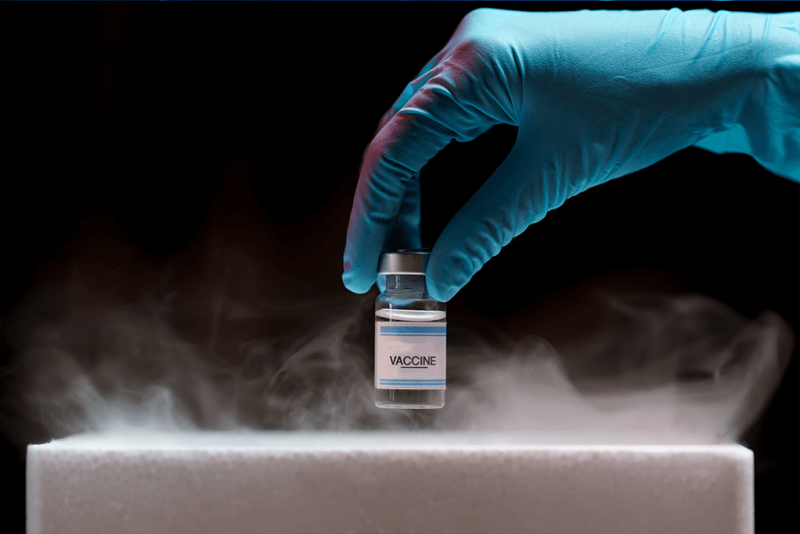
But there are more prosaic challenges, too. Among them: Companies may have to transport tiny glass vials thousands of miles while keeping them as cold as the South Pole in the depths of winter.

A number of the leading Covid-19 vaccines under development will need to be kept at temperatures as low as minus 80 degrees Celsius (minus 112 degrees Fahrenheit) from the moment they are bottled to the time they are ready to be injected into patients’ arms.

That will not be easy. Vaccines may be manufactured on one continent and shipped to another. They will go from logistics hub to logistics hub before ending up at the hospitals.

Follow the latest news and policy debates on sustainable agriculture, biomedicine, and other ‘disruptive’ innovations. Subscribe to our newsletter.

The U.S. military and a federal contractor are expected to play a role in coordinating the distribution. But a hodgepodge of companies are scrambling to figure out how to keep hundreds of millions of doses of a vaccine very, very cold.

Planes, trucks and warehouses will need to be outfitted with freezers. Glass vials will need to withstand icy climes. Someone will need to make a lot more dry ice.

“We’re only now beginning to understand the complexities of the delivery side of all of this,” said J. Stephen Morrison, senior vice president at the Center for Strategic and International Studies.


Read the original post

{{ reviewsTotal }}{{ options.labels.singularReviewCountLabel }}
{{ reviewsTotal }}{{ options.labels.pluralReviewCountLabel }}
{{ options.labels.newReviewButton }}
{{ userData.canReview.message }}

Related Articles

Infographic: Global regulatory and health research agencies on whether glyphosate causes cancer

Infographic: Global regulatory and health research agencies on whether glyphosate causes cancer

Does glyphosate—the world's most heavily-used herbicide—pose serious harm to humans? Is it carcinogenic? Those issues are of both legal and ...

Most Popular

ChatGPT-Image-May-7-2026-12_32_36-PM
Viewpoint: The state of U.S. vaccine policy? Dismal nationally, but some states are stepping up.
Screenshot-2026-04-22-at-10.46.29-AM
Viewpoint: How to counter science disinformation? Science journalist offers 12 practical tips
Screenshot-2026-04-13-at-1.39.26-PM
Viewpoint: ‘Safer for children?’ Stonyfield yogurt under fire for deceptive organic marketing
ChatGPT-Image-May-7-2026-12_16_37-PM-2
Viewpoint: Are cancer rates ‘skyrocketing’ as RFK, Jr. and MAHA claim? The evidence says mostly the opposite
the magic of mRNA
Viewpoint: Anti-vax fake ‘turbo cancer’ claims threaten cancer treatment breakthroughs
Picture1-1
Cooling the planet with balloons: Could a geoengineering gamble slow global warming?
artificial intelligence brain think illustration md
Viewpoint — Digital gods and human extinction: Will we be the first species ever to design our own descendants?
Defense_Secretary_Ash_Carter_tours_the_Microsoft_Cybercrime_Center_in_Seattle_March_3_2016
How criminals are using AI to target social media users and steal their money and confidential data
Picture1-14
When superbugs threaten vulnerable children: Can AI help solve antibiotic resistance?
ChatGPT-Image-May-7-2026-01_23_27-PM-2
Viewpoint: Will AI democratize personalized cancer treatment or fuel medical misinformation?
glp menu logo outlined

Get news on human & agricultural genetics and biotechnology delivered to your inbox.