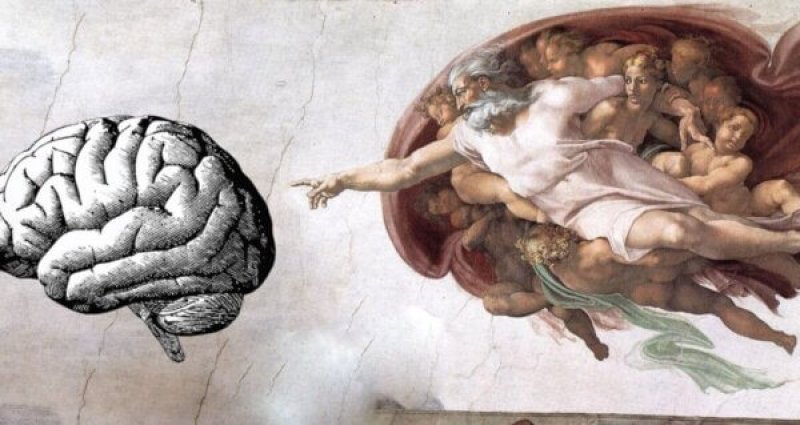

Individuals who can unconsciously predict complex patterns, an ability called implicit pattern learning, are likely to hold stronger beliefs that there is a god who creates patterns of events in the universe, according to neuroscientists at Georgetown University.
Their research, reported in the journal Nature Communications, is the first to use implicit pattern learning to investigate religious belief. The study spanned two very different cultural and religious groups, one in the U.S. and one in Afghanistan.
The goal was to test whether implicit pattern learning is a basis of belief and, if so, whether that connection holds across different faiths and cultures. The researchers indeed found that implicit pattern learning appears to offer a key to understanding a variety of religions.
“Belief in a god or gods who intervene in the world to create order is a core element of global religions,” says the study’s senior investigator, Adam Green, an associate professor in the Department of Psychology and Interdisciplinary Program in Neuroscience at Georgetown, and director of the Georgetown Laboratory for Relational Cognition.



“This is not a study about whether God exists, this is a study about why and how brains come to believe in gods. Our hypothesis is that people whose brains are good at subconsciously discerning patterns in their environment may ascribe those patterns to the hand of a higher power,” he adds.