False security: Many schools and businesses rely on temperature tests but COVID often not linked to fever

t z rc yi cmbhe rtrmadp health coronavirus italy schools
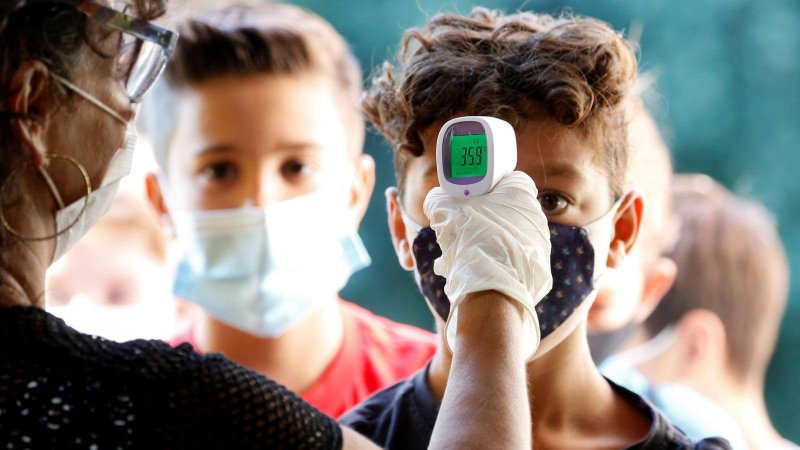
Credit: Remo Casilli/Reuters
[E]xperts and medical groups increasingly say that [temperature testing] isn’t a good gauge of Covid-19 as many infected children and adults don’t get fevers. Furthermore, variability in individual temperatures as well as questions about the accuracy of body-temperature scanners and infrared contact-free thermometers put such checks at risk of potential error.

A U.S. Centers of Disease Control and Prevention study of nearly 300 children with Covid-19 found that 56% had a fever. Its current guidance for school reopenings recommends against symptom screening for Covid-19. The American Academy of Pediatrics’ interim guidance on school reopenings similarly doesn’t recommend universal temperature checks.

“Thinking that you have done enough by simply screening a child for a temperature is one of those things that we felt created potentially a false sense of security for schools,” says Nathaniel Beers, a pediatrician at Children’s National Hospital in Washington, who co-chaired the committee that drafted the guidance.

Doctors say baseline temperature varies depending on age, gender and other factors. Temperatures also fluctuate throughout the day based on a person’s circadian rhythm.

Follow the latest news and policy debates on sustainable agriculture, biomedicine, and other ‘disruptive’ innovations. Subscribe to our newsletter.

Dr. [Beth] Gottlieb says she has seen more parents coming in with children who have consistent low-grade fevers. If a child is otherwise normal and happy she advises parents to stop taking their temperature. “This may be their normal body temperature based on the rhythm of the day,” she says.


Read the original post

{{ reviewsTotal }}{{ options.labels.singularReviewCountLabel }}
{{ reviewsTotal }}{{ options.labels.pluralReviewCountLabel }}
{{ options.labels.newReviewButton }}
{{ userData.canReview.message }}

Related Articles

Infographic: Global regulatory and health research agencies on whether glyphosate causes cancer

Infographic: Global regulatory and health research agencies on whether glyphosate causes cancer

Does glyphosate—the world's most heavily-used herbicide—pose serious harm to humans? Is it carcinogenic? Those issues are of both legal and ...

Most Popular

Screenshot-2026-05-01-at-1.29.41-PM
Viewpoint: What happens when whole grains meet modern food manufacturing? Labels don’t tell the whole story.
S
As vaccine rejectionism spreads, measles may be taking a more dangerous turn
Screenshot 2026-05-06 at 2.56
Singularity crisis ahead? Can super babies save us from rogue AI geniuses?
Screenshot-2026-05-06-at-2.07.43-PM
Manufacturing a conspiracy: The timeline of how  the White House embraced the fringe claim that scientists are being mysteriously murdered
Screenshot-2026-03-13-at-12.14.04-PM
The FDA wants to make many popular prescription drugs OTC—a great idea. Here’s why it’s unlikely to happen
Screenshot-2026-04-20-at-2.26.27-PM
Viewpoint — Food-fear world: The latest activist scientists campaign: Cancer-causing additives
Screenshot-2026-04-30-at-2.19.37-PM
5 myths about summer dehydration that could damage your health — or even kill you
ChatGPT-Image-May-6-2026-03_41_05-PM
‘Protecting the integrity of science’: Kennedy’s FDA blocks release of taxpayer-funded studies finding COVID and shingles vaccines safe
Screenshot-2026-05-01-at-11.56.24-AM
‘Science moves forward when people are willing to think differently’: Memories of DNA maverick Craig Venter
79d03212-2508-45d0-b427-8e9743ff6432
Viewpoint: The Casey Means hustle—Wellness woo opportunism dressed up as medical wisdom
Screenshot 2026-05-06 at 12.49
Immortal dragons: The quest to ‘make death optional’
glp menu logo outlined

Get news on human & agricultural genetics and biotechnology delivered to your inbox.