Here’s the skinny on the CRISPR patent saga between the Broad Institute and the CVC group

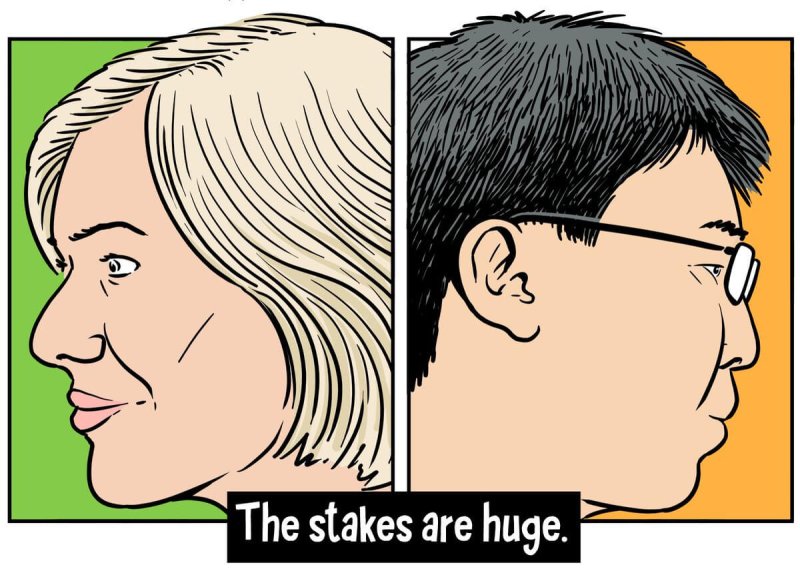
Jennifer Doudna of UC Berkeley (left) and Feng Zhang of the Broad Institute. Credit: The Nib

CRISPR was first reported by Jennifer Doudna and Emmanuelle Charpentier in 2012, as an outgrowth of their work on bacterial immunity at the University of California at Berkeley and the University of Vienna [CVC]. They did not explicitly show that CRISPR could edit genes in eukaryotic cells… in their earliest published work.

The first scientific publication demonstrating that CRISPR could be effectively practiced in eukaryotic cells was by Zhang and colleagues at The Broad Institute, MIT and Harvard University.

Both groups claimed inventorship over CRISPR applications to eukaryotic cells (which encompasses most of the most promising applications of the technology).

The Broad’s earliest date of conception is later than CVC’s, in June 2012, with asserted reduction to practice in July 2012.

This timeline would ordinarily indicate that CVC should win the priority battle, but the Broad has asserted a nuanced counter-argument; the Broad contends that the unpredictability of using CRISPR in eukaryotic cells is sufficiently high that only by actually reducing the invention to practice in a eukaryotic cell could the invention be conceived.

Follow the latest news and policy debates on sustainable agriculture, biomedicine, and other ‘disruptive’ innovations. Subscribe to our newsletter.

These circumstances leave the ownership status of eukaryotic CRISPR technology in limbo for at least the foreseeable future. This state of affairs raises clear impediments to commercial development, at least until and if the parties decide some way to cross-license CRISPR to third parties.


Read the original post

{{ reviewsTotal }}{{ options.labels.singularReviewCountLabel }}
{{ reviewsTotal }}{{ options.labels.pluralReviewCountLabel }}
{{ options.labels.newReviewButton }}
{{ userData.canReview.message }}

Related Articles

Infographic: Global regulatory and health research agencies on whether glyphosate causes cancer

Infographic: Global regulatory and health research agencies on whether glyphosate causes cancer

Does glyphosate—the world's most heavily-used herbicide—pose serious harm to humans? Is it carcinogenic? Those issues are of both legal and ...

Most Popular

ChatGPT-Image-May-7-2026-12_16_37-PM-2
Viewpoint: Are cancer rates ‘skyrocketing’ as RFK, Jr. and MAHA claims? The evidence says mostly the opposite
Screenshot-2026-04-13-at-1.39.26-PM
Viewpoint: ‘Safer for children?’ Stonyfield yogurt under fire for deceptive organic marketing
Screenshot-2026-04-22-at-10.46.29-AM
Viewpoint: How to counter science disinformation? Science journalist offers 12 practical tips
png-pill-omega-Supp-fish-oil
Millions take omega-3 fish oil for brain health. New research suggests it may do the opposite.
ChatGPT Image May 14, 2026, 09_51_35 PM
Facebook swamped by hundreds of thousands of scam ads for illegal or dangerous medical products
ChatGPT Image May 12, 2026, 01_21_30 PM
How big health brands are funding online medical misinformation 
Screenshot-2026-04-23-at-11.00.36-AM
Regulators' dilemma: Thalidomide, Metformin, and the cost of getting drug approvals wrong
Picture1-5
Science Disinformation Gap: The transatlantic battle over social media and censorship
ChatGPT-Image-May-13-2026-12_43_37-PM-2
Longevity: Is cellular rejuvenation even possible?
glp menu logo outlined

Get news on human & agricultural genetics and biotechnology delivered to your inbox.