Decades-past DDT exposure shown to ‘haunt’ our bodies for three generations or more

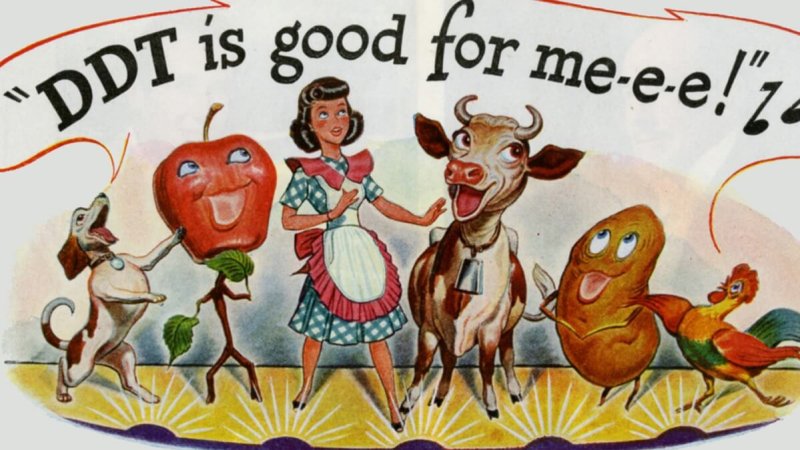
A 1947 advertisement for the pesticide DDT. Credit: Collectors Weekly

Friends and family often ask Barbara Cohn, an epidemiologist at Oakland’s Public Health Institute, why she studies the effects of the long-banned pesticide [DDT]. Her answer: DDT continues to haunt human bodies. In earlier studies, she found that the daughters of mothers exposed to the highest DDT levels while pregnant had elevated rates of breast cancer, hypertension and obesity.

Cohn’s newest study, on the exposed women’s grandchildren, documents the first evidence that DDT’s health effects can persist for at least three generations. The study linked grandmothers’ higher DDT exposure rates to granddaughters’ higher body mass index (BMI) and earlier first menstruation, both of which can signal future health issues.

Follow the latest news and policy debates on sustainable agriculture, biomedicine, and other ‘disruptive’ innovations. Subscribe to our newsletter.

“This study changes everything,” says Emory University reproductive epidemiologist Michele Marcus, who was not involved in the new research. “We don’t know if [other human-made, long-lasting] chemicals like PFAS will have multigenerational impacts—but this study makes it imperative that we look.” Only these long-term studies, Marcus says, can illuminate the full consequences of DDT and other biologically disruptive chemicals to help guide regulations.


Read the original post

{{ reviewsTotal }}{{ options.labels.singularReviewCountLabel }}
{{ reviewsTotal }}{{ options.labels.pluralReviewCountLabel }}
{{ options.labels.newReviewButton }}
{{ userData.canReview.message }}

Related Articles

Infographic: Global regulatory and health research agencies on whether glyphosate causes cancer

Infographic: Global regulatory and health research agencies on whether glyphosate causes cancer

Does glyphosate—the world's most heavily-used herbicide—pose serious harm to humans? Is it carcinogenic? Those issues are of both legal and ...

Most Popular

wuhan institute of virology main entrance
​​COVID lab leak? Making a case that the Wuhan market origins theory is wrong
Screenshot-2026-06-17-at-9.44.03-AM
Viewpoint: Embryos are becoming the newest battleground of love, loss, and legal uncertainty
Screenshot-2026-06-16-at-10.02.22-PM
Viewpoint: ‘Industrial food’ primer—Challenging the dangerous delusions of the alternative food movement
Screenshot-2026-06-17-at-11.57.12-AM
Viewpoint: Raw milk and the myth of safety—ProPublica exposes the growing anti-homogenization movement
ChatGPT-Image-Jun-16-2026-10_01_45-AM-2
Viewpoint—Recursive self-improvement: AI leader Anthropic calls for AI slowdown
ChatGPT-Image-Jun-16-2026-10_29_11-AM
What’s behind Anthropic’s warning about the accelerating development of AI
ChatGPT-Image-Jun-9-2026-01_11_37-PM
Turmeric supplements: More risks than benefits
Screenshot-2026-06-18-at-11.41.51-AM
Viewpoint—Protecting baloney science: Far right senators move to protect the phony homeopathy industry
ChatGPT-Image-Mar-10-2026-01_39_01-PM
Viewpoint—“Miracle molecule” debunked: Why acemannan supplements don’t work
ChatGPT-Image-Jun-4-2026-03_07_27-PM
AAP v. Kennedy: While a court challenge grinds on, RFK Jr. quietly advances his anti-vaccine conspiracy agenda
newborn infant baby mother
Facts & Fallacies Podcast: The truth about vitamin K shots
ChatGPT-Image-Jun-15-2026-02_31_28-PM-2
Trump-appointed cancer panel head backed by supplement and anti-vaccine companies promotes discredited support for ivermectin as a potential cure
Screenshot-2026-06-18-at-2.52.05-PM
Activist organization accuses Trump of protecting methane-generating stripper wells to benefit billionaire and donor Jeffrey Hildebrand 
glp menu logo outlined

Get news on human & agricultural genetics and biotechnology delivered to your inbox.