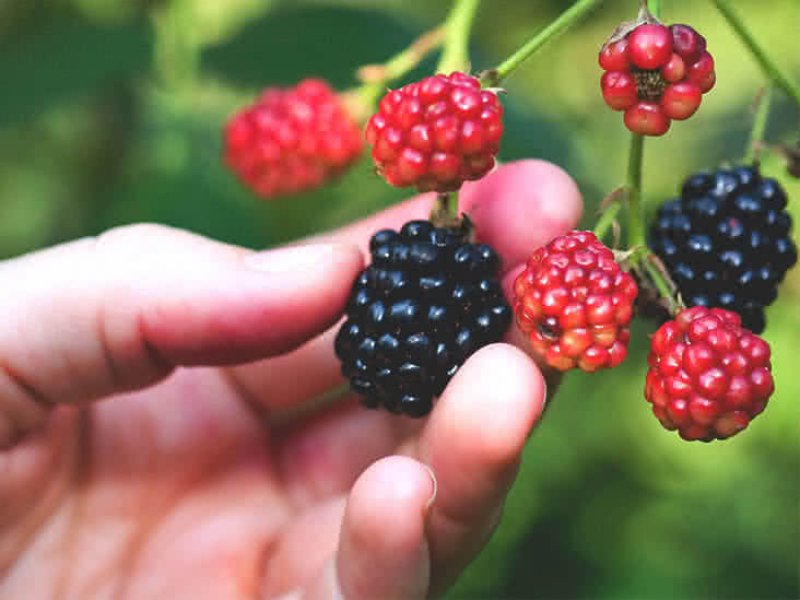
Seedless blackberries with a year-round growing season? Gene editing opens up new doors for radical improvements in the long-stagnant berry market

Credit: Healthline
Credit: Healthline

Genetic variation plus environmental effects are what make us, and the berries we grow, what we are. The interaction of these two factors continues to be exciting and challenging in berry breeding and production.

One of the biggest challenges with existing genetic variation occurs when a trait is desired but there is no known source for it. This means traditional breeding cannot make progress with the desired trait. Gene editing, often using Clustered Regularly Interspaced Short Palindromic Repeats (CRISPR) technology, offers a new way to create genetic variation by precisely changing the DNA of an organism without introducing unrelated DNA such as occurs in transformation or GMO technology.

Pairwise, an innovative company based in Durham, NC, has undertaken the improvement of caneberries, specifically blackberries, using gene-editing techniques.ย 

Follow the latest news and policy debates on sustainable agriculture, biomedicine, and other ‘disruptive’ innovations. Subscribe to our newsletter.

โ€œConsumers donโ€™t like seeds in blackberries, and that led to the first trait to target โ€” seedlessness (similar to seedless grapes). Further, we identified additional traits to improve including plant architecture (fruit easily accessible on fruiting laterals), everbearing (season-long production), plus thornlessness. These traits will help harvest laborers and growers,โ€ [said Pairwise Vice President Tom Spaulding.]

This is an excerpt. Read the original post here.

{{ reviewsTotal }}{{ options.labels.singularReviewCountLabel }}
{{ reviewsTotal }}{{ options.labels.pluralReviewCountLabel }}
{{ options.labels.newReviewButton }}
{{ userData.canReview.message }}

Related Articles

Infographic: Global regulatory and health research agencies on whether glyphosate causes cancer

Infographic: Global regulatory and health research agencies on whether glyphosate causes cancer

Does glyphosateโ€”the world's most heavily-used herbicideโ€”pose serious harm to humans? Is it carcinogenic? Those issues are of both legal and ...

Most Popular

ChatGPT Image May 26, 2026, 08_42_17 AM (1)
Viewpoint: Greenpeace and poison: How environmental advocacy groups rely on compliant (and often ignorant) journalists to spread disinformation and spark litigation
Screenshot 2025-07-30 at 10.48
Can gene editing eliminate Down syndrome? Scientists have done it in lab-grown cells
Screenshot-2026-05-28-at-1.36.28-PM
Viewpoint: Can mRNA research survive the Trump administration?
Screenshot-2026-06-02-at-11.59.11-AM
Magnifica Humanitas: Popeโ€™s encyclical broadside against AI naivete and overreach
ChatGPT-Image-May-26-2026-07_51_21-AM-2
Viewpoint: There are more than 1,000 chemicals in a cup of coffeeโ€”including many substances that can cause cancer. Why isnโ€™t it banned?
Screenshot 2025-11-18 at 3.45
Viewpointโ€”GMOs and sustainability: Why buying organic foods is the least environmentally-sensitive food choiceโ€”without offering any health benefits
Picture1
Sounds we canโ€™t hear โ€” the hidden planetary signals behind science, fear, and misinformation
ChatGPT-Image-Jun-2-2026-11_39_58-AM
Viewpoint: Who is RFK, Jr.โ€™s newly-appointed CDC senior counselor, Sara Brenner โ€” Vaccine skeptic and self-proclaimed โ€œMAHA momโ€
ChatGPT Image May 28, 2026, 08_16_38 PM
Viewpoint: Why the EPA mismeasures cancer risk of chemicals and what should be done to fix it
Screenshot-2026-05-27-at-10.51.25-AM
Viewpoint: โ€˜Monsantoโ€™ bluesโ€”Planned Netflix movie promises yet another round of anti-glyphosate disinformation
Screenshot-2026-06-01-at-1.35.32-PM
Viewpoint: Swine farmers are under attack for allegedly mistreating their animals. Here are the facts.
glp menu logo outlined

Get news on human & agricultural genetics and biotechnology delivered to your inbox.