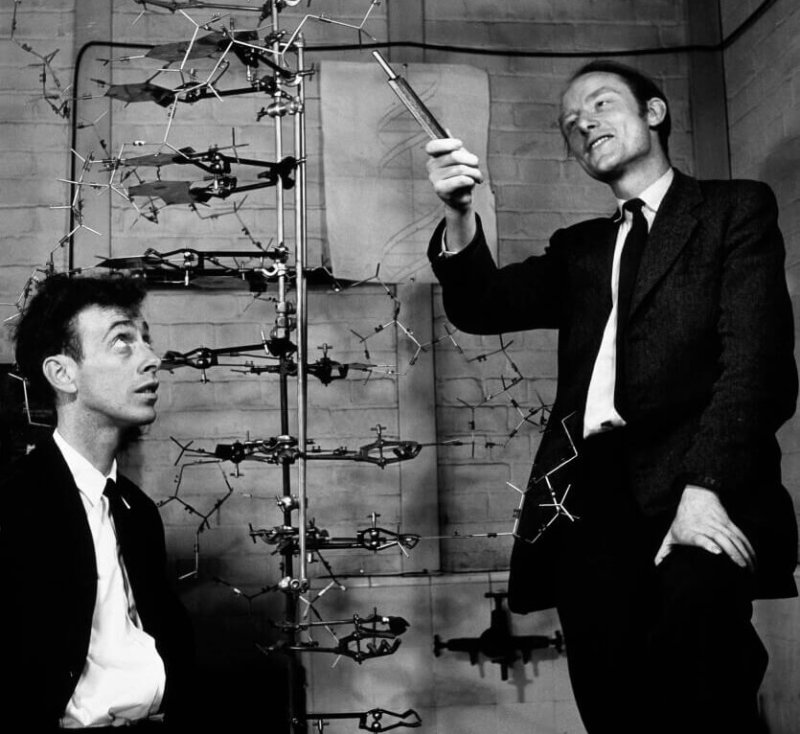
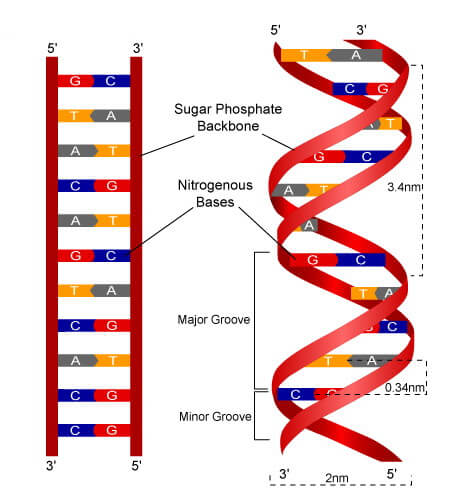
It has not escaped our notice that the specific pairing we have postulated immediately suggests a possible copying mechanism for the genetic material.
That copying mechanism gone awry spawns the mutations that create new viral variants.
Mutation, natural selection, and recombination, oh my!
Like Dorothy of Wizard of Oz fame exclaiming “lions and tigers and bears, oh my!” three major forces of nature set the stage for genome evolution: mutation, natural selection, and recombination.
The virus we’re battling has a single strand of RNA for its genetic material, and not the more familiar double-stranded DNA. But an RNA genome must also replicate – copy itself – when one virus becomes two. And mistakes, mutations, can happen when they do so, like perpetuating a typo when copying a document.
“Every chance a virus has to replicate it can come up with a new strategy to evade the immune system,” said Bruce Walker, MD, Director of the Ragon Institute of MGH, MIT and Harvard, at a recent press briefing of the Massachusetts Consortium on Pathogen Readiness (MassCPR). That’s too teleological an explanation for me – a virus doesn’t intentionally change itself into a fitter form. Instead, mutations tend to arise at genome locations where the sequence is repetitive, like CGCGCGCG compared to ACGCCUCGAU. It’s easier to mistype when “the” is next to “they” in a document, compared to “hippopotamus” next to “diarrhea.”
Viruses with changes that favor their spread persist, illustrating natural selection. “Survival of the fittest,” in the true Darwinian sense, refers to reproductive capacity, not athleticism or endurance. Natural selection is the most common, but not the only, force that can benefit a viral or other genetic variant. Sometimes a mutant virus is simply the first to arrive in a new place, explosively taking over an open niche just by chance. That’s called a founder effect. The D614G mutation in SARS-CoV-2 that arose early in the pandemic in Europe made its way to the US and spread via a founder effect. It persists in the new guises of the eclectic virus.
Another force molding the evolution of SARS-CoV-2 is recombination, which is the shuffling of existing mutations into new groups that flit from virus to virus, like the passengers on a plane. DNA Science covered in detail “How Viral Variants Arise” here.
The panel of experts at the recent Mass CPR meeting discussed how mutation, recombination, natural selection, and even human nature may have interacted to give rise to the Omicron variant – or rather to our awareness of it. The hypotheses aren’t mutually exclusive.
Four takes on Omicron’s origin
How did Omicron end up with a staggering 50 mutations, with 32 affecting the all-important spike protein that our immune systems recognize?
Scenario #1:
Special “keystone” mutations “permit other mutations to accumulate,” said Jeremy Luban, MD, from the University of Massachusetts Medical School. A keystone mutation is akin to a keystone species in an ecosystem, which disrupts the organization if it’s threatened. The effect of a keystone mutation is also a little like removing a building block from the base of a tower and watching the structure collapse. Researchers safely study the effects of keystone mutations in the viral genome by placing spike proteins on viral shells called pseudoviruses and seeing what happens.
“Mutations interact and a creature like Omicron emerges. It requires the right combination of mutations to appear, and these are enabling,” Luban said. His group described 9 keystone mutations in D614G. Added Walker, “Without the keystone mutations, the secondary, more clinically relevant mutations would probably not be possible.” Keystone mutations against the backdrop of a founder effect enabled this early viral variant to rocket through human populations.
Scenario #2:
We weren’t looking everywhere. “Over the past 2 years, these mutations (that comprise Omicron) may have been accumulating under the radar in parts of the world where sequencing wasn’t available. There are many unknown unknowns about this outbreak (that led to Omicron) because we don’t have information about certain parts of the world,” said Luban.
Scenario #3:
Viral evolution reached breakneck speed in a single person with a compromised immune system that let it replicate unchecked, like a concert that doesn’t adequately control the influx of attendees. This situation sounded like science fiction to me at first, a single human body incubating a new form of the beast, but the data are compelling and many papers are reporting the same phenomenon in different situations of immune-deficient patients.
A letter-to-the editor in The New England Journal of Medicine from December 3, 2020 was an early case report of the phenomenon. A man receiving immunosuppressant drugs to control an autoimmune disorder contracted COVID and required hospitalization. Although he was treated with remdesivir several times and various antibody cocktails, the infection raged out of control in waves of returning symptoms.

By the time the man died on day 154, his body was awash in wildly mutated virus. Most of the mutations affected the key part of the spike protein that the virus uses to glom onto and then invade our cells, the receptor binding domain. The man’s struggling immune response was exerting “selective pressure” on the detonating viral population, favoring versions that make us, the hosts, sickest – which facilitates viral spread as we cough and sneeze.
Runaway viral evolution in a single host is a rare but potentially significant event, wrote Bina Choi, MD, of Brigham and Women’s Hospital, Boston, MA and colleagues in the NEJM letter. “Samples were taken along the course of infection, and all the major mutations seen in Alpha, Beta, Gamma, and Delta were appearing as this virus grew in this one host,” Luban said of their findings.
Similarly, people with HIV who stopped taking their medication, allowing their immune response to crumble, fueled the initial spread of Omicron through South Africa.
Scenario #4:
The virus jumped from us to another animal species, mutated, and then boomeranged back to us. That’s called a “reverse zoonosis.“ “There’s great precedent in virology for this scenario, and with SARS-CoV-2 in mink and in a large proportion of white-tailed deer in the Midwest,” said Luban.
Zoos are now vaccinating thousands of animals, including the big cats that seem especially vulnerable, canines, bears, primates, otters, wolverines, ferrets, flying foxes, and hyenas. The vaccine for non-human animals consists of the spike protein, rather than the mRNA that encodes it.
Even hippos are coming down with the sniffles from COVID.
If the promiscuous virus raging through lions and tigers and bears isn’t disturbing enough, it’s also just fine persisting in the non-living environment. Unusual viral genome sequences found in sewage and in New York City wastewater suggest that future variants may be quietly incubating all over, as the virus leaps from species to species. “Clearly the demon virus can go back and forth between humans and animals. Will we have to live with it forever?” posed Walker.
I think that we will indeed have to learn to live with the changeling SARS-CoV-2 forever. An economist on CNN recently talked about the post-COVID world. I’m afraid that won’t happen. As Walker put it well at last week’s webinar: “In one form or another, this virus is here to stay.” I hope that form is a gentler one, for us, the hosts.
Watson and Crick revisited
The fact that genetic material changes, which enables the rise of viral variants, has been known for more than 60 years.
Watson and Crick’s second 1953 paper in Nature, not nearly as famous as the first, introduced what would become known as the “central dogma” of molecular biology – the fact that DNA encodes RNA, which encodes protein. And that explains how a vaccine consisting of a virus’s DNA or RNA sequence tells our cells to make the viral spikes that alert our immune response to the pathogen. It’s that simple.
I wish the continually flummoxed and hyperexcitable talking head commentators on TV news, instead of hauling in the celebrity docs and scientists, would ask a few biology instructors (and textbook authors) to stop by. Understanding how viral variants arise is, well, in our DNA.
Ricki Lewis has a PhD in genetics and is a science writer and author of several human genetics books. She is an adjunct professor for the Alden March Bioethics Institute at Albany Medical College. Follow her at her website or Twitter @rickilewis
A version of this article was originally posted at PLOS and has been reposted here with permission. PLOS can be found on Twitter @PLOS