AI and lasers might replace conventional weed killing techniques in some applications

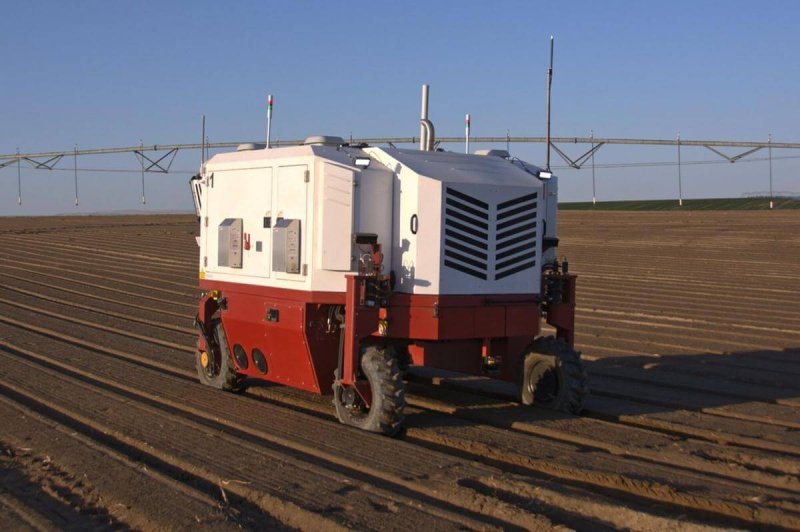
"Bud", the weed killing robot. Credit: Carbon Robotics

Like “The Terminator” for weeds, the Carbon Robotics machine, dubbed “Bud,” rolls through farm fields using artificial intelligence to discern weeds from crops and using a high-power laser to kill the weeds. This lets farmers cultivate crops with less herbicide and reduced labor, improving crop yields and saving money.

“AI and deep learning technology are creating efficiencies across a variety of industries and we’re excited to apply it to agriculture,” said [CEO] Paul Mikesell.

Follow the latest news and policy debates on sustainable agriculture, biomedicine, and other ‘disruptive’ innovations. Subscribe to our newsletter.

These robots can handle row crops in fields between 200 acres and tens of thousands of acres in size, with each robot clearing 15-20 acres per day to replace several deployments of hand-weeding crews. The robots have undergone testing on specialty crops farms, working on fields with a variety of crops, including broccoli and onions.


“This is one of the most innovative and valuable technologies that I’ve seen as a farmer,” said James Johnson of Carzalia Valley Produce in New Mexico, who uses Carbon Robotics technology on his farm. “I expect the robots to go mainstream because of how effectively they address some of farming’s most critical issues, including the overuse of chemicals, process efficiency, and labor.”


This is an excerpt. Read the original post here.

{{ reviewsTotal }}{{ options.labels.singularReviewCountLabel }}
{{ reviewsTotal }}{{ options.labels.pluralReviewCountLabel }}
{{ options.labels.newReviewButton }}
{{ userData.canReview.message }}

Related Articles

Infographic: Global regulatory and health research agencies on whether glyphosate causes cancer

Infographic: Global regulatory and health research agencies on whether glyphosate causes cancer

Does glyphosate—the world's most heavily-used herbicide—pose serious harm to humans? Is it carcinogenic? Those issues are of both legal and ...

Most Popular

Screenshot 2026-05-06 at 2.56
Singularity crisis ahead? Can super babies save us from rogue AI geniuses?
Screenshot-2026-05-01-at-1.29.41-PM
Viewpoint: What happens when whole grains meet modern food manufacturing? Labels don’t tell the whole story.
S
As vaccine rejectionism spreads, measles may be taking a more dangerous turn
Screenshot-2026-03-13-at-12.14.04-PM
The FDA wants to make many popular prescription drugs OTC—a great idea. Here’s why it’s unlikely to happen
Screenshot-2026-04-20-at-2.26.27-PM
Viewpoint — Food-fear world: The latest activist scientists campaign: Cancer-causing additives
Screenshot-2026-05-06-at-2.07.43-PM
Manufacturing a conspiracy: The timeline of how  the White House embraced the fringe claim that scientists are being mysteriously murdered
Screenshot-2026-05-01-at-11.56.24-AM
‘Science moves forward when people are willing to think differently’: Memories of DNA maverick Craig Venter
Screenshot-2026-04-03-at-11.15.51-AM
Paraben panic: How a flawed study, media hype, and chemophobia convinced the public of the danger of one of the safest classes of preservatives
images
The never-ending GMO debate: Pros and cons
Screenshot-2026-04-30-at-2.19.37-PM
5 myths about summer dehydration that could damage your health — or even kill you
Screenshot-2026-04-12-135256
Bixonimania: The fake disease scam that AI swallowed whole
glp menu logo outlined

Get news on human & agricultural genetics and biotechnology delivered to your inbox.