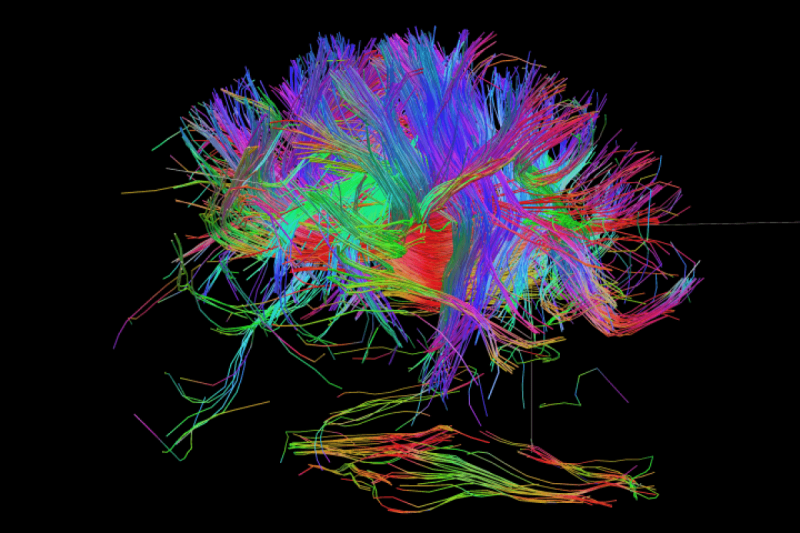
Maps of the neural ‘wiring’ in our brains could unravel secrets of behavior

Credit: Human Connectome Project

Last summer a group of Harvard University neuroscientists and Google engineers released the first wiring diagram of a piece of the human brain.

The tissue, about the size of a pinhead, had been preserved, stained with heavy metals, cut into 5,000 slices and imaged under an electron microscope. This cubic millimeter of tissue accounts for only one-millionth of the entire human brain.

Yet the vast trove of data depicting it comprises 1.4 petabytes’ worth of brightly colored microscopy images of nerve cells, blood vessels and more.

“It is like discovering a new continent,” said Jeff Lichtman of Harvard, the senior author of the paper that presented these results. 

Follow the latest news and policy debates on sustainable agriculture, biomedicine, and other ‘disruptive’ innovations. Subscribe to our newsletter.

Don’t expect a complete wiring diagram for a human brain anytime soon, however, because it’s technically infeasible: Lichtman points out that the zettabyte of data involved would be equivalent to a significant chunk of the entire world’s stored content today.

In fact, the only species for which there is yet a comprehensive connectome is Caenorhabditis elegans, the humble roundworm.

Recent work with C. elegans has demonstrated the power of large-scale connectomics. One experiment showed that it’s sometimes possible for scientists to predict the behavior of an animal from a knowledge of its connectome


This is an excerpt. Read the original post here. 

{{ reviewsTotal }}{{ options.labels.singularReviewCountLabel }}
{{ reviewsTotal }}{{ options.labels.pluralReviewCountLabel }}
{{ options.labels.newReviewButton }}
{{ userData.canReview.message }}

Related Articles

Infographic: Global regulatory and health research agencies on whether glyphosate causes cancer

Infographic: Global regulatory and health research agencies on whether glyphosate causes cancer

Does glyphosate—the world's most heavily-used herbicide—pose serious harm to humans? Is it carcinogenic? Those issues are of both legal and ...

Most Popular

Screenshot-2026-04-22-at-12.21.32-PM
Viewpoint: Why the retracted Monsanto glyphosate study doesn’t change the science—the world’s most popular herbicide is safe 
Picture1
The FDA couldn’t find a vaccine safety crisis, so it buried its own research
ChatGPT-Image-May-1-2026-11_42_59-AM-2
Viewpoint: NAD is the wellness grifters latest evidence-lite longevity fad. At least the mice are impressed.
global warming
‘Implausible’: Top climate scientists reject worst-case scenario—soaring temperatures and fast-rising sea levels
Screenshot-2026-05-21-at-12.15.17-PM
UK gene-editing milestone: Livestock barley that increases ruminant value and reduces methane emissions is first-approved CRISPR crop
vax-misinformation-main
Facts & Fallacies Podcast: Limit free speech to blunt social media misinfo?
ChatGPT-Image-Apr-16-2026-02_56_53-PM
Financial incentives, over diagnosis, and weak oversight: Autism claims are driving up Medicare costs
Screenshot-2026-05-21-at-3.15.53-PM
Chiropractors may no longer be modern-day snake oil salesmen, but the benefits of their therapy are limited–at best
ChatGPT-Image-May-12-2026-11_27_01-AM-2
AI likely to improve health care, research shows—but not for blacks and ethnic minorities
Screenshot-2026-05-20-at-5.11.17-PM
Viewpoint: No, sugar doesn’t ‘feed’ cancer — common cancer myths, debunked

Sorry. No data so far.

glp menu logo outlined

Get news on human & agricultural genetics and biotechnology delivered to your inbox.