Infographic: Is Huntington’s an ‘incurable’ brain disease? New gene therapies offer hope

Credit: Lisk Feng
Credit: Lisk Feng

Huntington’s disease (HD) is an inherited condition that causes widespread deterioration in the brain and disrupts thinking, behaviour, emotion and movement. The disease usually begins in midlife, with subtle changes such as mood swings and difficulty in staying focused. As it progresses, people develop dementia and an inability to speak or move.

Follow the latest news and policy debates on sustainable agriculture, biomedicine, and other ‘disruptive’ innovations. Subscribe to our newsletter.

There are no treatments available to stop or slow the progression of Huntington’s, even though its genetic cause has been clear since 1993. Most other neurodegenerative diseases also lack effective therapies and, although their genetic roots are less clear-cut than for Huntington’s, many of the genes associated with conditions such as motor neuron disease (amyotrophic lateral sclerosis, or ALS), Alzheimer’s and Parkinson’s have been known for decades.

Now, the tide might be turning for treating these kinds of diseases. Many researchers are hopeful about drugs known as antisense oligonucleotides (ASOs). These are short strings of DNA or RNA letters that are designed to cling to particular sequences of RNA made by faulty genes, and to rebalance the levels of proteins they produce—boosting missing proteins or quashing faulty ones.

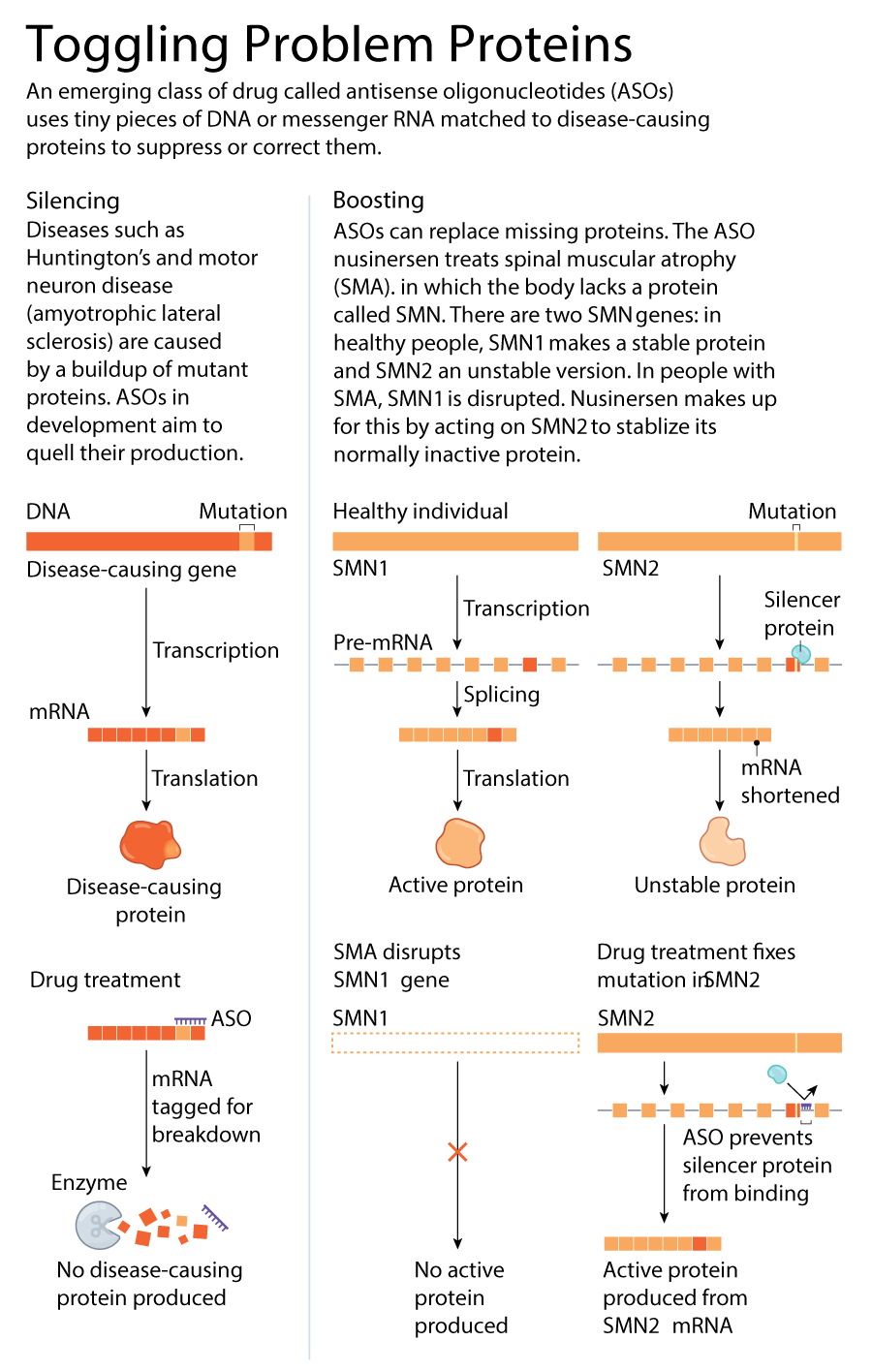
gene therapy graphic

This is an excerpt. Read the original post here.

{{ reviewsTotal }}{{ options.labels.singularReviewCountLabel }}
{{ reviewsTotal }}{{ options.labels.pluralReviewCountLabel }}
{{ options.labels.newReviewButton }}
{{ userData.canReview.message }}

Related Articles

Infographic: Global regulatory and health research agencies on whether glyphosate causes cancer

Infographic: Global regulatory and health research agencies on whether glyphosate causes cancer

Does glyphosate—the world's most heavily-used herbicide—pose serious harm to humans? Is it carcinogenic? Those issues are of both legal and ...

Most Popular

vax-misinformation-main
Facts & Fallacies Podcast: Limit free speech to blunt social media misinfo?
Picture1
The FDA couldn’t find a vaccine safety crisis, so it buried its own research
ChatGPT-Image-May-7-2026-01_23_27-PM-2
Viewpoint: Will AI democratize personalized cancer treatment or fuel medical misinformation?
ChatGPT-Image-Apr-16-2026-02_56_53-PM
Financial incentives, over diagnosis, and weak oversight: Autism claims are driving up Medicare costs
ChatGPT-Image-May-12-2026-11_27_01-AM-2
AI likely to improve health care, research shows—but not for blacks and ethnic minorities
modi visit sikkim
Viewpoint: Indian PM wants farmers to switch to 50% organic. It would take at least 10 years, likely won’t work, and isn’t more sustainable
Screenshot-2026-04-22-at-12.21.32-PM
Viewpoint: Why the retracted Monsanto glyphosate study doesn’t change the science—the world’s most popular herbicide is safe 
newborn infant baby mother
Sharp rise in number of parents refusing newborn vitamin K shots, putting babies at 81-fold higher risk of severe bleeding
ChatGPT-Image-May-20-2026-04_53_21-PM-2
Viewpoint: Doctors can fight health misinformation — if hospitals let them
ChatGPT-Image-May-7-2026-12_32_36-PM
Viewpoint: The state of U.S. vaccine policy? Dismal nationally, but some states are stepping up.
Screenshot-2026-04-13-at-1.39.26-PM
Viewpoint: ‘Safer for children?’ Stonyfield yogurt under fire for deceptive organic marketing
Screenshot-2026-05-18-at-3.04.37-PM-2
Social media’s health advice red flags
Screenshot-2026-05-19-at-11.23.34-AM
West-originated vaccine disinformation sparks murders of health care workers across Africa
glp menu logo outlined

Get news on human & agricultural genetics and biotechnology delivered to your inbox.