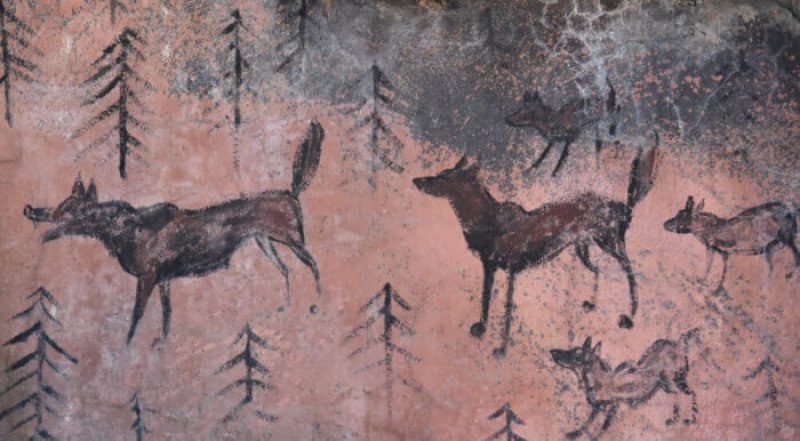
How did dogs evolve to be such close partners with humans? It may be helpful to look to mythology as well as science

connecting mythology to canine ancestors
Credit: Discover Magazine
[T]he similarities between wolves and early domesticated dogs can make it challenging for researchers to tell them apart. In the earliest days, before wolves were fully domesticated, perhaps the most notable difference is simply the animals’ involvement with people.

That’s where storytelling can help, says historian Julien d’Huy of the College of France in Paris. Our penchant for mythologizing canine companions may be just as ancient as our relationship with them, so d’Huy is turning to these stories in a bid to shed more light on the history of dog domestication.

Follow the latest news and policy debates on sustainable agriculture, biomedicine, and other ‘disruptive’ innovations. Subscribe to our newsletter.

D’Huy found three core storylines for the earliest myths related to dogs: The first links dogs with the afterlife, the second relates to the union of humans and dogs, and the third associates a dog with the star Sirius. Versions of these stories are found in many cultural regions around the world. He then borrowed statistical tools from biology to create family trees of myths, showing how the stories evolved as they followed humans from one region of the world to another.

The prevalence of ancient myths identifying dogs as guides to the afterlife hint that our ancestors initially domesticated wolves not for hunting partners, as commonly believed, but for spiritual and symbolic reasons, d’Huy argues.


This is an excerpt. Read the full article here

{{ reviewsTotal }}{{ options.labels.singularReviewCountLabel }}
{{ reviewsTotal }}{{ options.labels.pluralReviewCountLabel }}
{{ options.labels.noReviewsLabel }}
{{ options.labels.newReviewButton }}
{{ userData.canReview.message }}

Related Articles

Infographic: Global regulatory and health research agencies on whether glyphosate causes cancer

Infographic: Global regulatory and health research agencies on whether glyphosate causes cancer

Does glyphosate—the world's most heavily-used herbicide—pose serious harm to humans? Is it carcinogenic? Those issues are of both legal and ...

Most Popular

ChatGPT-Image-Jul-10-2026-12_21_03-PM
Viewpoint: Is there new evidence that the animal deworming drug ivermectin decreases the risk of Covid and cancer? Don’t waste your money.
ChatGPT-Image-Mar-10-2026-01_39_01-PM
Viewpoint—“Miracle molecule” debunked: Why acemannan supplements don’t work
Screenshot-2026-07-09-at-1.09.25-PM
Anti-vaccine myths rattle health care
Picture1
Hiroshima at 81: America’s new nuclear bomb, a buried Iranian target, and a question no one wants to ask
Screenshot-2026-07-30-at-3.07.42-PM
Controversy over WNBA star Sophie Cunningham’s comment opposing trans females in women’s sports reinvigorates the culture wars
leeteam
How Kennedy and his family could pocket millions from Merck’s $50 million vaccine injury settlement that he oversaw
Screenshot-2026-07-30-at-2.30.35-PM
Climate scientists claim conservative activists are promoting ‘lies’ that Europe’s summer heatwaves are far from unusual
ChatGPT-Image-Jun-25-2026-12_23_17-PM
No, Bill Gates did not secretly engineer ticks to promote veganism
ChatGPT Image Jul 29, 2026, 05_50_04 PM
Fear, science, and the law: If talc powder is unlikely to cause cancer and J&J was winning in court, why did it pay more than $5.5 billion to settle?
ChatGPT Image Jul 29, 2026, 10_14_27 PM
After muzzling RFK, Jr. over autism-vaccine conspiracy theories, Trump defies aides to push scares again

Sorry. No data so far.

glp menu logo outlined

Get news on human & agricultural genetics and biotechnology delivered to your inbox.