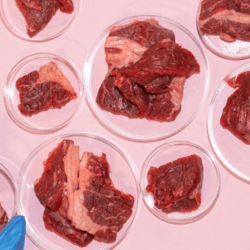
Cows of the future: Bill Gates predicts that genetically modifying beef cows, with the help of AI, could help fight climate change

bill gate super cows feature

In a recent episode of his podcast โ€œUnconfuse Me With Bill Gates,โ€ the Microsoft founder offered the prediction that AI would have a clear role to play in fighting climate change. This could include genetically modifying cows to produce less methane or to produce โ€œmeat without the cow.โ€ Gates was speaking to Hannah Ritchie, a data scientist and researcher at the University of Oxford, when he made the bold prediction about AIโ€™s potential role in fighting climate change.

Ritchie sounded a less optimistic note about the future of food technology, pointing to the difficulties currently being faced by advocates of plant-based diets as they try to convince others to change their food-consumption habits.

Follow the latest news and policy debates on sustainable agriculture, biomedicine, and other ‘disruptive’ innovations. Subscribe to our newsletter.

A few years ago, a study from Australia showed that 73% of men would rather lose ten years of their lives than give up meat. Manufacturers of plant-based โ€œmeatsโ€ like Beyond and Impossible continue to suffer drastic setbacks in their aim to replace traditional meat products, as sales continue to fall.

The hype behind so-called โ€œlab-grown meatโ€ has also largely evaporated. A recent New York Times opinion piece called it โ€œthe revolution that died on its way to dinner.โ€

Despite these difficulties, Gates expressed his hope for real change, and his role in driving it.


This is an excerpt. Read the original post here

{{ reviewsTotal }}{{ options.labels.singularReviewCountLabel }}
{{ reviewsTotal }}{{ options.labels.pluralReviewCountLabel }}
{{ options.labels.newReviewButton }}
{{ userData.canReview.message }}

Related Articles

Infographic: Global regulatory and health research agencies on whether glyphosate causes cancer

Infographic: Global regulatory and health research agencies on whether glyphosate causes cancer

Does glyphosateโ€”the world's most heavily-used herbicideโ€”pose serious harm to humans? Is it carcinogenic? Those issues are of both legal and ...

Most Popular

ChatGPT Image May 10, 2026, 08_16_59 PM 2
Overmedicalization? RFK Jr.โ€™s antidepressant crackdown raises conflict questions over his fee stake in Wisner Baum, the tort firm built on suing drug makers
Picture1-5
Science Disinformation Gap: The transatlantic battle over social media and censorship
Picture1-1
Cooling the planet with balloons: Could a geoengineering gamble slow global warming?
Screenshot-2026-05-11-104424
Hantavirus outbreak research: Trump administration shut down study last year on rodent-to-human transmission
Picture1-14
When superbugs threaten vulnerable children: Can AI help solve antibiotic resistance?
Screenshot 2026-05-11 at 11.30
Despite politicized disinformation, Midwest AI data centers are fueling a solar energy boom
ChatGPT-Image-Apr-13-2026-02_20_22-PM
Viewpoint: Misinformation infodemic? Why assessing evidence is so challengingย 
Screenshot-2026-05-08-at-11.55.47-AM
Anti-vax activists falsely blame COVID vaccines for the rising U.S. cancer rate among younger people.
S
As vaccine rejectionism spreads, measles may be taking a more dangerous turn
Screenshot-2026-05-01-at-1.29.41-PM
Viewpoint: What happens when whole grains meet modern food manufacturing? Labels donโ€™t tell the whole story.
Screenshot-2026-05-08-at-3.40.33-PM
Seeds of power: China turns to genetic engineering to become global superpower
Screenshot-2026-04-20-at-2.26.27-PM
Viewpoint โ€” Food-fear world: The latest activist scientists campaign: Cancer-causing additives
glp menu logo outlined

Get news on human & agricultural genetics and biotechnology delivered to your inbox.