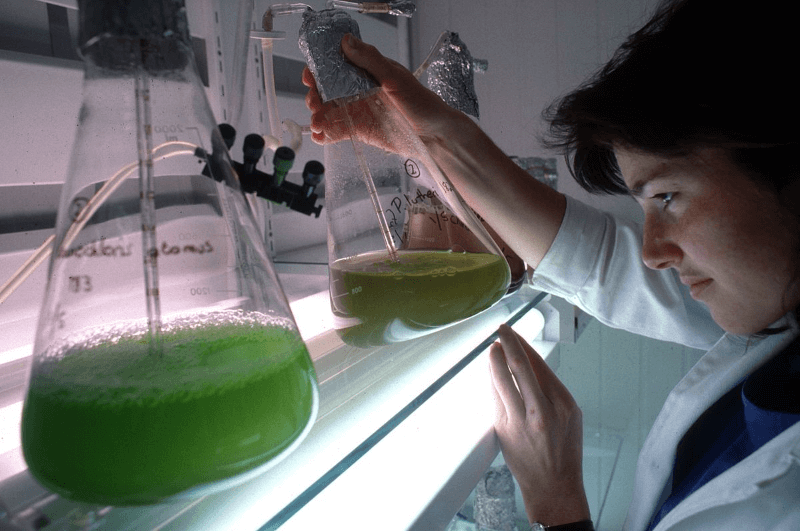
Algae contains high levels of protein and nutrients. Could it help boost food security in the face of climate change?

Credit: CSIRO via CC-BY-3.0

Scientists at the University of California, San Diego (UCSD) believe that algae could be a new type of superfood, thanks to its high protein and nutrient content. They present their arguments in a recently published paper in the journal Frontiers in Nutrition, which reviews the current body of scientific knowledge on microalgae – a general term for the thousands of tiny algal species and other photosynthetic organisms, such as cyanobacteria, found in aquatic environments.

Follow the latest news and policy debates on sustainable agriculture, biomedicine, and other ‘disruptive’ innovations. Subscribe to our newsletter.

“The biggest advantage is the protein production per acre,” [Dr. Stephen] Mayfield noted. “Algae simply dwarf the current gold standard of soybean by at least 10 times, maybe 20 times, more production per acre.”

In addition, some algal species can be grown in brackish or salty water – and, in at least one case, wastewater from a dairy operation – meaning freshwater can be reserved for other needs. Nutritionally, many algal species are rich in vitamins, minerals, and especially macronutrients essential to the human diet, such as amino acids and omega-3 fatty acids.

Mayfield said the need for alternative food systems has never been more urgent, as the human population swells, pushing resources and systems to the breaking point. “The only way to avoid a really bleak future is to start transitioning now to a much more sustainable future, and algae as food is one of those transitions that we need to make,” he said.


This is an excerpt. Read the original post here

{{ reviewsTotal }}{{ options.labels.singularReviewCountLabel }}
{{ reviewsTotal }}{{ options.labels.pluralReviewCountLabel }}
{{ options.labels.newReviewButton }}
{{ userData.canReview.message }}

Related Articles

Infographic: Global regulatory and health research agencies on whether glyphosate causes cancer

Infographic: Global regulatory and health research agencies on whether glyphosate causes cancer

Does glyphosate—the world's most heavily-used herbicide—pose serious harm to humans? Is it carcinogenic? Those issues are of both legal and ...

Most Popular

ChatGPT-Image-Mar-10-2026-01_39_01-PM
Viewpoint—“Miracle molecule” debunked: Why acemannan supplements don’t work
afb-a-b
As the EU loosens restrictions on agricultural gene editing, it remains years behind the rest of the world on equally-safe GMO foods
ChatGPT-Image-Jul-8-2026-12_32_48-PM
Viewpoint: SCOTUS strikes a blow against junk science in Bayer glyphosate case. Will it deter mass tort litigators?
Screenshot-2026-07-10-at-2.02.54-PM
Viewpoint: In abortion-restricting Florida, misinformation abounds when Republican congresswoman faces an ectopic pregnancy
ChatGPT-Image-Jul-7-2026-01_57_55-PM
Viewpoint: Europe’s rejection of air conditioning is the poster child for misunderstanding how to mitigate the impact of climate change
Screenshot-2026-07-10-at-3.10.50-PM
Snake-oil cures throughout history
ChatGPT-Image-Jun-25-2026-12_23_17-PM
No, Bill Gates did not secretly engineer ticks to promote veganism
Screen-Shot-at-PM-pe-vra-kipgaprbdo-vd-ms-jpule-n-jqqaxf-l-e
Viewpoint: Will new breeding techniques help make European agriculture more competitive?
Screenshot-2026-07-10-at-12.55.21-PM
Cancer health facts are particularly susceptible to online misinformation
Screenshot-2026-07-10-at-3.25.10-PM
Using AI for health questions? Here are 4 tips for the most accurate answers.
ChatGPT-Image-Jul-1-2026-03_33_49-PM
‘Alternative’ cancer treatments that could kill you
Screenshot-2026-07-08-at-11.25.14-AM
AI being mobilized to target misinformation about vaccines–on AI
glp menu logo outlined

Get news on human & agricultural genetics and biotechnology delivered to your inbox.