‘Food grown in labs pose no unusual health risks’: Joint Food and Agriculture Organization and and World Health Organization report

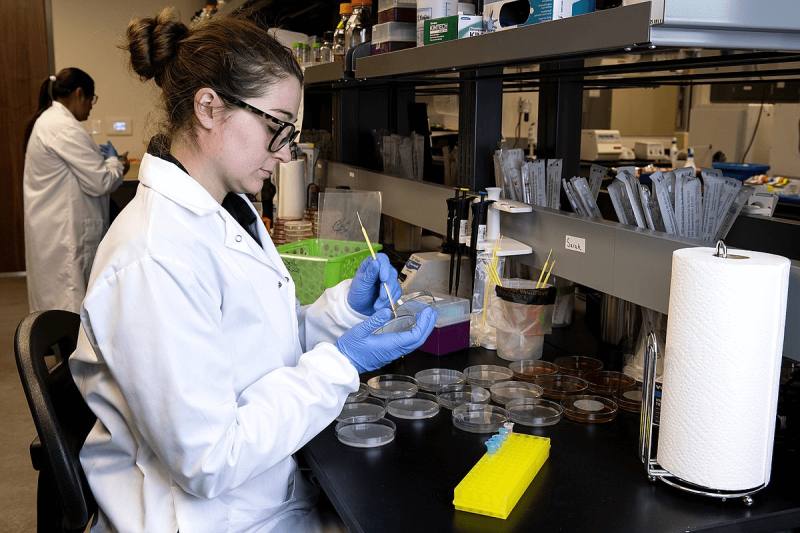
Ph.D. student Allyson Hamilton streaks petri dishes with sample solutions from a food safety study. Credit: Ark. Agricultural Experiment Station

Cell-based food production, which is the field of growing animal agricultural products directly from cell cultures, has been explored as an alleged sustainable alternative to the conventional livestock agricultural system. As commercial cell-based food production continues to expand, the urgency increases to address one of the most important questions of consumers, the question of food safety.

Thus, the Food and Agriculture Organization of the United Nations (FAO), in collaboration with the World Health Organization (WHO), has developed the present document to engage with respective Members and relevant stakeholders by proactively sharing the current knowledge to identify concrete ways to inform consumers and all other stakeholders about the food safety considerations for cell-based food products.

Follow the latest news and policy debates on sustainable agriculture, biomedicine, and other ‘disruptive’ innovations. Subscribe to our newsletter.

The way forward will consist of continuing to invest in research and development in order to understand whether the alleged benefits in increased sustainability can be realized. In this regard, it will be important to closely observe as to what extent, if any, cell-based foods result in differences from conventionally produced foods.


This is an excerpt. Read the original post here

{{ reviewsTotal }}{{ options.labels.singularReviewCountLabel }}
{{ reviewsTotal }}{{ options.labels.pluralReviewCountLabel }}
{{ options.labels.newReviewButton }}
{{ userData.canReview.message }}

Related Articles

Infographic: Global regulatory and health research agencies on whether glyphosate causes cancer

Infographic: Global regulatory and health research agencies on whether glyphosate causes cancer

Does glyphosate—the world's most heavily-used herbicide—pose serious harm to humans? Is it carcinogenic? Those issues are of both legal and ...

Most Popular

Screenshot-2026-04-13-at-3.54.04-PM
AI disinformation stress test: Challenges and response strategies
ChatGPT-Image-Feb-16-2026-01_04_32-PM
Raw milk myth wake-up call
ChatGPT-Image-Apr-23-2026-09_20_20-PM
Kennedy’s CDC blocks publication of study that shows vaccines reduce hospitalizations by 50%, then misrepresents why
ChatGPT-Image-Apr-20-2026-11_17_18-AM-2
10,000 scientists gone: Trump’s cuts create an unprecedented brain drain
ChatGPT-Image-Apr-22-2026-04_31_20-PM
‘Irresponsible decision’? On mandatory military flu shots, Hegseth chooses ‘freedom’ over health
images
The never-ending GMO debate: Pros and cons
ChatGPT-Image-Mar-11-2026-11_58_46-AM
The Trump administration has run out more than 4,000 National Institutes of Health employees. Here are the consequences

Screenshot-2026-04-22-at-1.14.34-PM
Latest fevered, right-wing conspiracy: Fox, New York Post, and kooky GOP legislators push ‘Dead Scientists’ scare
Screenshot-2026-04-12-135256
Bixonimania: The fake disease scam that AI swallowed whole
glp menu logo outlined

Get news on human & agricultural genetics and biotechnology delivered to your inbox.