
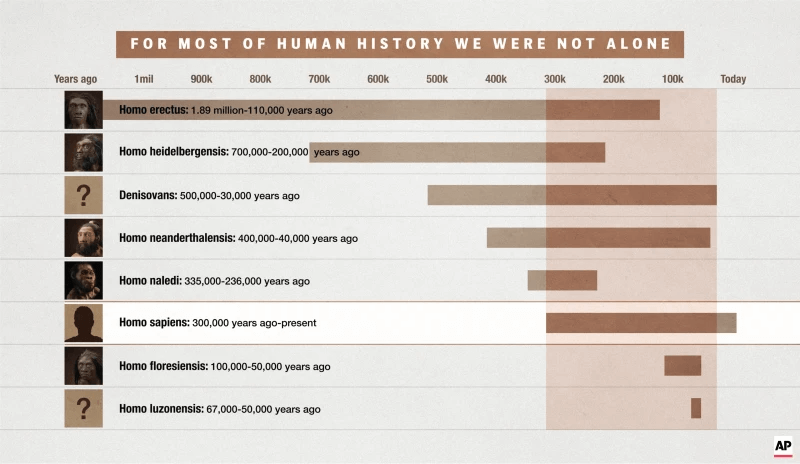
Modern humans co-existed with at least seven now extinct hominid ancestors, and in many cases integrated their DNA

Modern humans overlapped with at least seven now extinct hominid ancestors, and in many cases integrating their DNA
Credit: Midjourney/ Heenan

Ancient DNA technology has revolutionized the way we study human history and has quickly taken off, with a constant stream of studies exploring the genes of long-ago people.

Along with more fossils and artifacts, the DNA findings are pointing us to a challenging idea: We’re not so special.

Follow the latest news and policy debates on sustainable agriculture, biomedicine, and other ‘disruptive’ innovations. Subscribe to our newsletter.

Scientists now know that after H. sapiens first showed up in Africa around 300,000 years ago, they overlapped with a whole cast of other hominins, explained Rick Potts, director of the Smithsonian’s Human Origins Program.

Neanderthals were hanging out in Europe. Homo heidelbergensis and Homo naledi were living in Africa. The short-statured Homo floresiensis, sometimes known as the “Hobbit,” was living in Indonesia, while the long-legged Homo erectus was loping around Asia.

Scientists started to realize all these hominins weren’t our direct ancestors. Instead, they were more like our cousins: lineages that split off from a common source and headed in different directions.

“They didn’t have a map, they didn’t know where they were going,” the Smithsonian’s [Rick] Potts said. “But looking over the next hillside into the next valley, (they) ran into populations of people that looked a bit different from themselves, but mated, exchanged genes.”

assets apnews

This is an excerpt. Read the full article here

{{ reviewsTotal }}{{ options.labels.singularReviewCountLabel }}
{{ reviewsTotal }}{{ options.labels.pluralReviewCountLabel }}
{{ options.labels.newReviewButton }}
{{ userData.canReview.message }}

Related Articles

Infographic: Global regulatory and health research agencies on whether glyphosate causes cancer

Infographic: Global regulatory and health research agencies on whether glyphosate causes cancer

Does glyphosate—the world's most heavily-used herbicide—pose serious harm to humans? Is it carcinogenic? Those issues are of both legal and ...

Most Popular

Picture1
The FDA couldn’t find a vaccine safety crisis, so it buried its own research
Screenshot-2026-04-22-at-12.21.32-PM
Viewpoint: Why the retracted Monsanto glyphosate study doesn’t change the science—the world’s most popular herbicide is safe 
Screenshot-2026-05-19-at-11.23.34-AM
West-originated vaccine disinformation sparks murders of health care workers across Africa
Screenshot-2026-05-08-at-11.55.47-AM
Anti-vax activists falsely blame COVID vaccines for the rising U.S. cancer rate among younger people.
ChatGPT-Image-Apr-16-2026-02_56_53-PM
Financial incentives, over diagnosis, and weak oversight: Autism claims are driving up Medicare costs
ChatGPT-Image-May-7-2026-12_32_36-PM
Viewpoint: The state of U.S. vaccine policy? Dismal nationally, but some states are stepping up.
ChatGPT-Image-May-12-2026-11_27_01-AM-2
AI likely to improve health care, research shows—but not for blacks and ethnic minorities
modi visit sikkim
Viewpoint: Indian PM wants farmers to switch to 50% organic. It would take at least 10 years, likely won’t work, and isn’t more sustainable
Screenshot-2026-04-13-at-1.39.26-PM
Viewpoint: ‘Safer for children?’ Stonyfield yogurt under fire for deceptive organic marketing
Screenshot-2026-05-18-at-12.57.12-PM
Viewpoint—‘Technology is pulling us apart’: Environmental, political, and economic
glp menu logo outlined

Get news on human & agricultural genetics and biotechnology delivered to your inbox.