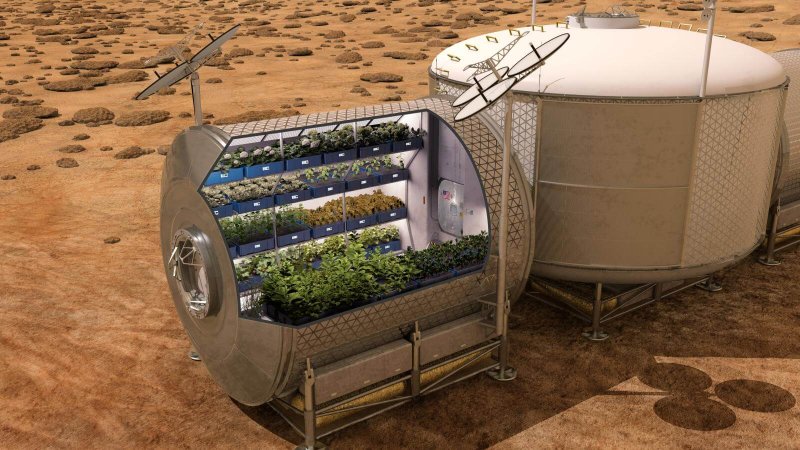
It takes 25,000 pounds of food to feed 4 astronauts on a 3 year mission to Mars. Here’s how ‘space farming’ might help feed them.

Credit: NASA
Credit: NASA

The biggest challenges is finding a way to feed crew members for the weeks, months and even years they spend in space.

Mis- and disinformation are distorting science and public policy. Subscribe to our Daily and Weekly Digests for incisive coverage of ‘disruptive’ innovations in AI, agricultural biotechnology, food, chemicals, nuclear energy, vaccines, and other disruptive innovations.

Rajkumar Hassamani, of the Institute of Agricultural Biotechnology at the University of Agricultural Sciences in India, told Al Jazeera Net in an emailed statement that according to NASA, “it costs between 20 and 20 to send a kilogram of packaged food to the International Space Station. 40 thousand dollars.”

…

Hosamani added, “According to an estimate, a crew of 4 would need 10 to 12 thousand kg of food for a 3-year journey, which is logistically impossible and not economically viable. Therefore, food production inside a ship “is necessary for long-duration space exploration missions in space or on the surface of a planet.”


…

Hossamani focuses on translating the results of space agriculture research into direct applications in terrestrial agriculture, and limits them to the following points:

  • Space agriculture research can help develop technologies that benefit the concept of a circular agricultural economy, as resource waste can be minimal or zero, and this has direct implications for conservation agriculture on Earth.
  • Space breeding is another application that comes directly from space agriculture research, and China has a dedicated space breeding program to help develop better varieties with higher yields, disease resistance, etc.
  • Breeding speed is another byproduct that helps plant breeders develop better varieties faster, reducing the time needed to breed new varieties.


This is an excerpt. Read the original post here

Related Articles

Infographic: Global regulatory and health research agencies on whether glyphosate causes cancer

Infographic: Global regulatory and health research agencies on whether glyphosate causes cancer

Does glyphosate—the world's most heavily-used herbicide—pose serious harm to humans? Is it carcinogenic? Those issues are of both legal and ...

Most Popular

ChatGPT-Image-Mar-10-2026-01_39_01-PM
Viewpoint—“Miracle molecule” debunked: Why acemannan supplements don’t work
Woman_Vaping_Electronic_Cigarette_50687233623
Trump administration clears the way for speedy approvals of once-restricted tobacco vapes and pouches
ChatGPT-Image-Sep-25-2026-11_36_56-AM
Now AI almost started a war with China
Screenshot-2026-09-17-at-1.07.08-PM
'We are dangerously addicted to antidepressants': Should we heed RFK Jr.’s sobering warning?
ChatGPT-Image-Sep-2-2026-02_03_32-PM
How much of a problem is AI’s water use?
Screenshot-2026-09-24-at-1.24.47-PM
80% of Americans take (mostly useless) supplements for their health
Screenshot-2026-09-16-at-10.27.33-AM
Viewpoint: SCOTUS poised to address First Amendment tension between mandatory vaccines, children’s health and religious freedom 
ChatGPT-Image-Sep-27-2026-10_00_17-AM
Current and future RFK Jr. aides criticize his science-rejectionist vaccine views
ChatGPT-Image-Sep-21-2026-11_54_00-AM
Viewpoint: Activist environmental NGOs are turning from public funding to activist billionaires to support their campaigns. It won’t end well.
ChatGPT-Image-Sep-23-2026-01_52_03-PM
Viewpoint: 4 very real AI doomsday scenarios
Screenshot-2026-09-16-at-2.26.42-PM
Viewpoint: How to ecologically damage America’s forests: Ban glyphosate
glp menu logo outlined

Get news on human & agricultural genetics and biotechnology delivered to your inbox.