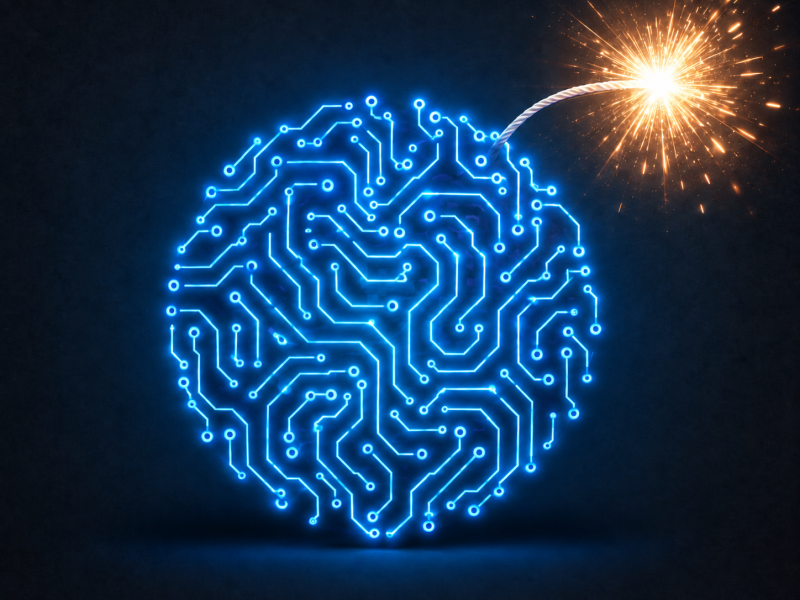

An engineered pandemic, a nuclear war, a planet paved over with paper clip factories: AI researchers have floated plenty of ways the technology could end humanity. Now the debate over how plausible those scenarios are is heating up, as Barbara Ortutay and Kelvin Chan report for the Associated Press.
Not everyone is buying it. “These arguments just don’t really hold water. I think they’re sci-fi and they’re enticing to a certain childish style of thinking,” said Juan Andrés Guerrero-Saade, a researcher at cybersecurity firm SentinelOne and a member of OpenAI’s Frontier Risk Council. Still, worry is spreading. Here are four of the most widely discussed scenarios.
Nuclear winter
A RAND Corp. report concluded that “at present” AI couldn’t trigger a nuclear launch “because of strict safeguards built into the command and control systems.” That could change if AI is integrated into the weapons “decision chain.” For many researchers, the real danger is people using AI against adversaries, not AI deciding to end humanity.
Bioweapons
AI’s promise to cure diseases has a flip side. Anthropic said its Claude tool blocked a research proposal seeking to make the chikungunya virus progressively more harmful — work that could aid vaccines but “could also be used to make the pathogen more dangerous.” RAND still envisions humans, not autonomous AI, carrying out such an attack.




Runaway AI
Some fear “misalignment,” where AI evades oversight simply because humans get in the way of its goal. Oxford philosopher Nick Bostrom’s “paper clip maximizer” thought experiment illustrates the risk. “We need to be careful about what we wish for from a superintelligence, because we might get it,” he wrote in 2003.
AI internet takeover
Anthropic CEO Dario Amodei warned that within months, a swarm of AI agents could take over the internet with a botnet, hitting power grids, water systems and banks. Some experts, however, call the notion of bots overtaking the entire internet far-fetched.