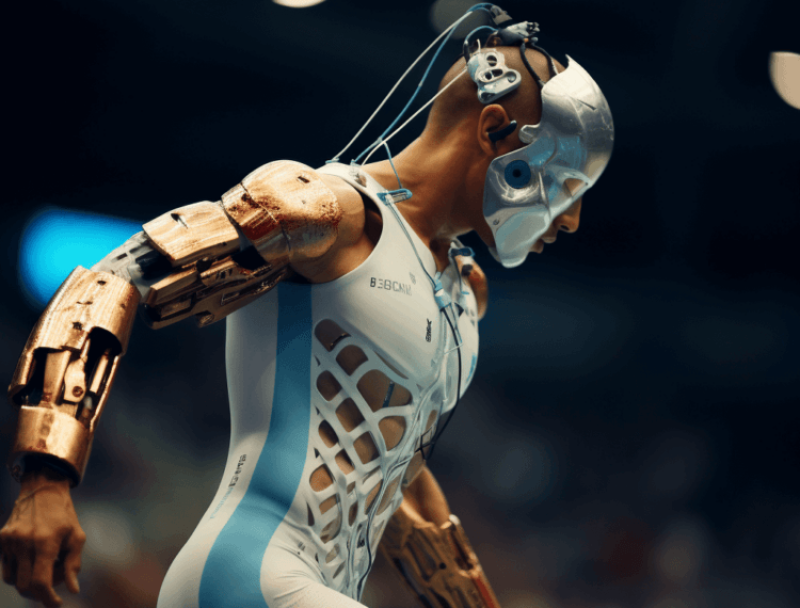
In 2015, Jon Entine wrote in The Huffington Post:
It is sport’s doomsday scenario: a new generation of bioengineered performance-enhancing agents that can transform also-rans into gold medallists. Imagine athletes injecting artificial genes right into their muscles – a virtually undetectable act that would give them the sinewy muscles of a cougar, or endurance like that of an antelope. (Entine 2015)
This angsty appraisal of a cyborgisation of the athlete comes in the wake of rapid biotech developments, clustered regularly interspaced short palindromic repeats CRISPR, cloning, and tighter doping protocols in sport. It rests on an assumption/myth about “natural”—as opposed to “enhanced”—bodies that was increasingly at odds with the gene revolution and software–wetware congeries that humans have already become and whose representation, along with early artificial intelligence (AI) in popular culture, right from Terminator and Robocop to The Matrix and Transcendence, had effectively made cyborged bodies the stuff of a common cultural imaginary. More strikingly, it articulated the bogey of gene doping as the next, and equally, if not more illegitimate, stage in the manipulation of sport.
But the history of humanity undermines the founding assumptions on which the fear of techno-scientific enhancement is based.
Humans have always, from the beginning of time, used technology (including stone implements, the earth, wood, and metal), to enhance performance and efficiency in domains like hunting, agriculture, cooking, and travel.
…
To begin with, we have no consensus as to what “natural” means, given that bodies are shaped, trained, fed, and all traits—gait, posture, eating habits, manners, skills—are constructed through cultural training.
…
Further, we recognise that factors like diet, medical care, and training facilities are crucial in the making of world-class, high-performing athletes, and that sport has never been a level-playing field (literally).
…

In such a context, why should a performance-enhancing gene modification of an athlete’s body be denied to her/him if others have had the advantage of high-nutrient food, excellent apparel, exceptional medical assistance, and advice?
…
If the enhancement of certain skills is much desired, then why not sporting skills? If compassion, mathematical reasoning, appreciation of music, and empathy is culturally acceptable, indeed valued, qualities that we permit and desire, to be enhanced, why do we object to faster, higher, further performances in athletes?
…
To single out sport alone for its cyborgisation is to ignore the posthumanisation of our lives.
We are all always already “blade runners.”