A new PNAS Nexus study led by scientists from the USDA Agricultural Research Service (USDA-ARS) and the University of Illinois Urbana-Champaign takes a retrospective look at glyphosate efficacy after the engineered crops were commercialized. Amassing data from annual herbicide evaluation trials at land-grant universities across the U.S. and Canada, the researchers show a significant and rapid decline in glyphosate control for all seven major weed species they examined.
“Our analysis represents one of the largest cumulative measures of how weed communities have adapted to the simplified weed management tactics adopted at an unprecedented scale throughout North America,” said Chris Landau, postdoctoral researcher for USDA-ARS and first author on the paper.
Although glyphosate provided superior weed control in the early years, most of the weeds in the dataset showed signs of adaptation to the chemical in just two to three years. Within a decade, weeds were up to 31.6% less responsive to glyphosate, with further linear declines as time went on.
“Nature did exactly what we were trying to help people avoid: it adapted,” said co-author Aaron Hager, professor and faculty Extension specialist in the Department of Crop Sciences and Illinois Extension, part of the College of Agricultural, Consumer and Environmental Sciences (ACES) at U. of I.
In addition to loss of control, glyphosate efficacy became more variable over time.
“When glyphosate-tolerant crops were first adopted, weed control was high in every environment; however, year after year glyphosate performance became less consistent,” said co-author Marty Williams, an ecologist with the USDA-ARS and affiliate professor of crop sciences. “For example, glyphosate provided nearly 100% control of a given species in most plots in the mid-1990s. But over time, acceptable weed control became rarer, often deteriorating below 50%, 30%, and worse.”
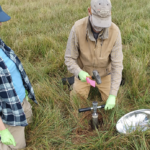
These patterns were derived from annual herbicide evaluation trials conducted at land-grant universities, usually in conjunction with their respective Extension services. These carefully managed trials test new and existing herbicides against numerous common and troublesome weed species. Most land-grant universities have multiple herbicide evaluation trials running statewide each year, with some continuously operating since the 1970s.
A couple of years ago, Landau, Hager, and Williams mined historical data from U. of I. herbicide evaluation trials to look at the effect of climate change on weed control in Illinois corn and soybean fields. When they decided to look at the history of the country’s most widely used herbicide, the team knew it would be more powerful to access data beyond Illinois. In cooperation with 24 institutions throughout North America, Landau compiled a massive database representing nearly 8 million observations from 1996 to 2021.
For the current study, Landau winnowed the data down to fields that tested glyphosate annually, alone or in combination with a pre-emergence herbicide. He also narrowed the target weeds to seven major players: annual and giant ragweed, horseweed, lambsquarter, Palmer amaranth, velvetleaf, and waterhemp. In the end, the dataset represented trial data from 11 institutions.
After documenting patterns of glyphosate control and variability over time, Landau re-ran the analysis for plots in which a pre-emergence herbicide had been applied before glyphosate. The results were strikingly different.


“Adding a pre-emergence herbicide effective against the target weed species significantly improved control and reduced variability of glyphosate over time,” Landau said. “The most we saw for any weed species was a 4.4% loss of control per decade, compared to 31.6% loss for glyphosate alone.”
Hager isn’t surprised. Along with several U. of I. colleagues, he has been cautioning against reliance on any single chemistry for 15 years. His 2008 recommendation aimed at avoiding glyphosate resistance included guidance to use a pre-emergence herbicide at the full rate. Far from common practice at the time, the recommendation was largely ignored.
“Having already seen loss of control with ALS- and PPO-inhibitors [other classes of herbicides], we eventually reached the point where we felt it necessary to come out with some very specific recommendations for glyphosate. Because if we didn’t, we had a pretty good idea of where this was going to end up,” Hager said. “And, unfortunately, we were right.”
The dataset for glyphosate can only show patterns, not explanations. While herbicide resistance might be to blame — the issue has become a major problem in agricultural weeds in recent decades — it’s not the only reason glyphosate may have loosened its grip.
Landau noted that two species he tracked in the analysis — velvetleaf and lambsquarter — have not yet had a confirmed case of glyphosate resistance anywhere in the world. Yet both followed the same trends as glyphosate-resistant species in the dataset. He said herbicide pressure — or concurrent climate changes — over the past 25 years may have selected for larger leaf area or earlier emergence, both of which could help weeds survive glyphosate.
Regardless of the mechanism, the pattern is clear: silver bullets for weed control don’t exist. The researchers urge diversification in chemistries, including soil- and foliar-applied products; crop rotation patterns; and mechanical controls.
And if another silver bullet is marketed in the future? Hager says the glyphosate story should serve as a cautionary tale.
“Let’s imagine a company says they have the next silver bullet. It’s going to enjoy a huge market share almost instantaneously. But it needs to come with a stewardship plan to better preserve that chemistry over time,” he said. “Why would we think nature would behave any differently? It won’t.”
The study, “The silver bullet that wasn’t: Rapid agronomic weed adaptations to glyphosate in North America,” is published in PNAS Nexus [DOI:10.1093/pnasnexus/pgad338]. Landau and Williams are with the Global Change and Photosynthesis Research Unit of USDA ARS, which supported the study.