“What we have found, essentially, is a biological signature of desire that helps us explain why we want to be with some people more than other people,” said senior author Zoe Donaldson, associate professor of behavioral neuroscience at CU Boulder.
The study, published Jan. 12 in the journal Current Biology, centers around prairie voles, which have the distinction of being among the 3% to 5% of mammals that form monogamous pair bonds.
Like humans, these fuzzy, wide-eyed rodents tend to couple up long-term, share a home, raise offspring together, and experience something akin to grief when they lose their partner.
By studying them, Donaldson seeks to gain new insight into what goes on inside the human brain to make intimate relationships possible and how we get over it, neurochemically speaking, when those bonds are severed.
The new study gets at both questions, showing for the first time that the neurotransmitter dopamine plays a critical role in keeping love alive.
“As humans, our entire social world is basically defined by different degrees of selective desire to interact with different people, whether it’s your romantic partner or your close friends,” said Donaldson. “This research suggests that certain people leave a unique chemical imprint on our brain that drives us to maintain these bonds over time.”
How love lights up the brain
For the study, Donaldson and her colleagues used state-of-the art neuroimaging technology to measure, in real time, what happens in the brain as a vole tries to get to its partner. In one scenario, the vole had to press a lever to open a door to the room where her partner was. In another, she had to climb over a fence for that reunion.
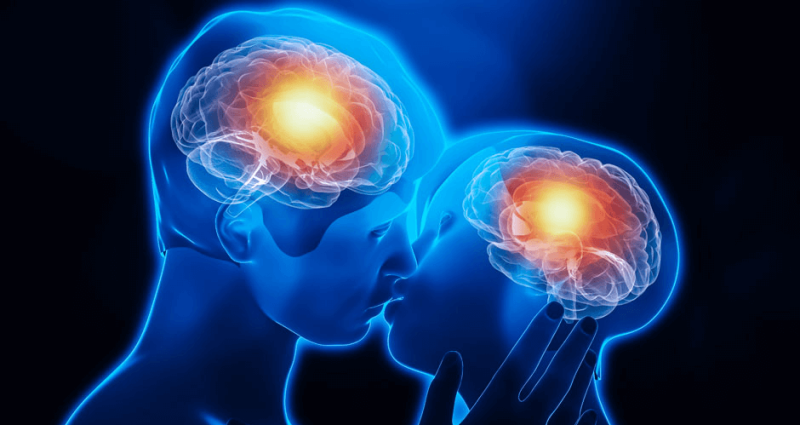
Meanwhile a tiny fiber-optic sensor tracked activity, millisecond by millisecond, in the animal’s nucleus accumbens, a brain region responsible for motivating humans to seek rewarding things, from water and food to drugs of abuse. (Human neuroimaging studies have shown it is the nucleus accumbens that lights up when we hold our partner’s hand.)
Each time the sensor detects a spurt of dopamine, it “lights up like a glow stick,” explained first-author Anne Pierce, who worked on the study as a graduate student in Donaldson’s lab. When the voles pushed the lever or climbed over the wall to see their life partner, the fiber “lit up like a rave,” she said. And the party continued as they snuggled and sniffed one another.

In contrast, when a random vole is on the other side of that door or wall, the glow stick dims. (In a previous study, when dopamine was diminished, she didn’t try as hard to reunite, either.)
“This suggests that not only is dopamine really important for motivating us to seek out our partner, but there’s actually more dopamine coursing through our reward center when we are with our partner than when we are with a stranger,” said Pierce.
Hope for the heartbroken
In another experiment, the vole couple was kept apart for four weeks—an eternity in the life of a rodent—and long enough for voles in the wild to find another partner.
When the couple was reunited, they remembered one another, but their signature dopamine surge had almost vanished. In essence, that fingerprint of desire was gone. As far as their brains were concerned, their former partner was indistinguishable from any other vole.
“We think of this as sort of a reset within the brain that allows the animal to now go on and potentially form a new bond,” Donaldson said.
This could be good news for humans who have undergone a painful breakup, or even lost a spouse, suggesting the brain has an inherent mechanism to protect us from endless unrequited love.
The authors stress that more research is necessary to determine how well results in voles translate to their bigger-brained, two-legged counterparts. But they believe their work could ultimately have important implications for people who either have trouble forming close relationships or those who struggle to get over loss—a condition known as prolonged grief disorder.
“The hope is that by understanding what healthy bonds look like within the brain, we can begin to identify new therapies to help the many people with mental illnesses that affect their social world,” said Donaldson.