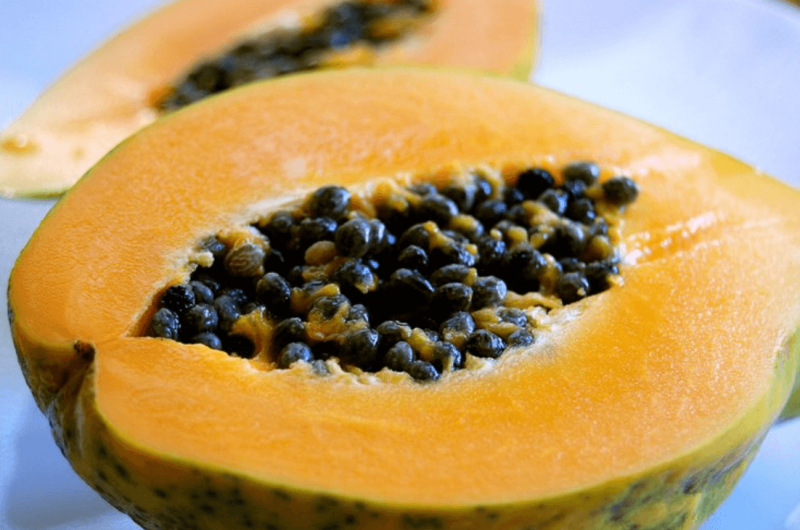
Papaya production faces various viruses, with over ten different strains reported worldwide. However, a few, such as the Papaya ringspot virus (PRSV), the Papaya leaf distortion mosaic virus (PLDMV), the Papaya lethal yellowing virus (PLYV), the Papaya mosaic virus (PapMV), and the Papaya Meleira Virus (PMeV), stand out due to their devastating impact on crop production. For instance, during the economic cycle of the crop in orchards where rogueing is performed, the PMeV infection may affect 20% of the plants. If the phytosanitary protocols are not implemented, it can affect up to 100% of the plants, causing a total yield loss.
Papaya production and importance
Papaya, scientifically known as Carica papaya, is the third most cultivated tropical crop worldwide for its fruit, papain, pectin, and antibacterial substances. Among common fruits, papaya is ranked first on nutritional scores for the percentage of vitamin A, vitamin C, potassium, folate, niacin, thiamine, riboflavin, iron and calcium, and fiber. Commercial production of papain is directed for protein digestion, mainly as a red meat tenderizer, for the brewing of beer, and the skin treatment of warts and scars.
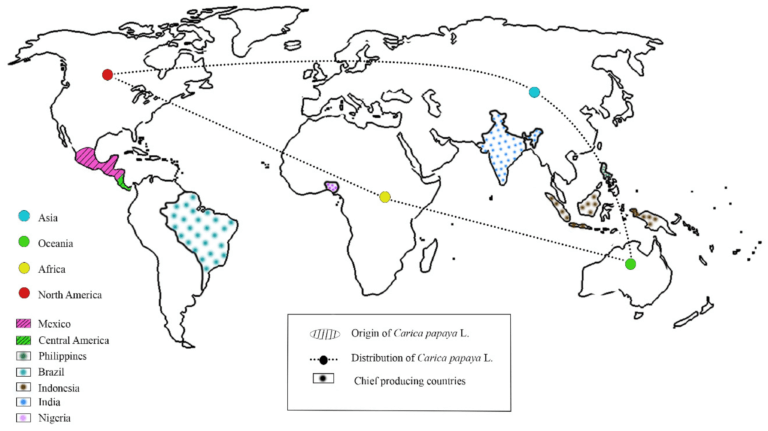
The production of this tropical fruit tree originated in Mesoamerica region (Figure 1) and is vital to the economies of especially Latin American and Caribbean (LAC) countries such as Brazil and Mexico. In 2021, Brazil produced a staggering 1.25 million tons of papaya, contributing approximately 9% of the world’s supply. Mexico, on the other hand, serves as a major exporter to the USA, cultivating 19,500 hectares of papaya in 2021. Together, those two countries are responsible for 17% of the world’s production of papaya which not only holds economic significance but also sustains countless smallholder farmers in both countries.
Papaya sticky disease
Papaya Sticky Disease (PSD) or “meleira” is a viral infection caused by the presence of two viruses known as Papaya Meleira Virus (PMeV) and Papaya Meleira Virus 2 (PMev2). The disease was first reported in Brazil in the 1980s, followed by Mexico in 2008. Australia also reported PSD in 2014 and in 2021, papaya trees exhibiting PSD-like symptoms were observed in Ecuador. This disease renders papaya fruits commercially unacceptable due to its adverse effects on texture and flavor, effectively prohibiting their exportation to international markets.
Plants affected by PSD are characterized by the spontaneous exudation of fluid and latex from the fruit and leaves (Figure 2). Upon exposure to the atmosphere, the latex oxidizes, resulting in small necrotic lesions on young leaves and a sticky appearance of the fruit, hence the disease’s name.
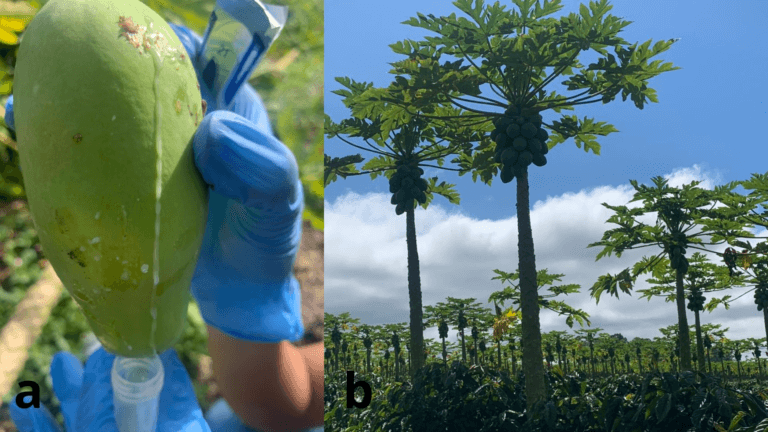
a) Latex exudation on infected papaya; b) C. papaya plantation infected with PMeV in Linhares, ES – Brazil
The challenge of diagnosis and management
Detecting the initial symptoms of Papaya Sticky Disease is challenging, as they typically appear in plants that are 6 to 9 months old depending on the papaya variety. The source of inoculum, whether from seeds, alternative hosts, or vectors, plays a crucial role in the health of papaya seedlings and the onset of disease incidence. Moreover, the transmission mode of the viruses remains unclear.

Despite extensive efforts in Brazil and Mexico, identifying a papaya genotype resistant to PSD remains elusive. Symptoms only manifest after flowering, allowing infected but asymptomatic plants to go undetected for months, acting as hidden sources of inoculum until their eventual discovery and removal. Consequently, rogueing, or the systematic removal of infected plants, remains the primary strategy for controlling this viral disease.
Gene-editing technology
Gene editing technology, such as CRISPR-Cas9, holds immense promise in mitigating the challenges posed by PSD in papaya cultivation. Scientists have already made significant strides by genetically editing C. papaya to confer resistance to Papaya Ringspot Virus.
The Laboratory of Biotechnology Applied to Agribusiness (LBAA) at the Federal University of Espírito Santo (Brazil) is the leading group on PMeV and PMeV2 research. In collaboration with Incaper (Capixaba Institute for Research, Technical Assistance and Rural Extension, from Portuguese Instituto Capixaba de Pesquisa, Assistência Técnica e Extensão Rural), LBAA is already working on the development of a C. papaya resistant to PMeV using the gene editing technology of CRISPR-Cas9.
The timeline for the release of a papaya resistant to PSD to the market remains uncertain, but CRISPR-Cas9 technology offers a swifter and more cost-effective approach than traditional methods. While traditional breeding could span decades, CRISPR-Cas9 can achieve results in months. Furthermore, this gene editing technique often produces crops not classified as GMOs in many countries, bypassing time-consuming regulations.
This breakthrough offers a beacon of hope for the papaya industry in Brazil, Mexico and beyond. By making specific genetic editing that enhance the plant’s natural defenses against PMeV, researchers are providing a sustainable and environmentally friendly solution to combat this devastating disease. As we navigate the battle against plant viruses, gene editing emerges as a powerful ally in our quest to safeguard global food security.
Dr. Luiza Favarato Santos is a microbiologist with a Ph.D. in Biotechnology from the Federal University of Espírito Santo. Follow Dr. Favarato on LinkedIn
A version of this article was originally posted at Sustainable Agriculture Innovation & Food and has been reposted here with permission. Any reposting should credit the original author and provide links to both the GLP and the original article. Find Sustainable Agriculture Innovation & Food on X @SAIFood_blog