What is ‘menopause brain’? Imaging shows dramatic structural changes in midlife that can impact behavior

lisa mosconi menopause brain
Lisa Mosconi. Credit: Flow Space

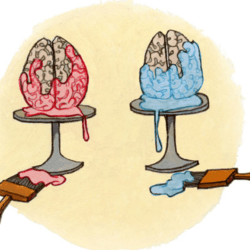
For decades, some doctors have told women that the brain fog, insomnia and mood swings they experience in midlife are “all in their heads.” Now, emerging brain research shows they’re right — but not because women are imagining it.

Brain imaging studies of women — conducted before, during and after menopause — reveal dramatic physical changes in structure, connectivity and energy metabolism. These changes are not only visible on the scans, but many women can also feel them, said Lisa Mosconi, a neuroscientist and author of the book “The Menopause Brain.”

Follow the latest news and policy debates on sustainable agriculture, biomedicine, and other ‘disruptive’ innovations. Subscribe to our newsletter.

Mosconi and her colleagues have been imaging women’s brains and have found that gray matter volume is reduced in areas of the brain involved in attention, concentration, language and memory. There also are changes in connectivity, meaning some areas involved in reproductive functions become less connected, while other regions become more connected. And there are declines in brain energy levels, meaning the brain pulls glucose from the bloodstream and does not burn it as fast or, perhaps, as efficiently as it used to, Mosconi said.

It is not known whether there is a way to prevent, stop or reverse the changes that occur in the brain during menopause, but at least some of them appear to be temporary. When Mosconi and her colleagues followed up with participants two years later, they found that metabolic activity tends to stabilize in some regions of the brain and that gray matter volume can rebound for some — but not all — women after menopause.


This is an excerpt. Read the original post here

{{ reviewsTotal }}{{ options.labels.singularReviewCountLabel }}
{{ reviewsTotal }}{{ options.labels.pluralReviewCountLabel }}
{{ options.labels.newReviewButton }}
{{ userData.canReview.message }}

Related Articles

Infographic: Global regulatory and health research agencies on whether glyphosate causes cancer

Infographic: Global regulatory and health research agencies on whether glyphosate causes cancer

Does glyphosate—the world's most heavily-used herbicide—pose serious harm to humans? Is it carcinogenic? Those issues are of both legal and ...

Most Popular

Screenshot-2026-05-01-at-1.29.41-PM
Viewpoint: What happens when whole grains meet modern food manufacturing? Labels don’t tell the whole story.
S
As vaccine rejectionism spreads, measles may be taking a more dangerous turn
Screenshot 2026-05-06 at 2.56
Singularity crisis ahead? Can super babies save us from rogue AI geniuses?
Screenshot-2026-05-06-at-2.07.43-PM
Manufacturing a conspiracy: The timeline of how  the White House embraced the fringe claim that scientists are being mysteriously murdered
Screenshot-2026-03-13-at-12.14.04-PM
The FDA wants to make many popular prescription drugs OTC—a great idea. Here’s why it’s unlikely to happen
Screenshot-2026-04-20-at-2.26.27-PM
Viewpoint — Food-fear world: The latest activist scientists campaign: Cancer-causing additives
Screenshot-2026-04-30-at-2.19.37-PM
5 myths about summer dehydration that could damage your health — or even kill you
ChatGPT-Image-May-6-2026-03_41_05-PM
‘Protecting the integrity of science’: Kennedy’s FDA blocks release of taxpayer-funded studies finding COVID and shingles vaccines safe
Screenshot-2026-05-01-at-11.56.24-AM
‘Science moves forward when people are willing to think differently’: Memories of DNA maverick Craig Venter
79d03212-2508-45d0-b427-8e9743ff6432
Viewpoint: The Casey Means hustle—Wellness woo opportunism dressed up as medical wisdom
Screenshot 2026-05-06 at 12.49
Immortal dragons: The quest to ‘make death optional’
glp menu logo outlined

Get news on human & agricultural genetics and biotechnology delivered to your inbox.