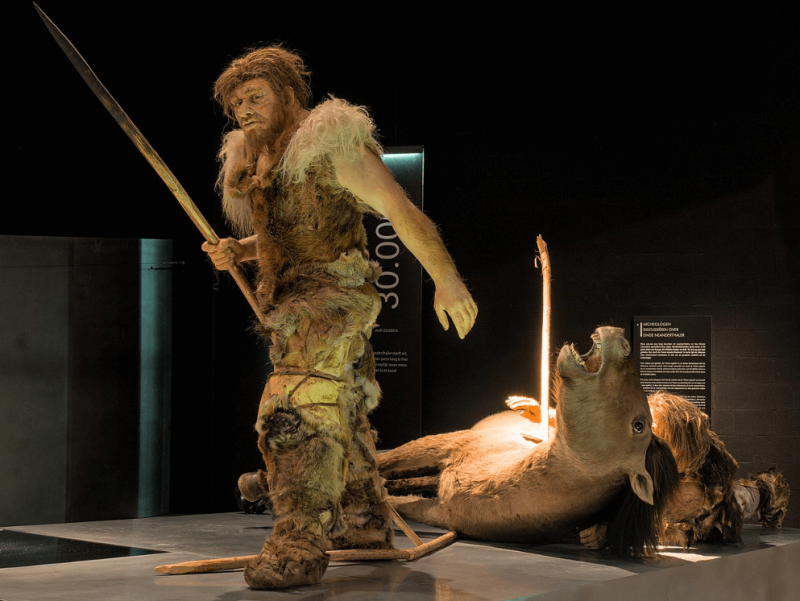
Neanderthals had big brains, language and sophisticated tools. They made art and jewellery. They were smart, suggesting a curious possibility. Maybe the crucial differences weren’t at the individual level, but in our societies.
Two hundred and fifty thousand years ago, Europe and western Asia were Neanderthal lands. Homo sapiens inhabited southern Africa. Estimates vary but perhaps 100,000 years ago, modern humans migrated out of Africa.
Forty thousand years ago Neanderthals disappeared from Asia and Europe, replaced by humans. Their slow, inevitable replacement suggests humans had some advantage, but not what it was.
Anthropologists once saw Neanderthals as dull-witted brutes. But recent archaeological finds show they rivalled us in intelligence.
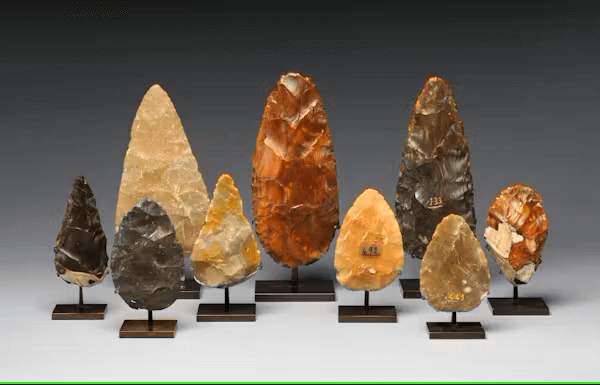
Neanderthals mastered fire before we did. They were deadly hunters, taking big game like mammoths and woolly rhinos, and small animals like rabbits and birds.
They gathered plants, seeds and shellfish. Hunting and foraging all those species demanded deep understanding of nature.
Neanderthals also had a sense of beauty, making beads and cave paintings. They were spiritual people, burying their dead with flowers.
Stone circles found inside caves may be Neanderthal shrines. Like modern hunter-gatherers, Neanderthal lives were probably steeped in superstition and magic; their skies full of gods, the caves inhabited by ancestor-spirits.
Then there’s the fact Homo sapiens and Neanderthals had children together. We weren’t that different. But we met Neanderthals many times, over many millennia, always with the same result. They disappeared. We remained.
The hunter-gatherer society
It may be that the key differences were less at the individual level than at the societal level. It’s impossible to understand humans in isolation, any more than you can understand a honeybee without considering its colony. We prize our individuality, but our survival is tied to larger social groups, like a bee’s fate depends on the colony’s survival.

Modern hunter-gatherers provide our best guess at how early humans and Neanderthals lived. People like the Namibia’s Khoisan and Tanzania’s Hadzabe gather families into wandering bands of ten to 60 people. The bands combine into a loosely organised tribe of a thousand people or more.
These tribes lack hierachical structures, but they’re linked by shared language and religion, marriages, kinships and friendships. Neanderthal societies may have been similar but with one crucial difference: smaller social groups.
Tight-knit tribes
What points to this is evidence that Neanderthals had lower genetic diversity.
In small populations, genes are easily lost. If one person in ten carries a gene for curly hair, then in a ten-person band, one death could remove the gene from the population. In a band of fifty, five people would carry the gene – multiple backup copies. So over time, small groups tend to lose genetic variation, ending up with fewer genes.
In 2022, DNA was recovered from bones and teeth of 11 Neanderthals found in a cave in the Altai Mountains of Siberia. Several individuals were related, including a father and a daughter – they were from a single band. And they showed low genetic diversity.



Because we inherit two sets of chromosomes – one from our mother, one from our father – we carry two copies of each gene. Often, we have two different versions of a gene. You might get a gene for blue eyes from your mother, and one for brown eyes from your father.
But the Altai Neanderthals often had one version of each gene. As the study reports, that low diversity suggests they lived in small bands – probably averaging just 20 people.
It’s possible Neanderthal anatomy favoured small groups. Being robust and muscular, Neanderthals were heavier than us. So each Neanderthal needed more food, meaning the land could support fewer Neanderthals than Homo sapiens.
And Neanderthals may have mainly eaten meat. Meat-eaters would get fewer calories from the land than people who ate meat and plants, again leading to smaller populations.
Group size matters
If humans lived in bigger groups than Neanderthals it could have given us advantages.
Neanderthals, strong and skilled with spears were likely good fighters. Lightly built humans probably countered by using bows to attack at range.
But even if Neanderthals and humans were equally dangerous in battle, if humans also had a numeric advantage they could bring more fighters and absorb more losses.
Big societies have other, subtler advantages. Larger bands have more brains. More brains to solve problems, remember lore about animals and plants, and techniques for crafting tools and sewing clothing. Just as big groups have higher genetic diversity, they’ll have higher diversity of ideas.
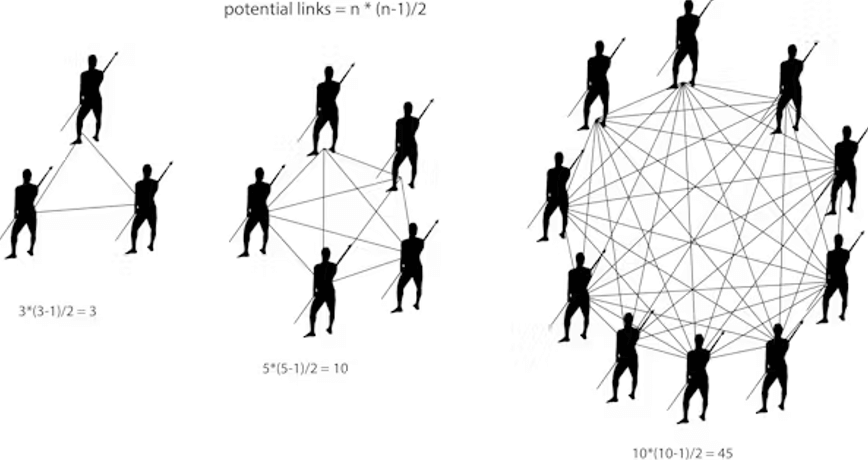
And more people means more connections. Network connections increase exponentially with network size, following Metcalfe’s Law. A 20-person band has 190 possible connections between members, while 60 people have 1770 possible connections.
Information flows through these connections: news about people and movements of animals; toolmaking techniques; and words, songs and myths. Plus the group’s behaviour becomes increasingly complex.
Consider ants. Individually, ants aren’t smart. But interactions between millions of ants lets colonies make elaborate nests, forage for food and kill animals many times an ant’s size. Likewise, human groups do things no one person can – design buildings and cars, write elaborate computer programmes, fight wars, run companies and countries.
Humans aren’t unique in having big brains (whales and elephants have these) or in having huge social groups (zebras and wildebeest form huge herds). But we’re unique in combining them.
To paraphrase poet John Dunne, no man – and no Neanderthal – is an island. We’re all part of something larger. And throughout history, humans formed larger and larger social groups: bands, tribes, cities, nation states, international alliances.
It may be then that an ability to build large social structures gave Homo sapiens the edge, against nature, and other hominin species.
enior Lecturer in Paleontology and Evolutionary Biology in the department of Life Sciences at the University of Bath. Follow Nicholas on X @NickLongrich