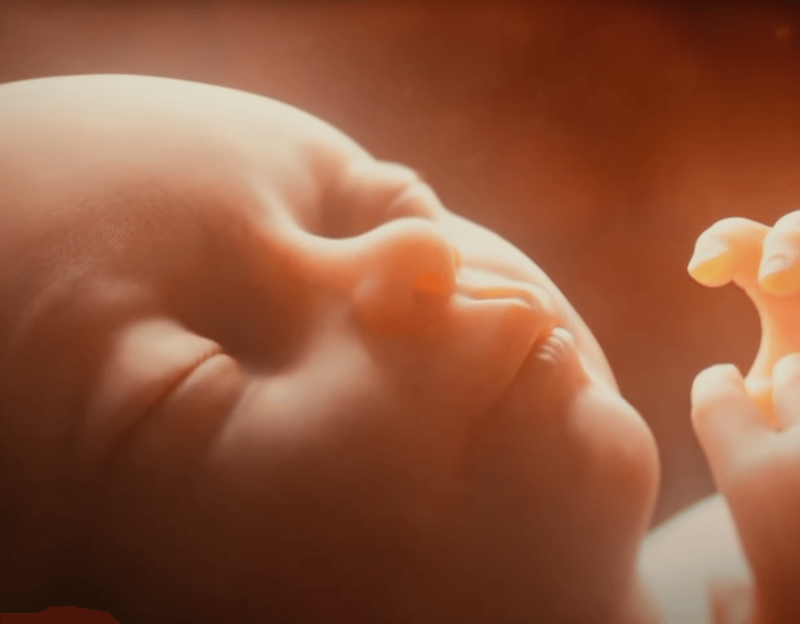
Some restless infants don’t wait for birth to let out their first cry. They cry in the womb, a rare but well-documented phenomenon called vagitus uterinus (from the Latin word vagire, meaning to wail).
…
Vagitus uterinus occurs – always in the last trimester – when there’s a tear in the uterine membrane. The tear lets air into the uterine cavity, thus enabling the fetus to vocalise. Vagitus uterinus provided scientists with some of the earliest insights into the fetus’s vocal apparatus, showing that the body parts and neural systems involved in the act of crying are fully functional before birth.
…

In fact, newborns cry in the accent of their mother tongue. They make vowel-like sounds, growl and squeal – these are protophones, sounds that eventually turn into speech.
Babies communicate as soon as they are born. Rigorous analyses of the developmental origins of these behaviours reveal that, contrary to popular belief – even among scientists – they are not hardwired into our brain structures or preordained by our genes. Instead, the latest research – including my own – shows that these behaviours self-organise in utero through the continuous dance between brain, body and environment.