In his own words: Controversial CRISPR Chinese scientist He Jiankui says he will continue to gene edit human embryos — nonviable ones this time

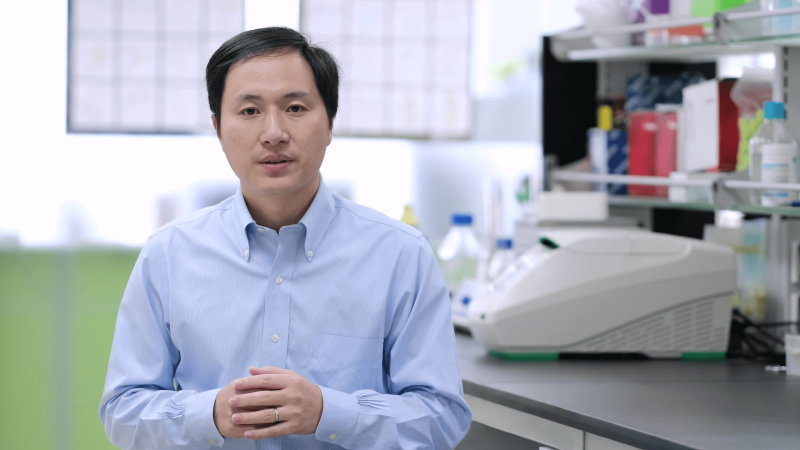
He Jiankui. Credit: Wikimedia

Back in 2018, it was my colleague Antonio Regalado, senior editor for biomedicine, who broke the story that a Chinese scientist named He Jiankui had used CRISPR to edit the genes of live human embryos, leading to the first gene-edited babies in the world. The news made He (or JK, as he prefers to be called) a controversial figure across the world, and just a year later, he was sentenced to three years in prison by the Chinese government, which deemed him guilty of illegal medical practices.

[July 25], JK, who was released from prison in 2022, sat down with Antonio and Mat Honan, our editor in chief, for a live broadcast conversation on the experiment, his current situation, and his plans for the future.

Follow the latest news and policy debates on sustainable agriculture, biomedicine, and other ‘disruptive’ innovations. Subscribe to our newsletter.

During the MIT Technology Review conversation, JK confirmed that he’s currently in Hainan and working on using gene-editing technology to cure genetic diseases like Duchenne muscular dystrophy (DMD).

He’s currently funded by private donations from Chinese and American companies, although he refused to name them. Some have even offered to pay him to travel to obscure countries with lax regulations to continue his previous work, but he turned them down. He would much prefer to return to academia to do research, JK said, but he can still conduct scientific research at a private company.

For now, he’s planning to experiment only on mice, monkeys, and nonviable human embryos, JK said.

His experiment in 2018 inspired China to come out with regulations that explicitly forbid gene editing for reproductive uses. Today, implanting an edited embryo into a human is a crime subject to up to seven years in prison. JK repeatedly said all his current work will “comply with all the laws, regulations, and international ethics” but shied away from answering a question on what he thinks regulation around gene editing should look like.


This is an excerpt. Read the original post here

{{ reviewsTotal }}{{ options.labels.singularReviewCountLabel }}
{{ reviewsTotal }}{{ options.labels.pluralReviewCountLabel }}
{{ options.labels.newReviewButton }}
{{ userData.canReview.message }}

Related Articles

Infographic: Global regulatory and health research agencies on whether glyphosate causes cancer

Infographic: Global regulatory and health research agencies on whether glyphosate causes cancer

Does glyphosate—the world's most heavily-used herbicide—pose serious harm to humans? Is it carcinogenic? Those issues are of both legal and ...

Most Popular

Screenshot-2026-04-22-at-12.21.32-PM
Viewpoint: Why the retracted Monsanto glyphosate study doesn’t change the science—the world’s most popular herbicide is safe 
Picture1
The FDA couldn’t find a vaccine safety crisis, so it buried its own research
ChatGPT-Image-May-1-2026-11_42_59-AM-2
Viewpoint: NAD is the wellness grifters latest evidence-lite longevity fad. At least the mice are impressed.
ChatGPT-Image-Apr-16-2026-02_56_53-PM
Financial incentives, over diagnosis, and weak oversight: Autism claims are driving up Medicare costs
global warming
‘Implausible’: Top climate scientists reject worst-case scenario—soaring temperatures and fast-rising sea levels
ChatGPT-Image-May-12-2026-11_27_01-AM-2
AI likely to improve health care, research shows—but not for blacks and ethnic minorities
ChatGPT-Image-May-7-2026-01_23_27-PM-2
Viewpoint: Will AI democratize personalized cancer treatment or fuel medical misinformation?
vax-misinformation-main
Facts & Fallacies Podcast: Limit free speech to blunt social media misinfo?

Sorry. No data so far.

glp menu logo outlined

Get news on human & agricultural genetics and biotechnology delivered to your inbox.