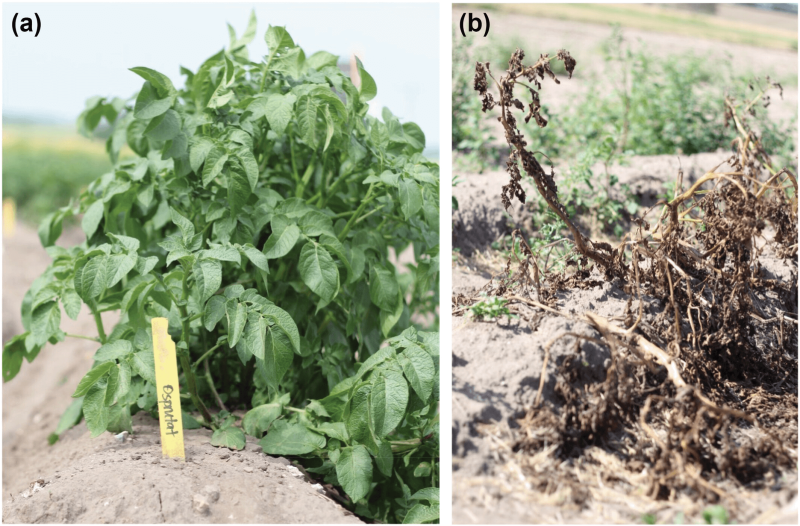

Can modern breeding technologies, such as genome editing, contribute to reduced pesticide usage? This question has been accentuated by a recent legal proposal to exempt genome-edited plants from the strict regulations applied to classical genetically modified (GM) crops within the European Union (EU). Using official statistics on crop cultivation and pesticide usage for two example crops commonly grown in Sweden, we calculate that cereal farmers collectively could save up to 70 million € in pesticide usage for wheat alone and that a late blight-resistant potato could reduce pesticide usage by over 80% provided that the EU legislation is amended.
…
NGT plants can contribute to reduced pesticide usage but also that the required number of loci that need to be modified can be quite high, especially in polyploid species. In order to increase the longevity of—genes, the genes should be stacked, possibly combining three R-genes per pathogen. Hence, if we want to make a potato resistant against the major diseases outlined above, we would need to introduce at least nine modifications
It should be noted that there are no technical limitations to the number of modifications that can be induced in a crop, and efficient methods have been developed to induce multiple mutations using one CRISPR/Cas9 construct….
…



However, the EC recommends a maximum of 20 targeted mutations for category 1 NGT plants. This limit may pose a challenge for polyploid crops, such as crops like wheat or potato….
…
The NGT legislative proposal holds the promise to facilitate the implementation of NGT crops in European agriculture. However, several technical limitations in the proposal will, if implemented, hamper that development. To account for differences in genome size and complexity among different plant species, we urge legislators to count the maximum number of allowed changes for a category 1 NGT plant per basic set of chromosomes, allowing for an increased number of modifications in polyploid species.