Are weeds destined to win their escalating assault on agriculture?

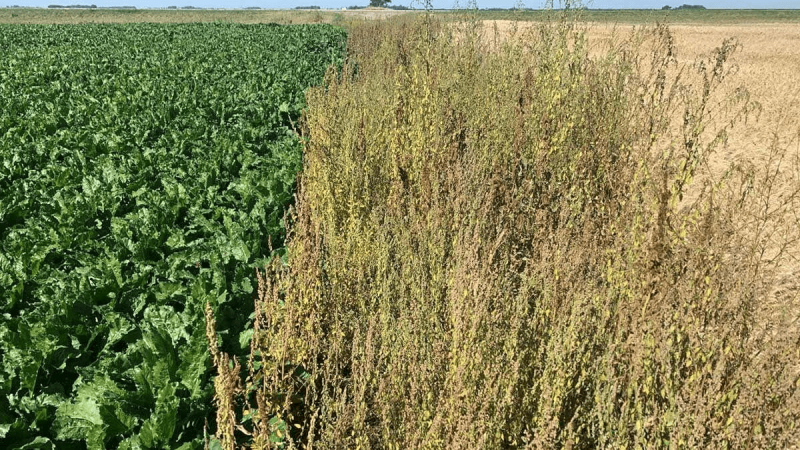
Weeds along edges of neighboring fields in Norman County, Minn.
Credit: AgUpdate/University of Minnesota
Weeds along edges of neighboring fields in Norman County, Minn. Credit: AgUpdate/University of Minnesota

Since the 1980s, more and more plants have evolved to become immune to the biochemical mechanisms that herbicides leverage to kill them. This herbicidal resistance threatens to decrease yields—out-of-control weeds can reduce them by 50% or more, and [in] extreme cases can wipe out whole fields. At worst, it can even drive farmers out of business.

Water hemp (Amaranthus tuberculatus), which can infest just about any kind of crop field, … has burst forth in much greater abundance over the last few years, because it has become resistant to seven different classes of herbicides. Season-long competition from water hemp can reduce soybean yields by 44% and corn yields by 15%, according to Purdue University Extension.

Follow the latest news and policy debates on sustainable agriculture, biomedicine, and other ‘disruptive’ innovations. Subscribe to our newsletter.

“We really need a fundamental change in weed control, and we need it quick, ’cause the weeds have caught up to us,” says Larry Steckel, a professor of plant sciences at the University of Tennessee. “It’s come to a pretty critical point.”


This is an excerpt. Read the original post here

{{ reviewsTotal }}{{ options.labels.singularReviewCountLabel }}
{{ reviewsTotal }}{{ options.labels.pluralReviewCountLabel }}
{{ options.labels.newReviewButton }}
{{ userData.canReview.message }}

Related Articles

Infographic: Global regulatory and health research agencies on whether glyphosate causes cancer

Infographic: Global regulatory and health research agencies on whether glyphosate causes cancer

Does glyphosate—the world's most heavily-used herbicide—pose serious harm to humans? Is it carcinogenic? Those issues are of both legal and ...

Most Popular

Screenshot-2026-05-01-at-1.29.41-PM
Viewpoint: What happens when whole grains meet modern food manufacturing? Labels don’t tell the whole story.
S
As vaccine rejectionism spreads, measles may be taking a more dangerous turn
Screenshot 2026-05-06 at 2.56
Singularity crisis ahead? Can super babies save us from rogue AI geniuses?
Screenshot-2026-05-06-at-2.07.43-PM
Manufacturing a conspiracy: The timeline of how  the White House embraced the fringe claim that scientists are being mysteriously murdered
Screenshot-2026-04-20-at-2.26.27-PM
Viewpoint — Food-fear world: The latest activist scientists campaign: Cancer-causing additives
Screenshot-2026-03-13-at-12.14.04-PM
The FDA wants to make many popular prescription drugs OTC—a great idea. Here’s why it’s unlikely to happen
Screenshot-2026-04-30-at-2.19.37-PM
5 myths about summer dehydration that could damage your health — or even kill you
ChatGPT-Image-May-6-2026-03_41_05-PM
‘Protecting the integrity of science’: Kennedy’s FDA blocks release of taxpayer-funded studies finding COVID and shingles vaccines safe
Screenshot 2026-05-06 at 12.49
Immortal dragons: The quest to ‘make death optional’
Screenshot-2026-05-01-at-11.56.24-AM
‘Science moves forward when people are willing to think differently’: Memories of DNA maverick Craig Venter
glp menu logo outlined

Get news on human & agricultural genetics and biotechnology delivered to your inbox.