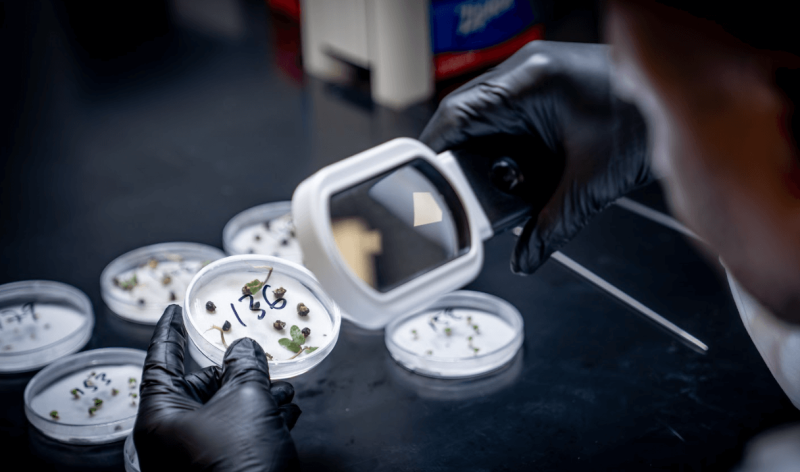
Not surprisingly, some weeds have been able to adapt to modern weed control techniques. Just as there were certain weeds that were still able to persist in a strictly mechanical weed control setting, some weeds have evolved the ability to tolerate chemical herbicides. This is just biology and analogous to the issue of antibiotic resistance in human health. In some cases, those new, herbicide-tolerant lines of the weed can be controlled with another herbicide that acts through a different “mode of action” but some weeds are now developing resistance to multiple different “modes of action.” This is making it more difficult for farmers to continue with their minimum- and no-till systems that protect and improve soil. In the meantime, companies have found discovering new modes of action very time-consuming and expensive. There has been a drought of truly new “modes of action” options for a farmer’s “toolbox” for controlling the most problematic, herbicide-tolerant species.
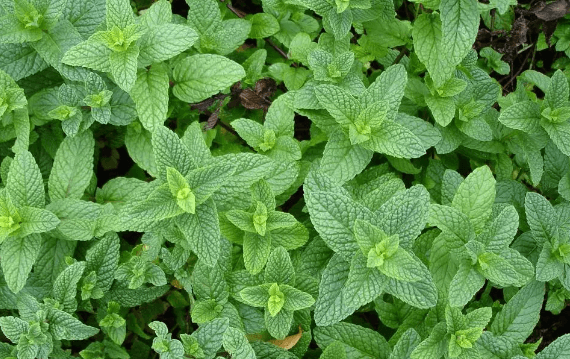
There is a company called Harpe Bioherbicide Solutions, Inc., has found a novel way to address this issue of herbicide tolerance. They have been working with combinations from among a series of natural chemicals derived from various species of mint – a plant family that produces a very interesting collection of compounds which humans value for their flavor and odor properties. At higher concentrations some of these mint ingredients can act as herbicides and directly kill a weed or weed seed. But at lower concentrations they can alter the permeability or metabolism of plant cells in such a way that a weed that had once been able to tolerate a certain herbicide is no longer able to do so if the herbicide and the mint-based chemical are applied in combination.
For a farmer this can mean restoring the utility of a key herbicide that enables their more soil-friendly farming system. The Harpe Bioherbcide approach also has a significant advantage with regard to the steps that are required to gain the regulatory approval needed from the EPA. Bringing at completely new synthetic chemical to market can takes 12 years and costs more than $300 million. The percentage of those costs that are regulatory approvals has grown rapidly to almost 14%. (source: CropLife). Because many of the chemicals that a mint plant produces are already part of our food supply, they qualify for what is known as GRAS status – Generally Regarded as Safe. For natural chemicals that fall in that category there is a fast-track in the EPA regulatory process called “25B”, or “Reduced Risk” and this can mean that this technology could become available to farmers relatively soon and at a reasonable cost.

While the regulatory path is promising, the development of this technology involves some very challenging complexity. The synergistic interaction of specific herbicides with specific mint extracts gives Harpe Bio the basis for patent coverage, but it also means that they have to work out which specific mixtures will be most effective for which herbicide tolerant weeds at what stage of their growth. The products they sell may need to be suitable for “tank mixing” with other chemicals and spray adjuvants that a farmer may been to apply in the same spray pass. While some of this can be worked out in greenhouse tests – the ultimate product and product use details have to be tested in the real world – on farmers’ fields. This stage of research is now being actively pursued.
An academic weed scientist that has been involved with some of this testing and an independent contract research have both confirmed that there have been some very encouraging results to date in terms of overcoming the tolerance in certain weed species. The direct herbicidal properties at higher concentration have also been confirmed and that may be a fit for the emerging technologies that use aerial imagery to guide “spot spraying” with controllers on a sprayer or from a drone.



One of the major challenges for all agricultural technologies is that there is only one growing season per year for a crop in any given geography so the field tests need to be very well designed and replicated to make the best use of that time window.

That is why it is very encouraging that Harpe Bio has gathered a highly experienced set of leaders and advisors who have been working with agricultural technology companies such as Bayer, BASF, Monsanto, UPL along with those who led firms that supported many global product launches. There has been a considerable degree of consolidation in the agribusiness sector since 1999 and particularly in the 2017-19 time-frame. This made business sense but it also led to a large number of senior employees being offered generous retirement benefits by the companies that were seeking to streamline their business. The downside of this is that these are individuals who have extremely valuable and hard to replicate experience and perspective. In academia there is often the option for uniquely experienced people to move into an “emeritus” role in which they can still do research and selective teaching, but also have more personal free time and maybe avoid some of the less desirable roles (e.g. committee work). In a way, what Harpe Bio has offered agricultural industry experts is a quazi-emeritus role. Their company currently employes ten individuals that have worked for the major industry players and that includes nearly all of their senior leadership. For instance Harpe CEO, Bill Buckner, former North American president and CEO of Bayer CropScience LP; Dr. Robert (Robb) Fraley a member of the Harpe Bioherbicide Board is the former Executive Vice President and Chief Technology Officer at Monsanto Company; Aidan Connolly, also on the Board,spent more than 25 years to Alltech, ultimately rising to become the company’s Chief Innovation Officer and the company’s most recent announcement sees Dr. Peter Eckes, former CTO of BASF Agricultural Solutions, to assume the role of chairperson for Harpe Bioherbicide Board beginning in May.
In conclusion, this GRAS chemical/herbicide synergy is a promising approach to deal with a major agricultural challenge of our day and the prospects for its timely development are certainly enhanced by the collective experience of the team leading the effort.
Steven Savage works topics ranging from biotechnology, to bio-fuels, to pesticide residues assessments and technologies that reduce food waste. He holds a PhD in plant sciences from UC Davis and frequently works as a consultant. Steven also has a role in the PopAgriculture podcast. Follow Steven on Twitter @grapedoc