Are glyphosate’s days numbered?
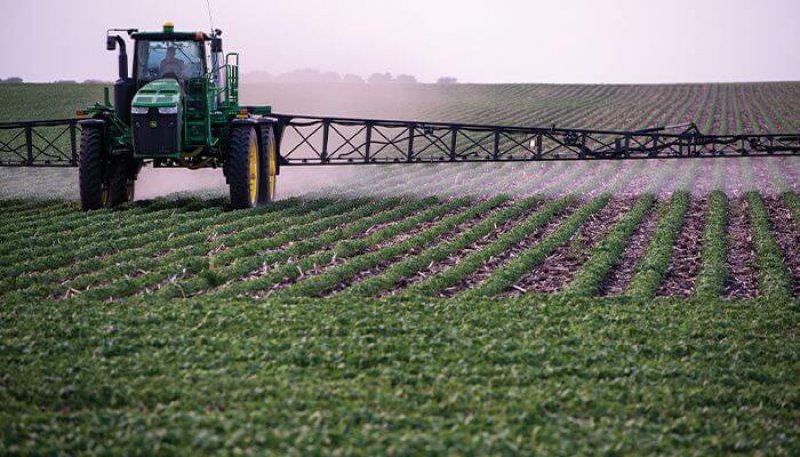
It’s the world’s most popular weedkiller by far. Since its introduction in the 1970s, glyphosate has become the farmers most important weedkiller, praised for its effectiveness and broad-spectrum weed control capabilities. It fulfills many agricultural and regulatory requirements—it’s effective, relatively inexpensive, boosts crop yields, and is safe for humans as well as plants engineered to avoid its herbicidal functions.
About 90 chemical companies across the globe produce it, more than 50 of them in China. One company still dominates the market with a 40% share—Bayer, which acquired its original patent holder, Monsanto, in 2018, although the patent for its original formulaton, known as Roundup, expired in 2000.
Although the global regularly community has unanimously concluded glyphosate is safe as used [more on that below], it’s been under relentless attack from environmental activist groups. And because of the casino-like U.S. tort system, Bayer has paid out more than $11 billion so far with another $1.2 billion allocated for potential future adverse verdicts or settlements.
These legal issues—with 67,000 pending suits, there is no end in site to its courtroom challenges—have led Bayer to consider ceasing production of Roundup unless it receives legal protections against future litigation. Bayer recently informed farmers, suppliers and retailers that it may stop selling Roundup, which would leave U.S. farmers reliant on imported glyphosate from China.
“We’re pretty much reaching the end of the road,” Bayer Chief Executive Bill Anderson said in an interview. “We’re talking months, not years.”
What could replace it if Bayer pulls the plug?
The ‘super weed’ case against glyphosate
Glyphosate has been under environmental activist attack for more than fifteen years. The original criticism focused on its alleged role as a superweed creator. That’s not unique to glyphosate, however. The first synthetic herbicide, 2,4-dichlorophenoxyacetic acid (2,4-D), was introduced in the 1940s. It was used mainly to control weeds in cereal grains. About 10 years later, in 1956, the first evidence of resistant weeds (Daucus carota, or “Queen Anne’s Lace”) was reported in Canada.
However, the extensive and at times indiscriminate use of glyphosate led to significant agronomic challenges: the development of glyphosate-resistant weeds. The first weed resistant to glyphosate was reported in Australia in 1996. Shortly after, the resistant ryegrass weeds were discovered in a New South Wales orchard.
Glyphosate targets the enzyme 5-enolpyruvylshikimate-3-phosphate synthase (EPSPS), which is essential for synthesizing aromatic amino acids in plants. By inhibiting this enzyme, glyphosate effectively kills a wide range of weed species. However, with repeated use, certain weed populations, such as Palmer amaranth, have evolved resistance.
The increased use of glyphosate tied to herbicide-resistant GMO crops gradually emerged as a proxy used by advocacy groups to turn the public against the crop biotechnology revolution. When some farmers did not rotate herbicides as part of an Integrated Weed Management program, activists raised a storm as weed problems escalated.
But as Michigan State University’s AgBioResearch department noted, weed resistance is not unique to glyphosate; exclusive use of almost any herbicide can result in herbicide-resistant weeds.
The new difficulties in weeds, pests, and biodiversity encountered in modern agriculture don’t stem directly from the use of GMO crops, but rather from treating the crops’ traits as a final solution to weed and pest management issues. Treating GMO crops as one among many tools in a management plan will help limit the spread of superweeds and secondary pests, as well as preserve landscape biodiversity.
Resistant strains of weeds have continued to gain speed over herbicide development, and that’s partly driven by the enormous success of glyphosate.
Now, more glyphosate-resistant weeds have been recorded, including weeds found in farms with “Roundup-Ready” soybeans. According to a report from Iowa State University, these include:
- Rigid ryegrass in a wheat production system in Australia and in California
- Italian ryegrass in Chile
- Goosegrass in Malaysia
- Horseweed (marestail) in the eastern, midwestern, and southeastern United States.
Iowa State noted that the biochemical mechanisms for all, but goosegrass remain unknown. And now, according to the International Herbicide-Resistance Weed Database, more than 50 weed species are resistant to glyphosate.
Weed resistance is not unique to glyphosate or genetically engineered crops; it is a widespread agronomic challenge affecting nearly all forms of weed control. For example, resistance to triazine herbicides like atrazine has been documented in pigweed and lambsquarters, even in non-GMO, conventially grown corn and sorghum systems. 2,4-D resistance has emerged in several broadleaf weeds such as waterhemp and wild radish in cereal crops.
In organic farming, which relies heavily on mechanical cultivation and natural herbicides like vinegar (acetic acid), weed resistance is less chemically driven but still a growing issue due to weed adaptation to repetitive tillage and shallow cultivation. Some weeds, such as bindweed and nutsedge, thrive under organic systems because they can regenerate from underground structures that are difficult to eradicate without systemic herbicides.
The lesson is clear: weed resistance is an evolutionary inevitability across all farming systems when control methods are not diversified.
Effective alternatives to glyphosate?
Not knowing the mechanisms of resistance is one of the several factors that make herbicide development difficult. To evade (or at least postpone) resistance, a new herbicide needs a new mechanism of action. But in the last 40 years, only one herbicide with a new mechanism has been introduced.
A 2012 paper by Steve Duke at the University of Mississippi showed US patents for new herbicides totaled 432 in 1997. By 2009, that number dropped to 65. Some of this decline was attributed to the popularity of glyphosate—Why compete with success?



Another challenge is the cost and time needed to develop a new product. Currently, a new agricultural chemical involves screening 100,000 compounds, a process that runs more than $200 million and can take 8 to 10 years.
There is currently no viable alternative to glyphosate. For that to happen, scientists must identify new modes of action. According to the Herbicide Resistance Action Committee, there are 25 herbicidal modes of action, usually involving the direct inactivation of an enzyme key to a plant’s growth and/or function. These include nucleic acid inhibitors, inhibition of internal microtubule assembly, or fatty acid synthesis inhibitors, for example. Unfortunately, only one new mode of action was discovered since 1984.
Omics revolution
The longshot hope is that new and equally effective herbicides can be developed. The rapidly growing field of “multiomics” offers some hope. This research area includes familiar lines of discovery in genomics and proteomics, but also involves a wide range of cell functions, including “transcriptomics” (the study of mRNA) and “metamics” (molecules involved in cellular energy production and consumption). These “omics” areas (which are difficult to define, and many other “omics” are popping up every few months), already used in pharmaceutical development, could result in unique new herbicide modes of action to fend off resistance.
Such a “multiomics” approach could diversify the ways that herbicides function, as well as more easily satisfy the other requirements of a new agricultural chemical—that it be safe and relatively easy to use, doesn’t harm the environment and is cost-effective.
One problem with traditional herbicide development has been its single mode of action, reacting to “target-site based resistance,” or TSR. This type of resistance involves a point mutation, single codon deletion, or target gene overexpression. Building a chemical to counteract these singular events can initially be effective, but eventually fall victim to resistance.
More powerful resistance comes from what’s known as “non-target site-based resistance” (NTSR), which involves changes in metabolism, reduced uptake of herbicide, and an ability to adapt to oxygen radicals (often used to kill plants).
Modern high-throughput technologies based on the various “omics” could help us understand the complexity of resistant weeds and therefore develop new modes of action. And because these modes are more integrated, it’s more difficult for weeds to develop resistance. But genomics alone won’t develop more modes of action. For example, gene expression can remain constant, while metabolism levels can vary widely at the same time.
A research team from Czechia recently published a review in Frontiers in Plant Science admitted that “inadequate initiatives have been taken to integrated multiple omics-based studies to elucidate the mechanisms of herbicide resistance in economically significant weeds.” Even in their review, they limited their search to transcriptomics and metabolics. “High-resolution genomic analyses of weedy plants will be needed in the future,” they added.
While no single herbicide matches the broad-spectrum effectiveness and cost-efficiency of glyphosate, several alternatives and integrated approaches can be substitutes, although without its effectiveness or safety profile. Glusofinate, dicamba, 2,4-D, and paraquat cannot fill glyphosate’s shoes.
While development of fungicides and insecticides has also been lagging over the past few decades, herbicides present an even more unique and formidable challenge—requiring solutions to plant complexity. Plants have evolved very intricate chemical defenses (including resistance to other chemicals) for a very good reason—they can’t run, and they can’t hide.
Glyphosate analysis
Are there any non-chemical alternatives? Mechanical weeding does work but it’s very inefficient and results in the release of carbon from the soil, exacerbating climate change instability. The value of cover crops and biological controls is limited. The only strategy that currently works, now and for the foreseeable future, involves Integrated Weed Management. And that requires the best and safest pesticide available: glyphosate.
The sad irony is that a sizable faction of the environmental movement, in defiance of the scientific consensus, remains steadfast in its opposition to all agricultural chemicals, including glyphosate. Chemophobia has been part of our culture for decades, but it accelerated after a disputed evaluation of glyphosate issued in 2015 by the controversial International Agency for Research on Cancer, which evaluates what’s known as a “hazard”. It controversially based its conclusion on three dozen studies out of more than three thousand available, concluding that glyphosate was a possible carcinogen to applicators; it did not hold that micro-traces in food posed any known harm.
It’s safe to say that no independent chemical oversight or regulatory risk agency, most reviewing hundreds and in some cases thousands of studies, agrees with that assessment. “No pesticide regulatory authority in the world currently considers glyphosate to be a cancer risk to humans at the levels at which humans are currently exposed,” Health Canada wrote in its 2019 assessment, a conclusion that holds today. The global consensus is illustrated in this infographic. [Click here for a downloadable pdf version]
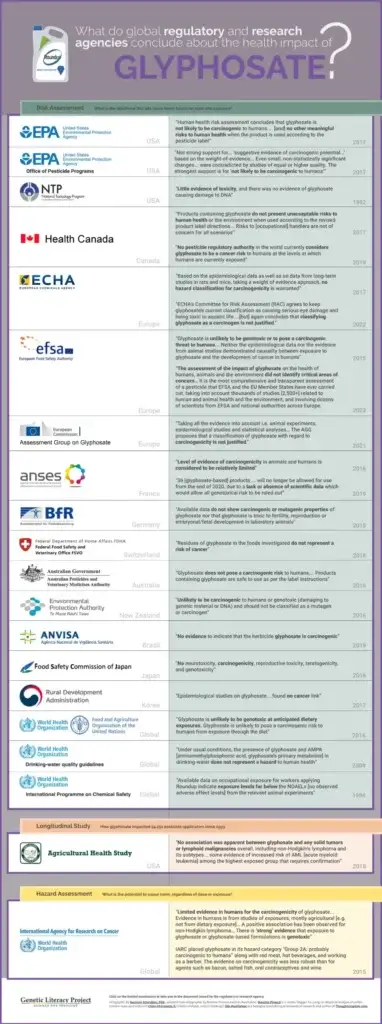
The 19 regulatory and research agencies—all independent— including the 2023 report from the European Food Safety Authority, have unanimously concluded that there is no convincing evidence that glyphosate can be linked to cancer. EFSA “did not identify critical areas of concern”. The consensus is more universal than the belief that humans are a critical driver of climate change.
Glyphosate is not only the world’s most popular herbicide, it’s the most effective. It’s the most studied herbicide by far with a relatively small environmental footprint per treatment. Organic herbicides are safer in perception but underperform in real-world efficacy, require frequent applications, and often have higher indirect environmental costs due to energy and labor inputs.
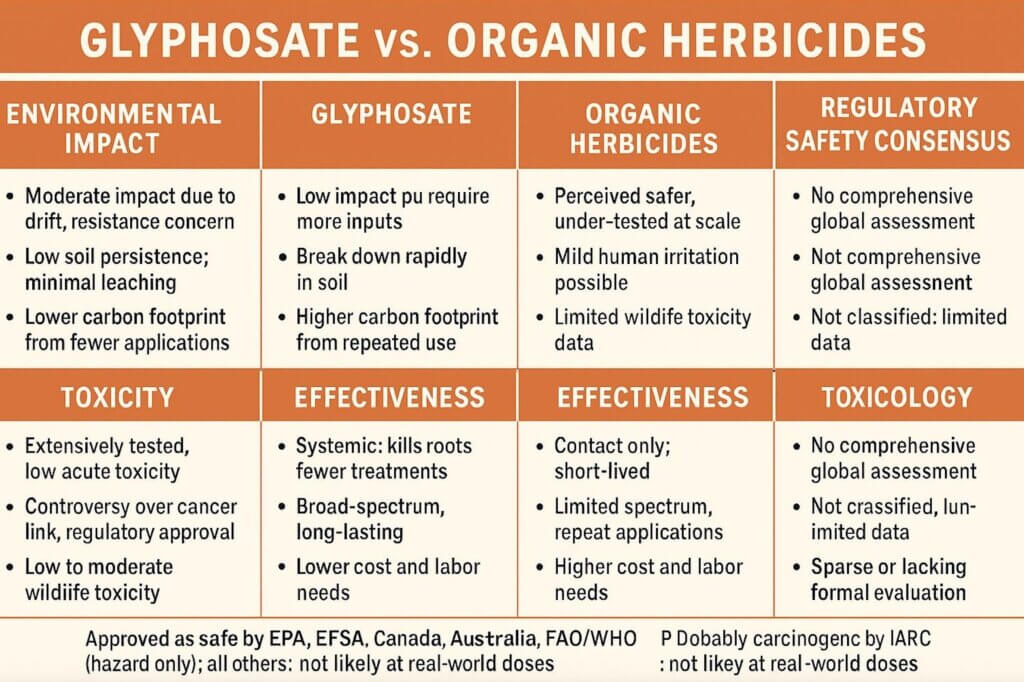
Despite ongoing debates and litigation, no currently available alternative matches glyphosate’s unique combination of broad-spectrum effectiveness, low application rates, and thoroughly studied safety profile. Organic and so-called “natural” herbicides are less efficient, require more frequent application, and lack rigorous regulatory vetting. Mechanical weeding and cover crops may supplement weed control in some systems but are neither scalable nor sustainable for global food production. Glyphosate remains the most practical, scientifically validated, and environmentally balanced tool available—its elimination would not enhance safety or sustainability but would instead drive up costs, increase carbon emissions, and force reliance on less effective or less understood alternatives.
Jon Entine is the executive director of the Genetic Literacy Project. Bio. Follow him on X @JonEntine
Andrew Porterfield is a writer and editor and has worked with numerous academic institutions, companies, and non-profits in the life sciences. BIO. Follow him on X @AMPorterfield