Even before the dinosaur era, mammal characteristics had begun to emerge

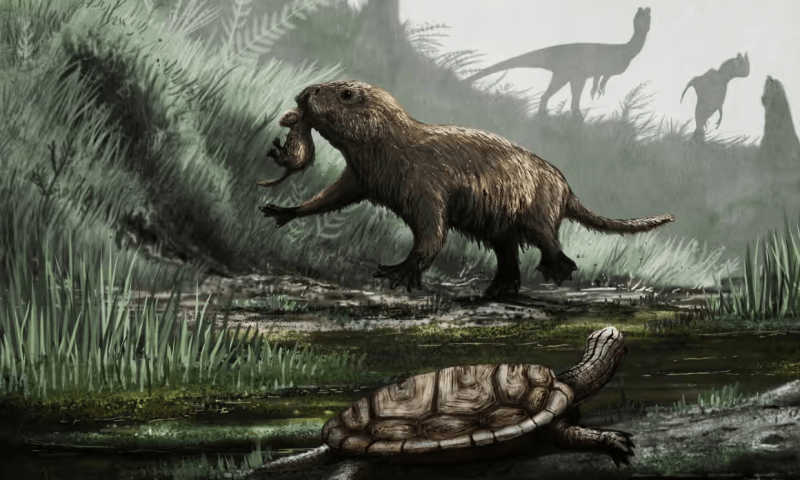
An artist’s impression of Mesozoic animals found fossilised in the Kayenta rock formation. It shows Dilophosaurus (dinosaur) at the back, Kayentatherium (Mesozoic mammal) in the centre, and Kayentachelys (Mesozoic turtle) at the front. Credit: Mark Witton/Recreating an Age of Reptiles

Mammals are familiar beasts. From a squirrel on a power line to a blue whale swimming through the sea, we share the world with more than 6,000 mammal species of all shapes and sizes. While we can easily distinguish a creature like a jaguar from a reptile or a bird in the modern world, however, mammals as we know them are the result of hundreds of millions of years of evolutionary changes. In fact, many of the key features that make us mammals evolved even before the dinosaurs.

Follow the latest news and policy debates on sustainable agriculture, biomedicine, and other ‘disruptive’ innovations. Subscribe to our newsletter.

Paleontologists have known for decades that mammals emerged from a broader, diverse group of creatures called synapsids. The very first synapsids of about 306 million years ago were small and lizard-like, but distinguishable by a single opening in their skull behind their eye socket. (We have a modified version of this hole, the space between your cheekbone and your cranium where a jaw-closing muscle runs through.) Nevertheless, a big evolutionary gap exists between a very early, lizard-like synapsid and modern mammals like ourselves.


This is an excerpt. Read the original post here

{{ reviewsTotal }}{{ options.labels.singularReviewCountLabel }}
{{ reviewsTotal }}{{ options.labels.pluralReviewCountLabel }}
{{ options.labels.newReviewButton }}
{{ userData.canReview.message }}

Related Articles

Infographic: Global regulatory and health research agencies on whether glyphosate causes cancer

Infographic: Global regulatory and health research agencies on whether glyphosate causes cancer

Does glyphosate—the world's most heavily-used herbicide—pose serious harm to humans? Is it carcinogenic? Those issues are of both legal and ...

Most Popular

Screenshot-PM-24
Viewpoint: The herbicide glyphosate isn’t perfect. Banning it would be far worse.
ChatGPT-Image-Mar-27-2026-11_27_05-AM
The myths of “process”: What science says about the “dangers’ of synthetic products and ultra-processed foods
d-b
Blocked arteries, kidney stones, nausea, constipation, fatigue: Long list of health problems caused by too much vitamin D 
79d03212-2508-45d0-b427-8e9743ff6432
Viewpoint: The Casey Means hustle—Wellness woo opportunism dressed up as medical wisdom
ChatGPT-Image-Apr-30-2026-05_00_48-PM
Wellness grifter physician turned wellness influencer out as surgeon general nominee
Screenshot-2026-04-30-at-11.33.46-AM
Anti-seed-oil to anti-vax pipeline: MAHA movement spreads to teen influencers
ChatGPT-Image-Mar-10-2026-01_39_01-PM
Viewpoint—“Miracle molecule” debunked: Why acemannan supplements don’t work
ChatGPT-Image-Mar-3-2026-01_17_14-PM
MAHA wellness influencers deride proven anxiety medications, tout lifestyle fixes
Screenshot-2026-04-29-at-11.31.42-AM
Dad brains: Only women undergo bodily changes during and after childbirth? Think again.
ChatGPT-Image-Feb-16-2026-01_04_32-PM
Raw milk myth wake-up call
glp menu logo outlined

Get news on human & agricultural genetics and biotechnology delivered to your inbox.