GLP Spaces on X: Deadly Thin Mints? $5 million chemical tort scam targets Girl Scout cookies

Credit: US Army via Wikipedia.
Tired of chasing ambulances and suing chemical companies, tort lawyers have identified a new villain: the Girl Scouts. You may view them as a benevolent children’s group that teaches young women how to make their way in an increasingly complex world. And you’d be correct. But that hasn’t stopped activist plaintiffs from filing a class action suit against the organization for allegedly selling cookies tainted with heavy metals and a pesticide. The complaint–which concedes that the plaintiffs were not physically harmed by Girl Scout cookies–is a glaring example of activists denying science and needlessly frightening an already anxious public, especially parents concerned about their children’s health.

The scientific basis for the suit stems from a spurious laboratory analysis by the advocacy groups Moms Across America and GMOScience, which tested just 25 cookie samples from three states and found trace amounts of arsenic, cadmium, mercury and the weedkiller glyphosate. Critics, including an expert writing for the GLP, have debunked the panic, noting that the study’s small sample size and lack of peer review render its findings unreliable, at best.

Moreover, the Girl Scouts have emphasized their compliance with stringent federal regulations—which empower the Food and Drug Administration (FDA) to recall products that pose a significant health risk. The FDA has not recalled any Girl Scout Cookies, further undermining the litigation’s already feeble foundation.
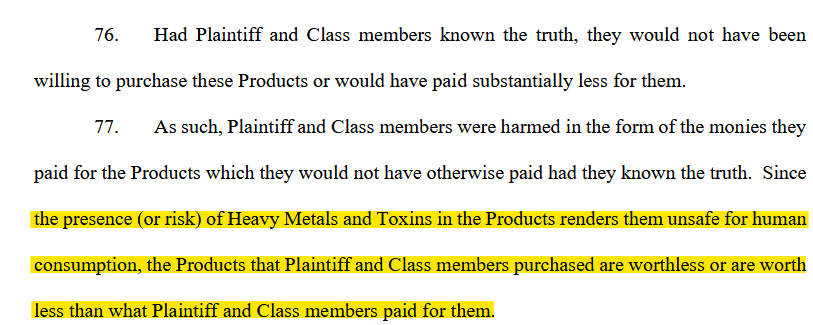
A screen shot from the complaint filed in New York District Court

Heavy metals and glyphosate can be found in the environments where food crops grow—present in soil, water, and air—but their trace presence in food does not pose a health risk at the levels detected. By pursuing this lawsuit, the plaintiffs ignore robust evidence and regulatory oversight, opting instead to amplify fear through sensational claims.

Parents, already bombarded with fallacious health scares on social media, are left questioning the safety of a beloved treat that funds valuable programs for Girl Scouts. This fear-mongering not only undermines public trust in science but also risks overshadowing the cookies’ role in teaching entrepreneurship and leadership to young girls.

The lawsuit is yet another case of reckless activism needlessly scaring families and tarnishing the reputation of a wholesome institution.

Join GLP founder Jon Entine and longtime contributors Liza Dunn and Cameron English as they discuss the fabricated Girl Scout cookie scam. Follow this link or listen to the conversation below:

Dr. Liza Dunn is a medical toxicologist and the medical affairs lead at Bayer Crop Science. Follow her on X @DrLizaMD

Jon Entine, founder and executive director of the Genetic Literacy Project, is an Emmy-winning investigative TV News producer and author of seven books, including three on genetics. Please follow him on X at @JonEntine

Cameron J. English is the director of bio-sciences at the American Council on Science and Health. Visit his website and follow him on X @camjenglish


 

Related Articles

Infographic: Global regulatory and health research agencies on whether glyphosate causes cancer

Infographic: Global regulatory and health research agencies on whether glyphosate causes cancer

Does glyphosate—the world's most heavily-used herbicide—pose serious harm to humans? Is it carcinogenic? Those issues are of both legal and ...

Most Popular

Personalized-Cancer-mRNA-Vaccine-Vial
Personalized mRNA vaccines are poised to revolutionize cancer treatments. Here are the barriers.
ChatGPT-Image-Mar-10-2026-01_39_01-PM
Viewpoint—“Miracle molecule” debunked: Why acemannan supplements don’t work
Screenshot-2026-10-11-at-10.24.21-AM
Viewpoint: RFK Jr.’s new CDC head Erica Schwartz greenlights hepatitis B vaccine study critics call “unethical and designed to cast doubts on its safety”
Screenshot-2026-10-05-at-11.57.44-AM
Scaremongering or legitimate safety concerns? The political dogfight over America’s food safety system
Screenshot-2026-09-22-at-12.26.15-PM
‘Forever chemical’ concerns: Separating hysteria from reasonable concern in the debate over PFAS danger
Deepfake Democracy Media Mosaic
31 states have passed a patchwork of laws to limit election deepfake commercials. They’re not working very well.
Screenshot 2026-10-12 at 12.25
Tearful onions? CRISPR has a solution for that
Screenshot-2026-10-08-at-1.23.28-PM
Countries around the world are rushing to pass teenage social media bans. Could they backfire?
Eating Nuts Adds up to Longer Life x
For millions with peanut allergies, Nurtured Nuts’ CRISPR gene-edited peanuts could ease the fear of accidental exposure
AI-Force-Uniform-Insignia-Close-Up
Trump wants an AI Force like Space Force, but that could make AI’s risks harder to manage
generated-1790707585414
Facts & Fallacies podcast: America's health care system is broken. A doctor explains how to fix it
Radioactive-Americana-Collage-2
The kooky logic behind the raft of spurious cancer claims from Harvard’s T.H. Chan School of Public Health
Screenshot-2026-09-22-at-10.54.12-AM
‘They misunderstand science’: Research attempting to tie autism to changes in the gut microbiome comes under fire
glp menu logo outlined

Get news on human & agricultural genetics and biotechnology delivered to your inbox.