I recall the precise moment I realized U.S. science was in for a very rough time. My wife and I were out getting pizza and beer on the evening of Friday, February 7, 2025 when she got a text from a friend in grants administration: “Have you seen this???”. The National Institutes of Health (NIH) had announced on the social media platform X that they would cut several billion dollars in indirect costs to US research institutions effective Monday morning. If the medium is the message, then the message to U.S. science was clear: You are now under attack.

Every US scientist understands that the social contract with the federal government that held since the 1940’s is now being shredded by the Trump administration. In the last 16 months, the administration has used every executive branch lever available to it—and many that were not—to pour “cement in the pipes” of the federal science funding system, withhold data access, fire longstanding advisory panels, cancel ongoing research grants, and install political review of new ones. To add insult to injury, the administration that empowered Department of Health and Human Resources Secretary Robert F. Kennedy Jr, who is famously not trained as a scientist, and issued an embarrassing report with hallucinated references has also proclaimed its adherence to principles of “Gold Standard Science”.
Much of the blitzkrieg phase of the attack on U.S. science has been reversed by courts which is perhaps why the Trump administration now seeks to make many of the same maneuvers legal through the federal rulemaking process. Russ Vought, the Office of Management and Budget (OMB), revealed his plans ahead of time in Project 2025, a highly partisan wish list for Trump’s second term which he disavowed during the campaign but that many of his appointees appear to be making decisions based on. It has now metastasized into a new proposal for vast changes to federal granting known as OMB-2026-0034-0001.
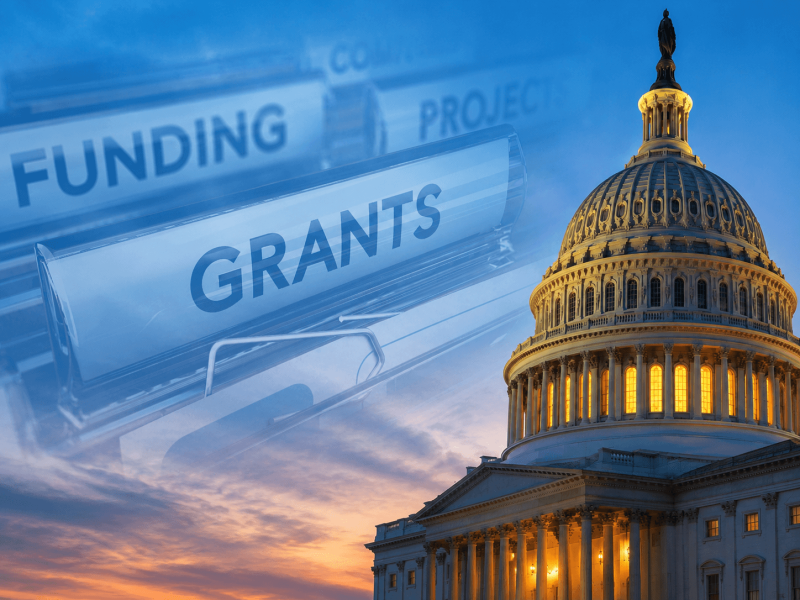
This 412-page magnum opus of antagonism to U.S. science has been called a five-alarm fire and an extinction-level event for federal funding. Among the most concerning provisions are the elevation of political rather than scientific decision-making in the selection of grants and the unilateral ability to cancel grants without recourse. If these rule changes take hold, it will completely alter how scientific funding operates; I call it the Grantpocalypse.
But this proposal is not yet set into law. It can still be stopped if U.S. scientists and their allies put their abilities to the task. Everyone should comment on OMB-2026-0034-0001 to slow or stop its implementation.
OMB’s Proposal is Damaging and Self-Conflicting
OMB’s proposal, “Regulation for Federal Financial Assistance”, seeks to make vast changes to federal science grants. One former NIH employee compiled a more detailed explainer about the proposal, but these are the provisions that I find most concerning:
- §200.205 – Political appointees have final say on funding decisions.
- §200.205(d) – Peer review may be discarded by political appointees.
- §200.205 – Vague Gold Standard Science metrics are elevated in evaluation criteria.
- §200.340 – Grants may be cancelled at any time for any reason.
- §200.300 – Specific topics of DEI or “gender ideology” are banned from funding.
- §200.220 and §200.202(e) – Foreign collaborations with some countries are barred from funding.
- §200.206 – Grants may be denied to applicants based on affiliations.
- §200.432 – Conference travel may not be supported except by prior authorization in the grant agreement.
Many of these provisions in OMB-2026-0034-0001 are self-contradictory or fail to consider relevant law or principles of research ethics and safety, which are mandated by Congress to be applied to federally funded research. For instance, political appointees, who will not be required to have scientific training, may have no idea if or how a complex scientific proposal fits administration priorities. Cancelling clinical trials at a moment’s notice is obviously unethical and contradicts the “Common Rule”.
If enacted into law, this proposal would allow the administration broad latitude to elevate politics over science across all stages of federal research grant funding.
Scientists Take Action: Specific Comments Make the Best Offense
Despite claiming to improve transparency, accountability, and oversight of federal grants, this proposal will do the opposite. The preamble is intentionally provocative and poorly sourced but simply criticizing it on social media or amongst peers won’t cause OMB to change or drop any of the proposed rule changes.




By law OMB must respond to each original, substantive comment, so every researcher should make it a priority to submit at least one objection against this proposal. General objection to the whole of OMB-2026-0034-0001, though, won’t influence changes either. Effective comments are specific and logical. Focus your comments on specific provisions, specific defects of the provision, and specific harms to your research if the provision were implemented. You may comment as an individual as many times as you like and may choose to remain anonymous.
If thousands of US scientists and their allies write from their own experience and form their own arguments about why each provision is defective, then novel variants will inevitably appear. OMB is not equipped to resolve all the various ways the proposal contradicts itself and current federal law.
While the fear of speaking out is palpable and justified, we all should fear the Grantpocalypse far, far more. If OMB-2026-0034-0001 is adopted as is, all federal science funding will be controlled at the whim of whomever is in the White House, and the current occupant has shown great contempt for U.S. science.
There is safety in numbers if we fight back together, and the cost of failing is too awful to bear. U.S. scientists—comment early, comment often, and comment productively by July 13 to prevent the Grantpocalypse.
Logan G. Spector, Ph.D. is Professor in the Department of Pediatrics at the University of Minnesota Medical School. Currently, he is Chair of the Childhood Cancer and Leukemia International Consortium. Find Logan on LinkedIn
A version of this article was originally posted at The Scientist and has been reposted here with permission. Any reposting should credit the original author and provide links to both the GLP and the original article. Find The Scientist on X @TheScientistLLC