This past summer, we read about Danish farmers paying a carbon tax on their cows and pigs. Starting in 2030, they will pay about $43 per ton of carbon dioxide emissions equivalent. But despite cows and pigs 9% contribution to global methane, cows can actually play a positive role in climate change.
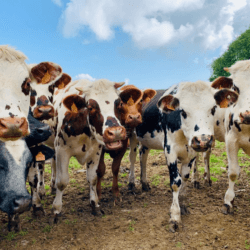
Just like this example illustrates, dairy cow and cattle farms are often criticized for their methane emissions and manure runoff, which are believed to significantly contribute to climate change.
However, let’s challenge this assumption by exploring how farmers manage their farms and ranches to positively impact the environment. Here are some ways farmers and ranchers are reducing methane output and enhancing environmental sustainability.
Land management
Many of us outside of the ag sector are surprised to learn that livestock and dairy cows are one of the best tools for land management.
Ranchers who allow their cattle to graze on grasslands practice regenerative agriculture, which benefits the environment in multiple ways. Grazing animals contribute nutrients to the soil, promoting healthy plant growth and supporting native wildlife. Additionally, healthy soil absorbs rainfall more effectively, reducing water runoff into roads, streams, and wetlands.
Research from the Soil Health Institute highlights that livestock grazing improves soil health by increasing organic matter and enhancing soil structure, which helps retain moisture and nutrients. This method of land management not only sustains livestock but also promotes a balanced ecosystem.
Emissions reduction
A study by The Nature Conservancy, “Reducing Climate Impacts of Beef Production,” shows that ranchers who manage both grasslands and livestock can cut emissions by up to 50%. This approach is particularly effective in the U.S. and Brazil.
When cattle graze, their hooves help mix seeds into the soil, and their manure acts as a natural fertilizer, promoting plant growth and creating a carbon sink. For example, Texas rancher Meredith Ellis sequesters 2,500 tons of carbon annually, equivalent to removing 551 cars from the road.
A 2020 meta-analysis published in Global Change Biology supports these findings, indicating that managed grazing systems can significantly reduce greenhouse gas emissions compared to conventional farming methods.

Pasture management
While 95% of cattle begin their lives on grass, they typically finish in feedlots. There’s a debate over which system is better for the environment.
Surprisingly, grass-fed cattle emit approximately 20% more methane than feedlot cattle because it takes longer for them to reach market weight.
Animal Nutrition
Animal nutrition companies are actively researching ways to reduce methane emissions through diet. Studies have shown that specific feed additives can reduce methane emissions by 30% to 50%. According to a 2022 study in Animal Feed Science and Technology, optimized feedlot diets result in less methane production compared to roughage-heavy grass diets.
Most recently, a study published in the Proceedings of the National Academy of Sciences showed that a pelleted form of seaweed added to the animal feed can reduce methane by an average of 38% without adversely affecting the animal.


Dairy digesters
The dairy industry has utilized anaerobic methane digesters for years to manage waste and reduce emissions. These systems capture methane from manure, converting it into electricity for the farm or selling it back to the grid.
California’s commitment to reducing dairy methane emissions by 40% by 2030 is largely driven by the implementation of digesters. According to a report by the California Air Resources Board, farms using these systems are greenhouse gas-negative, meaning they offset more emissions than they produce.
Carbon-neutral cows

Contrary to popular belief, cows are effectively carbon-neutral emitters over time. When cows consume plants, they intake carbohydrates containing carbon.
Through digestion, some of this carbon is released as methane, which is a potent greenhouse gas but only remains in the atmosphere for about eleven to twelve years. It then breaks down into carbon dioxide and water through hydroxyl oxidation.
A 2021 study published in Frontiers in Sustainable Food Systems explains that this cycle ensures that the methane emitted by cows is part of a short-term carbon cycle, balancing out over time.
 Interested in learning more?
One of our favorite sources for learning about this topic is Dr. Frank Mitloehner, a professor and air quality specialist at University California, Davis.
Dr. Mitloehner is a leader in helping governments understand cattle, methane emissions, and solutions to mitigate climate change. He has a practical and optimistic approach for solving cattle’s contribution to climate change. You can listen to his podcast with Damien Mason on The Business of Agriculture.
For further reading and detailed research, refer to:
-
Soil Health Institute‘s research on livestock grazing and soil health
-
“Reducing Climate Impacts of Beef Production” by The Nature Conservancy
-
Global Change Biology‘s 2020 meta-analysis on managed grazing systems
-
Animal Feed Science and Technology‘s 2022 study on feedlot diets
- Proceedings of the National Academy of Sciences study on seaweed added to animal diets
-
California Air Resources Board‘s report on dairy methane digesters
-
Frontiers in Sustainable Food Systems‘ 2021 study on the carbon cycle of cows
The Bottom Line
Regenerative agriculture, carbon sequestration, methane-reducing animal feed, dairy methane digesters, and the natural carbon cycle of cattle are five ways that livestock farming can benefit the environment. So, enjoy your steak and burgers knowing that responsible farming practices can help, not hurt, our climate.
A version of this article was originally posted at Dirt to Dinner and is reposted here with permission. Dirt to Dinner can be found on Twitter @Dirt_To_Dinner